

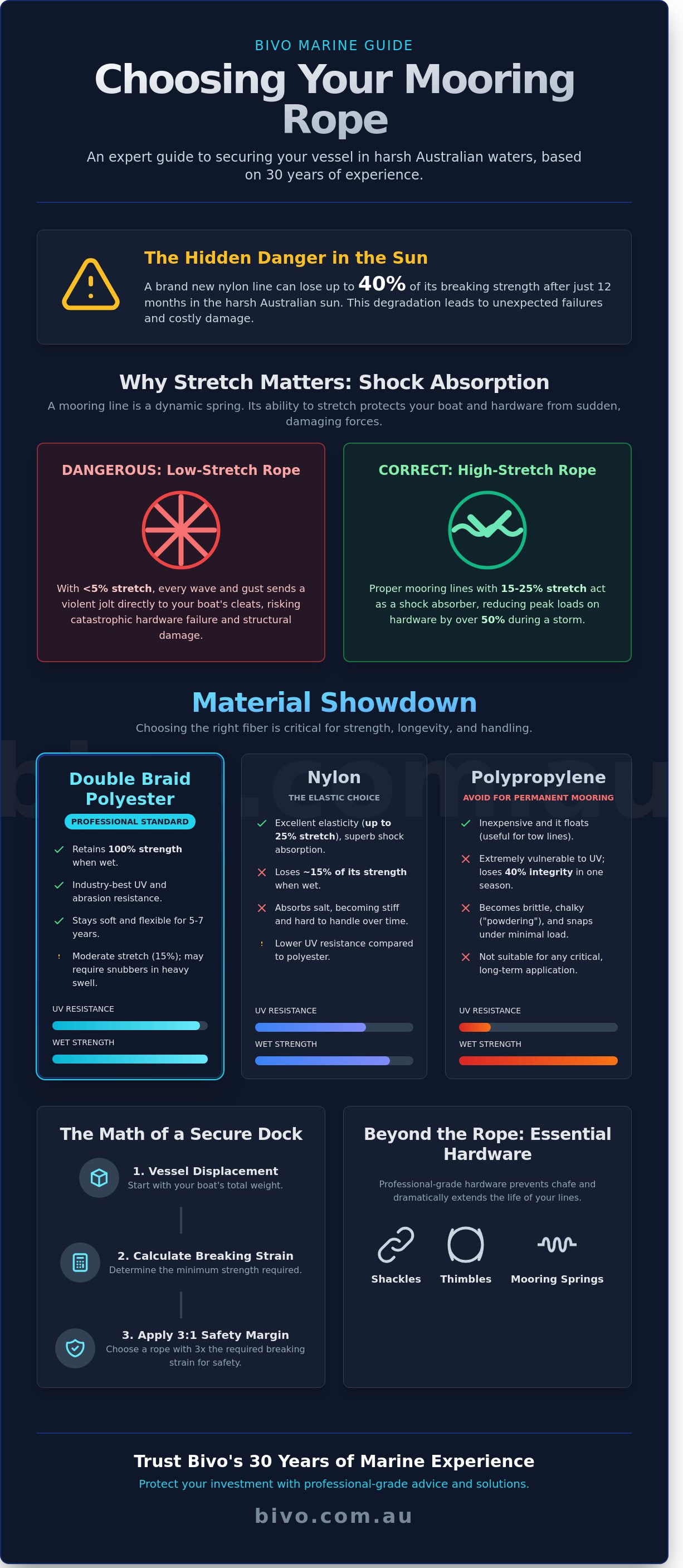
That brand new nylon line you bought last summer can lose up to 40% of its breaking strength after just 12 months in the Queensland sun. You likely know the frustrating sound of a stiff, salt-encrusted rope groaning against a cleat at 2 AM. It's a noise that keeps boat owners awake; they wonder if their lines will snap or if a lack of stretch is prying the hardware right out of the fiberglass. Finding the best rope for mooring a boat isn't about buying the thickest cord at the shop. It's about matching material science to the harsh Australian climate to avoid a A$15,000 repair bill after a summer storm.
At Bivo, we leverage our 30 years of marine experience to help you select lines that stay supple, remain silent, and provide a reliable safety margin. We're here to help you protect your investment with professional-grade advice that works in the real world. This guide breaks down the specific technical pros of polyester versus nylon and shows you how to size your lines for maximum shock absorption. You'll gain the confidence to leave your boat unattended, knowing it's secured by the right gear for the job.
Key Takeaways
- Understand the critical role of kinetic energy absorption and why material choice dictates your boat's safety in heavy swell.
- Compare the pros and cons of Nylon, Polyester, and Polypropylene to find the best rope for mooring a boat in the harsh Australian climate.
- Use our 3:1 safety margin math to calculate the exact rope diameter and length required for your vessel’s displacement.
- Learn how to extend the life of your lines and prevent chafe using professional-grade thimbles, shackles, and mooring springs.
- Access 30 years of Bivo’s marine industry experience to build a mooring system that delivers genuine quality and value for money.
Understanding Mooring Line Fundamentals: Why Your Choice Matters
A mooring line is the single most important link between your vessel and the dock. It isn't just a tether; it's a dynamic safety system designed to protect your investment. After 30 years in the Australian marine industry, we've seen that finding the best rope for mooring a boat requires looking beyond simple breaking strain. You need a line that manages the constant movement of the water without failing under pressure.
The primary function of any mooring setup is to absorb kinetic energy. When a 40-knot gust hits or a 2-metre tide surge moves through the marina, your boat generates massive momentum. To understand the basics of Mooring Line Fundamentals, you must view the rope as a giant spring. If the rope is too rigid, that energy transfers directly to your hardware. If it's too soft, the boat moves too far. Balance is essential for safety.
Static strength is often overemphasised by novice boaters. While a high breaking strain is necessary, dynamic elasticity is the trait that actually prevents accidents. A rope that can stretch and return to its original length will survive years of service. A rigid rope will eventually snap or tear a cleat out of your deck. There is also the "Quiet Marina" factor to consider. High-quality marine ropes are engineered to move silently. Cheap, hardware-store alternatives often produce annoying creaks and groans that keep you awake at night and signal a lack of proper lubrication in the fibres.
Shock Absorption: Protecting Your Cleats
Rope stretch acts as a built-in shock absorber for your deck hardware. Using "low-stretch" lines like Dyneema for permanent mooring is a dangerous mistake. These materials have less than 5% stretch, meaning every wave sends a violent jolt through your boat's structure. High-quality nylon or polyester mooring lines provide between 15% and 25% elongation. This damping effect can reduce the peak load on your cleats by over 50% during a storm, preventing structural fibreglass damage.
The Australian UV Challenge
The Australian sun is brutal on synthetic fibres. Standard polypropylene ropes often lose 40% of their integrity within a single season in regions like Queensland or Western Australia. They become brittle, start "powdering," and eventually snap under minimal load. We only recommend UV-stabilised polyester or double-braid nylon. These materials are chemically treated to resist molecular breakdown from radiation. You can spot UV damage by looking for chalking or a stiff, crunchy texture when the rope is bent. If the colour has faded significantly, the internal fibres are likely already compromised.
Material Showdown: Which Marine Rope is Best for You?
Choosing the right material determines if your vessel stays secure during a 40-knot southerly or ends up drifting toward the rocks. Bivo has supplied Australian boaties for 30 years. We know which fibers survive our harsh salt environments and which ones fail after a single season. The best rope for mooring a boat must balance strength, stretch, and durability against the intense UV levels found in the Southern Hemisphere.
Double Braid Polyester: The Professional Standard
Bivo recommends double braid polyester for most Australian permanent moorings. This construction features a braided core protected by a braided cover. It distributes the load evenly across the entire rope. Unlike 3-strand rope, double braid will not hockle or kink when you're coiling it. It remains soft on your hands even after three years of salt exposure. This material maintains its flexibility and strength over a typical 5 to 7-year lifespan. It's the standard choice for owners who value a tidy deck and reliable performance.
Nylon vs. Polyester: The Great Debate
Nylon is famous for its elasticity. It can stretch by up to 25% before breaking, which acts as a shock absorber during heavy surges. However, nylon has a significant drawback; it loses 15% of its breaking strength the moment it gets wet. Over time, nylon also absorbs salt crystals and becomes stiff and difficult to handle.
Polyester is the superior choice for consistency. It retains 100% of its strength when wet and offers the best UV resistance in the industry. While it has less stretch than nylon, you can compensate for this by using longer lines or snubbers. While choosing a material, ensure you also meet the official mooring line requirements for your vessel's displacement and length. For those DIY enthusiasts, 3-strand nylon is easier to splice, but the long-term handling benefits of polyester usually outweigh the initial assembly effort.
The Polypropylene Trap
Polypropylene is the bright yellow rope you see at budget hardware stores. It's cheap, but it's rarely the best rope for mooring a boat. This material is highly susceptible to UV degradation. In Australian conditions, where the UV index frequently hits 11+, polypropylene can lose 50% of its strength in less than 12 months. It floats, which is helpful for rescue lines or ski ropes, but dangerous for dock lines because it can easily get sucked into your or a neighbor's propeller. Only use floating lines for temporary tasks where visibility is more important than long-term security.
We've spent 30 years in the industry helping customers secure their investments. If you're unsure which diameter fits your cleats, we're here to help you select high-quality dock lines that last. Our team provides practical advice based on decades of experience on the water.
Sizing and Length: The Math of a Secure Dock
Choosing the best rope for mooring a boat depends on physics, not guesswork. At Bivo, we've spent 30 years advising boaties that the 3:1 safety margin is the industry benchmark. This means the combined breaking strength of your mooring lines must be at least three times the vessel's fully loaded displacement. If your cruiser weighs 6,000kg, your lines should collectively handle 18,000kg of force to manage sudden wind gusts or heavy surges.
A standard mooring setup requires a minimum of four lines: two bow lines and two stern lines. However, a secure dock always includes two spring lines. These are the secret to a stable vessel. Spring lines prevent fore-and-aft movement, stopping your boat from surging into the dock or the boat behind you. Without them, your bow and stern lines take 100% of the horizontal load, which leads to premature wear and potential hardware failure.
Material choice also dictates how these loads are distributed. A mooring line material study by the BoatUS Foundation confirms that nylon's ability to stretch up to 15% under load is vital for absorbing shock. This elasticity protects your cleats and prevents the "jarring" motion common with inferior ropes.
Diameter Guide by Boat Weight
- 10mm - 12mm: Ideal for tinnies, jet skis, and small runabouts up to 6m. These provide enough strength without being too bulky for small cleats.
- 14mm - 16mm: The standard for mid-sized cruisers and yachts between 7m and 12m. These diameters offer the best balance of grip and durability.
- 18mm+: Required for heavy displacement vessels over 15m or boats moored in high-exposure areas. Larger diameters provide the surface area needed to resist chafe over long periods.
Calculating Ideal Line Lengths
Your bow and stern lines should be 1.5 times the length of your boat. This extra length allows you to adjust the angle of the line to account for different dock heights. For a 10m yacht, keep 15m lengths ready. This ensures you have enough tail to tie off safely on various pier configurations across Australian marinas.
Spring lines must be the full length of the boat. Since they run from the bow to a mid-ship cleat, or mid-ship to the stern, they need that extra reach to create a shallow angle. This angle is what provides the leverage to stop the boat's momentum. You must also adjust for the local tidal range. In places like Darwin, where tides can swing 8 meters, your lines need significantly more slack than in Sydney, where the average range is closer to 1.6 meters. Getting this math right is the only way to ensure the best rope for mooring a boat actually does its job when the weather turns.
Beyond the Rope: Essential Mooring Hardware and Maintenance
Selecting the best rope for mooring a boat is only half the battle. Even a premium line will fail if your hardware is subpar or your maintenance is neglected. In Australian tidal environments, hardware takes a beating from constant salt spray and UV exposure. You need a system that works together to absorb energy and resist abrasion. High-quality stainless steel thimbles and shackles are essential. They prevent the rope from rubbing directly against metal eyes or pylons, which can cause heat build-up and fiber fusion.
Mooring springs, or snubbers, are another critical component. While nylon rope offers 20% to 25% stretch, a heavy surge in an exposed marina can exceed this limit. A rubber or stainless steel spring acts as a shock absorber. It reduces peak loads on your boat's cleats by up to 40%, preventing structural damage during a storm. Maintenance is equally vital. Salt crystals act like tiny knives inside your rope. They saw through internal fibers every time the line tensions. Wash your lines with fresh water every three months to keep them supple and extend their lifespan by at least 2 years.
Chafe Protection: The Silent Killer
Chafe causes 75% of mooring line failures in Australian waters. Identify "hot spots" where the rope passes through fairleads or over concrete dock edges. Use anti-chafe sleeves or heavy-duty fire hose offcuts to shield these areas. Smooth, high-quality wholesale marine hardware is your first line of defense. If a fairlead has a burr or a sharp edge, it'll ruin even the best rope for mooring a boat in a single afternoon. Check your hardware for pitting or corrosion every month.
Knots vs. Splices
The way you secure your line determines its ultimate strength. An eye splice is a permanent loop that retains roughly 90% of the rope's original breaking strain. In contrast, a common knot like a bowline can reduce that strength by 50% because of the sharp bends it creates in the fibers. For permanent berths, invest in pre-spliced double braid polyester marine rope. It provides a professional finish and maximum security. Every boatie should still master the Cleat Hitch and the Bowline for temporary docking, but don't rely on knots for long-term mooring.
Safety at the dock also involves visibility. Integrating your mooring setup with reliable marine electrical supplies Australia ensures your dock lighting is always functional. Good lighting prevents trip hazards and helps you monitor your lines during night-time inspections. With 30 years in the industry, we've seen that a well-lit, well-maintained dock is the hallmark of a safe vessel.
Ready to upgrade your dock setup? Shop our full range of marine hardware and ropes at Bivo today.
Why Bivo is Australia’s Trusted Partner for Mooring Solutions
Selecting the best rope for mooring a boat involves more than picking the thickest line on the shelf. It requires a deep understanding of tensile strength, UV degradation, and abrasion resistance in the unique Australian climate. Bivo brings 30 years of industry experience to every product recommendation we make. We've spent three decades supplying the marine sector, ensuring that the gear you buy is the same professional-grade equipment used by trade experts.
Our business started in the wholesale and trade sector. This history shaped our no-nonsense approach to quality. We don't stock products that can't handle the salt and sun of our local waters. The Bivo promise is simple: quality hardware that offers genuine value for money. We prioritize durability over flashy packaging because we know your vessel's safety depends on the gear holding it in place.
- 30 Years of Expertise: Three decades of testing gear in real Australian conditions.
- Professional Standards: Our trade background ensures every line meets commercial-grade requirements.
- Fast & Free Delivery Australia Wide: We dispatch daily from our Sydney warehouse to get you back on the water sooner.
- Transparent Value: High-performance marine hardware at prices that make sense for local boat owners.
The Veteran Advantage
We don't sell "fluff" or low-grade alternatives. Our inventory consists of practical gear designed for real-world scenarios. Our team provides helpful, expert-backed customer service to ensure you get the right specifications for your hull weight and mooring location. You can explore our full range of boating accessories Australia to find everything required for a complete vessel fit-out.
It's our goal to make your shopping experience pleasant and efficient. We understand that boat maintenance is a constant task, so we focus on providing gear that lasts longer and performs better. This reliability has made us a "safe pair of hands" for thousands of Australian boaties over the last 30 years. We're here to help you find exactly what you need without the unnecessary preamble.
Ready to Secure Your Vessel?
Securing the best rope for mooring a boat is straightforward with our easy online ordering system. We cater to both retail and trade clients, offering the same high level of service to every order. With daily dispatch from our Sydney facility, your gear is packed and moved quickly. We're here to help you protect your investment with the right equipment. Shop our premium Mooring Lines and Marine Hardware today!
Get Your Vessel Ready for the 2026 Season
Selecting the right gear is the only way to ensure your boat survives a heavy swell or a sudden storm. You've learned that Double Braid Nylon provides the best balance of strength and stretch for Australian conditions. You also know that matching your rope diameter to your boat's displacement is a vital safety step. Finding the best rope for mooring a boat shouldn't be a guessing game. It requires technical precision and materials that won't degrade in the harsh salt and sun.
Bivo brings 30+ years of industry experience to every order. We're trade and wholesale specialists who understand the unique needs of local marinas and private owners. We provide Fast & Free Delivery Australia Wide to get your supplies to the dock quickly. Our team is here to help you make the right choice for your specific vessel and mooring location. Don't leave your boat to chance when the weather turns.
Secure your boat with Bivo’s Premium Double Braid Marine Rope
We're here to help you get back on the water with confidence.
Frequently Asked Questions
Is nylon or polyester better for mooring lines?
Nylon is the superior choice for mooring because it offers between 15% and 25% elasticity. This stretch is vital for absorbing shock loads from waves and wind, which protects your deck hardware from damage. While polyester has better UV resistance, it lacks the necessary "give" to prevent cleats from pulling out during a storm.
How thick should my mooring rope be?
You should use a minimum of 12mm diameter for boats up to 8 metres and 16mm for vessels up to 12 metres. A standard 10-metre cruiser typically requires 14mm lines to handle Australian coastal surges safely. Choosing the best rope for mooring a boat involves matching the diameter to your boat's displacement to ensure the line doesn't snap under tension.
What is the best rope for a permanent mooring?
Three-strand nylon is the industry standard for permanent moorings because it is easy to splice and provides 20% elongation under load. Many Australian marinas now recommend 8-plait nylon because it doesn't kink or stiffen as it ages. Bivo's 30 years of experience shows that high-grade nylon offers the most reliable balance of strength and durability in harsh saltwater environments.
How long do mooring ropes usually last in Australia?
Most mooring lines in Australia last between 3 and 5 years before UV degradation and internal abrasion compromise their safety. High UV index levels in Queensland and Western Australia can reduce this lifespan by 15% compared to cooler southern states. You should inspect your lines every 6 months for signs of fuzziness or stiffening to avoid unexpected failures.
Should mooring lines be stretchy?
Yes, mooring lines must be stretchy to act as shock absorbers for your vessel. Without this elasticity, the kinetic energy from swell and wind transfers directly to your boat's cleats and the dock structure. Nylon is the best rope for mooring a boat because it can stretch significantly before breaking, which prevents structural damage during heavy weather events.
How do I stop my mooring lines from squeaking?
Install polyester anti-chafe sleeves or heavy-duty rubber snubber compensators to eliminate friction noise at the fairlead. Squeaking occurs when the rope rubs against metal surfaces under tension. A quick fix involves pouring fresh water over the lines, but permanent protective sleeves provide a 100% effective solution while also extending the life of your gear.
Can I use a tow rope for mooring my boat?
You shouldn't use a standard yellow polypropylene tow rope for mooring because it lacks UV stability and degrades within 12 months of sun exposure. Tow ropes are designed to float and have different tension properties that don't suit long-term docking. Stick to purpose-built marine lines to ensure your boat stays secure and your insurance remains valid.