

A single corroded terminal can turn a A$60,000 vessel into a dead weight 15 kilometres off the coast. It’s a harsh reality that many boat owners face when they rely on components not built for the salt. You likely know the sinking feeling of a dead engine or a failed bilge pump right when the weather turns. Sourcing high-quality marine electrical supplies Australia requires an understanding of how our local environment reacts with copper and solder. We’ve seen these issues firsthand during our 30 years in the industry; we know that shortcuts usually lead to expensive repairs.
We'll help you master the essentials of marine wiring, from eliminating voltage drop to choosing the correct tinned copper cables. You’ll gain the confidence to install a system that handles the rigours of the Southern Ocean or the humidity of the Top End. We’ll walk through the exact connectors used by professionals and how to get trade-quality gear delivered to your door with fast and free shipping Australia wide. It’s about giving you a fail-safe system so you can focus on the water, not the wiring.
Key Takeaways
- Learn why tinned copper and heat-shrink insulation are essential for surviving the harsh salt spray and extreme UV exposure of the Australian coast.
- Understand the "Solder Wick" problem and why professional crimping is superior to soldering for preventing brittle, snapping wires in marine environments.
- Master the step-by-step process for calculating onboard electrical loads and selecting the correct wire gauge to prevent dangerous voltage drops.
- Discover how to source high-performance marine electrical supplies Australia wide, backed by over 30 years of professional industry experience.
- Gain expert insights into choosing between marine circuit breakers and fuse holders to ensure your boat’s frontline protection is trade-quality.
Why Specialist Marine Electrical Supplies are Essential in Australia
Boat owners often learn the hard way that the ocean doesn't forgive shortcuts. Standard electrical components work fine in a dry garage, but they fail quickly at sea. Choosing the right marine electrical supplies Australia offers is about safety, not just convenience. Australia's coastal conditions are among the harshest in the world. High salt concentrations and extreme UV exposure demand specialized hardware. Without "Marine Grade" components, your vessel's electrical heart will fail when you need it most. We've spent 30 years in the industry seeing exactly what happens when people cut corners.
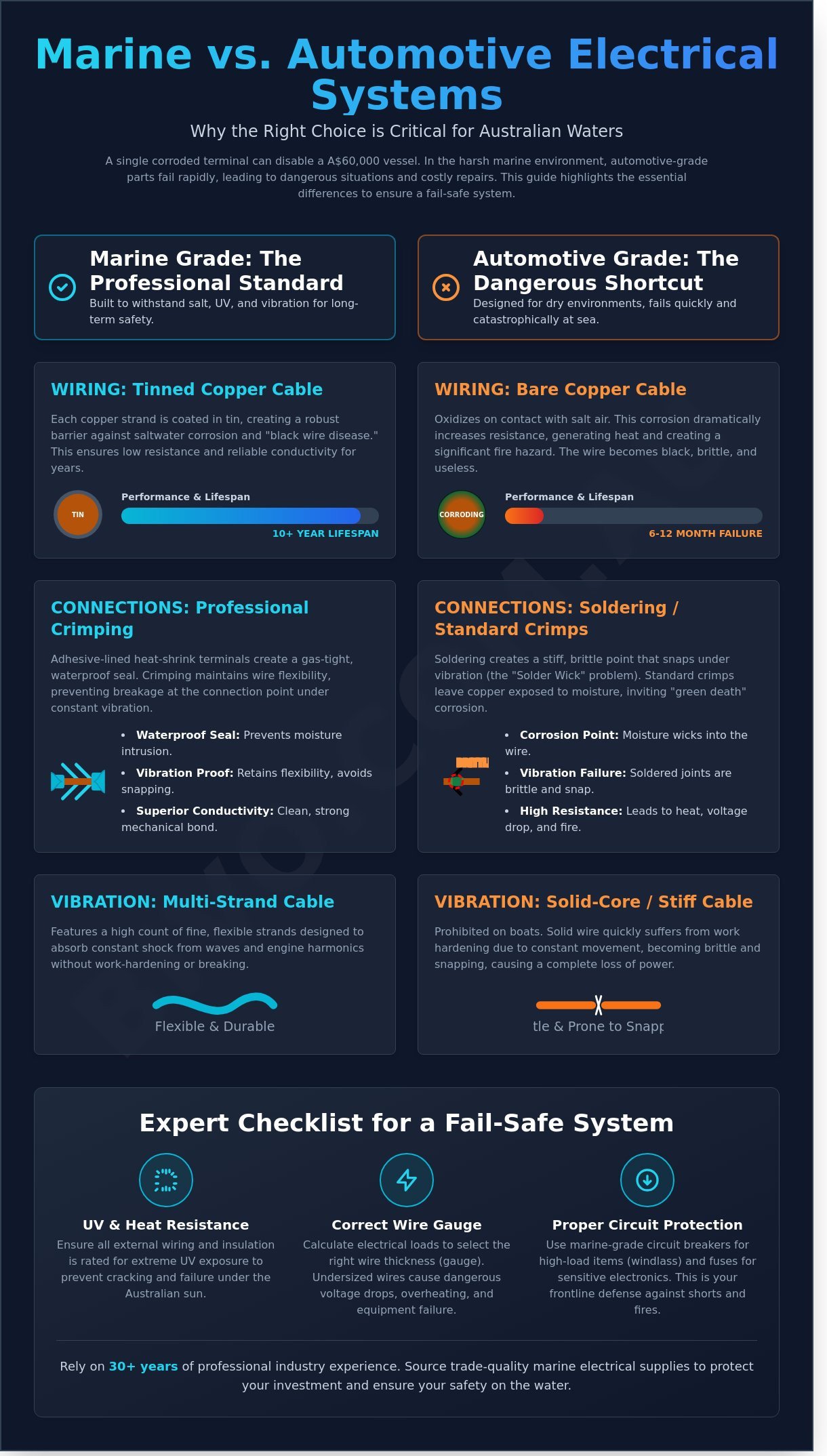
The "Automotive Mistake" is the leading cause of electrical fires on recreational vessels. Car wiring uses bare copper. In a marine environment, bare copper oxidizes the moment it touches salt air. This creates high resistance and heat. Marine-grade wiring uses tinned copper. Each individual strand is coated in tin to block oxidation. It's a more expensive process, but it's the only way to ensure a 10-year lifespan instead of a 6-month failure. Understanding the Core Components of a Reliable Marine Electrical System helps boaties avoid these common, dangerous pitfalls.
Electrolysis and galvanic corrosion can destroy a boat from the inside out. When different metals interact in saltwater, they create a small electrical current. This current literally dissolves your underwater fittings. Poorly insulated wiring accelerates this process. Using tinned copper and adhesive-lined heat-shrink insulation creates a gas-tight seal. This prevents moisture from turning your wiring into a corridor for corrosion. In tropical regions where humidity stays above 70%, this protection is non-negotiable for long-term reliability.
The Science of Saltwater Corrosion
Salt air is relentless. It penetrates standard PVC insulation and wicks up copper strands through capillary action. This leads to "black wire disease," where the copper turns black and brittle, losing its ability to conduct electricity. This hidden rot can travel several meters inside a cable jacket before it's noticed. The AS/NZS 3004.2 standard specifies the essential requirements for the design, construction, and installation of electrical systems on boats to ensure safety and prevent fire hazards.
Vibration: The Hidden Enemy of Marine Wiring
Boats don't sit still like cars. They endure constant pounding from waves and engine harmonics. Solid-core wire is prohibited on boats because it suffers from work hardening. It becomes brittle and snaps under stress. Quality marine electrical supplies Australia relies on use multi-stranded, flexible cables designed to absorb these shocks. These cables feature a high strand count to maintain connectivity even under extreme physical stress. BIVO’s 30 years of experience informs our selection of vibration-resistant hardware. We've seen how 30-year-old vessels stay powered when they use the right gear from day one. We're here to help you get the right parts the first time.
- Tinned Copper: Prevents oxidation and "black wire disease."
- Multi-Strand Cables: Resists breakage from engine and wave vibration.
- Heat-Shrink Insulation: Creates a waterproof, gas-tight seal at connection points.
- UV Resistance: Prevents insulation from cracking under the Australian sun.
Core Components of a Reliable Marine Electrical System
A boat's electrical system lives in one of the most corrosive environments on earth. In Australia, salt spray and high humidity can ruin standard automotive-grade wiring in less than 12 months. Choosing the right marine electrical supplies Australia offers isn't just about convenience; it's about safety. Terminals and connectors act as the frontline of your boat's health. If these fail, your bilge pumps or navigation lights won't work when you need them most. We've seen for 30 years how poor component choice leads to 70% of on-water electrical failures.
Circuit protection is your next line of defense. You must choose between marine circuit breakers and fuse holders. Breakers are ideal for high-load circuits you may need to reset, like an anchor windlass. Fuses are often better for "set and forget" electronics because they provide a cost-effective way to protect individual circuits. A 100A main breaker at the battery is a non-negotiable safety standard for any modern offshore vessel.
Heat Shrink Connectors vs. Standard Terminals
Standard crimp terminals leave the wire core exposed to oxygen and moisture. Over time, this causes copper oxidation, often called "green death." Heat Shrink Solder Connectors solve this by using an adhesive-lined polyolefin sleeve. When you apply heat, the internal solder melts to create a mechanical bond. Simultaneously, the adhesive flows to create a 100% waterproof seal. This prevents water from wicking up the wire. It's the only way to ensure a connection lasts more than a single season in saltwater conditions.
Managing the Load: Fuse Blocks and Bus Bars
Wiring often turns into a "spaghetti" mess behind the dashboard. A Fuse Holder Box with a Negative Bus simplifies this by providing a central hub for all connections. This layout eliminates the need for multiple wires running back to the battery. When you calculate current capacity, ensure your bus bar is rated for 20% more than the total possible load. For example, a 150A bus bar is the reliable standard for medium-sized center consoles. Proper labeling on these panels reduces troubleshooting time by 50% during an emergency at sea. We're here to help you select the right distribution hardware for your specific boat layout.
Battery management is the final piece of the puzzle. Battery boxes protect terminals from accidental shorts caused by dropped tools or shifting gear. An isolator switch allows you to cut power entirely when the boat is docked. This stops parasitic draw, which can drain a standard 100Ah battery in just 14 days if left unchecked. High-quality isolators are rated for 300A continuous use to handle the heavy cranking demands of modern outboard engines. If you're looking to upgrade your setup, you can view our professional range of distribution and battery management tools.
Reliability comes from using components designed for the task. Marine-grade copper is tinned to resist corrosion, and every connection point should be sealed. Investing in quality parts today prevents expensive repairs tomorrow. We've spent 30 years in the industry identifying which parts survive the Australian sun and surf. Stick to proven brands and heavy-duty materials to keep your vessel running smoothly.
The Great Debate: Crimping vs. Soldering Boat Wiring
Bivo has supplied the Australian boating community for 30 years. Over these three decades, we've seen the same electrical failures repeat themselves. The most common culprit isn't the salt air alone; it's the method used to join wires. While soldering was once the standard for electronics, the marine industry has largely abandoned pure solder joints for primary wiring. The reason is simple. Solder is a rigid metal. Boats are high-vibration environments where everything moves, flexes, and shakes.
The "Solder Wick" problem is a genuine threat to your vessel's reliability. When you apply heat and solder to a stranded copper wire, the liquid metal travels up the strands under the insulation. This creates a stiff, solid section of wire. This rigid point becomes a "stress riser" right at the end of the joint. In a boat engine room vibrating at 3,000 RPM, that brittle point is exactly where the wire will eventually snap. This is why professional installers of marine electrical supplies Australia wide now insist on mechanical crimping as the primary connection method.
A professional-grade connection requires two things: a mechanical crimp and an environmental seal. By using a tinned copper terminal and a high-quality crimp tool, you create a gas-tight bond. This bond excludes oxygen and moisture, preventing the internal corrosion that destroys electrical conductivity. Once the mechanical bond is set, a dual-wall heat shrink sleeve provides the final layer of protection, ensuring the joint remains flexible and waterproof.
Why Mechanical Crimping Wins on Water
Mechanical crimping creates what engineers call a "cold-weld." When you compress a terminal onto a wire with the correct force, the metal actually deforms and bonds at a molecular level. This connection resists vibration far better than a brittle solder joint. To get this right, you must avoid the two biggest pitfalls: under-crimping and over-crimping. Under-crimping leaves air gaps that lead to high resistance and heat. Over-crimping weakens the terminal walls, causing them to crack. A professional ratchet crimp tool ensures 100% repeatable pressure, unlike manual pliers.
- Vibration Resistance: Crimped joints allow the wire to flex naturally without snapping.
- Corrosion Control: Using tinned copper terminals prevents the "green rot" common in salty conditions.
- Speed and Consistency: A ratchet tool removes the guesswork from every single join.
When (and How) to Use Solder Connectors
There is still a place for solder in specific DIY repairs and tight spaces. Heat shrink solder connectors are a popular choice for many boat owners. These sleeves contain a pre-measured ring of low-temperature solder and a waterproof adhesive. When you apply heat, the solder melts into the strands while the tubing shrinks and seals the connection. It's an efficient way to combine mechanical strength with environmental sealing in one step, especially when you can't fit a large crimping tool into a small inspection hatch. If you're looking for the right gear to get started, check out our Ratchet Crimp Tool guide for a breakdown of essential hardware.
Bivo remains a trusted source for marine electrical supplies Australia because we focus on what actually works at sea. We recommend keeping a kit of both tinned crimp terminals and solder sleeves. Use the crimp terminals for your heavy-duty power runs and battery cables. Use the solder sleeves for light-duty signal wires or emergency repairs. This balanced approach ensures your boat stays powered and your electronics stay dry, no matter how rough the conditions get outside the heads.
Planning and Installing Your Marine Electrical Circuit
Success on the water starts long before you pick up a pair of crimpers. Proper planning prevents the common electrical failures that account for 55% of on-water breakdowns in Australia. You need a systematic approach to ensure your vessel remains safe and operational during every trip. We've seen how salt air and vibration can ruin a poorly planned system, so focus on these core steps first.
Step 1: Load Calculation. Create a spreadsheet listing every component, from your GPS to your cabin lights. Record the maximum current draw in Amps for each. Sum these values to determine your total peak load. This figure dictates your battery capacity and main fuse ratings. Don't guess these numbers; check the manufacturer data plates for accuracy.
Step 2: Wire Selection. Choose the correct American Wire Gauge (AWG) based on current and distance. Using undersized wire is a common mistake that leads to equipment failure. Always source tinned copper wire from reputable marine electrical supplies Australia retailers to resist the corrosive salt air that quickly destroys standard automotive cable.
Step 3: Route Mapping. Plan your wire runs away from heat sources like the engine manifold and keep them out of the bilge. Corrosive bilge water can track up through wire insulation via capillary action, ruining entire harnesses within 12 months. Keep power and data cables separated by at least 100mm to prevent signal interference.
Step 4: Seal and Secure. Use the "Seal and Secure" method. This involves using adhesive-lined heat shrink on every terminal. It creates an airtight seal that prevents oxygen and moisture from reaching the copper. Secure wires every 450mm with nylon P-clips to prevent vibration damage.
Step 5: Final Testing. Before you launch, use a digital multi-meter to check for continuity and voltage at each appliance. A healthy 12V system should show at least 12.6V at the battery and minimal loss at the end of the circuit. Testing under load is the only way to find weak connections before they fail at sea.
Combating Voltage Drop in 12V Systems
Voltage drop is the enemy of performance. For critical systems like navigation lights and VHF radios, a maximum 3% voltage drop is the industry standard. If your battery provides 12.6V, your light should receive at least 12.22V. For non-essential items like cabin fans, a 10% drop is acceptable. Always calculate the "round trip" distance, which means the total length of the positive plus the negative cable, when using a marine wire size chart. Undersized wires generate heat, which is a leading cause of boat fires in Australian marinas.
Waterproofing and Cable Management
Water will find a way in if you let it. Use IP68-rated cable glands for any bulkhead penetrations to maintain structural integrity and keep the cabin dry. Always incorporate "drip loops" before a wire enters a component. This simple loop allows gravity to pull water off the wire before it reaches the connection point. For professional-grade organisation, protect your looms with marine-grade double-braid polyester rope or high-density polyethylene conduit. This prevents chafing against the hull, especially in high-vibration areas near the transom.
Ready to upgrade your vessel? Browse our full range of marine electrical supplies Australia to get trade-quality components for your next installation.
BIVO: Your Trusted Veteran for Marine Electrical Supplies Australia
Experience isn't just a number. It's the difference between a reliable power system and a dead battery when you're 20 nautical miles offshore. Bivo started in 1994. For 30 years, we've supplied the Australian marine industry with components that actually work. We specialize in the marine electrical supplies Australia boaters need for our specific, harsh conditions. Our focus remains on high-value, trade-quality components. We don't stock "budget" items that fail after one season. You're buying the same gear used by professional boat builders and commercial fleets across the country.
We understand the urgency of marine repairs. If your boat is on the hard stand, every day costs you money and missed time on the water. That's why we offer Fast & Free Delivery Australia Wide. It's our primary promise to every customer. Most orders leave our Sydney warehouse within 24 hours. We also provide extensive support for the 2,500+ marine businesses operating across Australia. Our wholesale program offers trade-specific pricing and technical documentation that helps your business stay profitable and efficient. We're here to help you get your clients back on the water sooner.
The BIVO Quality Standard
Salt air is relentless. In Sydney, humidity and salt levels can corrode standard copper wiring in weeks. We vet our suppliers against these specific Australian conditions. Every product in our catalog meets strict durability benchmarks. We look for tinned copper, IP67 or IP68 ingress protection, and UV-stabilized plastics. Our advice is always practical. We'll tell you exactly what you need for your specific hull type without the marketing fluff. If you're looking for bulk quantities or professional components, check our range of Wholesale Marine Hardware Australia for solutions that last. We've seen what happens when you cut corners; we choose to provide gear that survives the Tasman Sea.
Ready to Upgrade Your Vessel?
A 2026 electrical refit should prioritize efficiency and smart monitoring. Essential must-haves for the coming seasons include LiFePO4 battery banks, high-output alternators, and NMEA 2000 integrated sensors. These upgrades can reduce house battery weight by 60% while doubling your usable capacity. Our Sydney-based team provides the technical support you need to ensure your new components are compatible with your existing setup. We've been a safe pair of hands in this industry for three decades. We're ready to help you plan your next project with marine electrical supplies Australia professionals trust. Visit our online store to Shop BIVO Marine Electrical Supplies and start your vessel's transformation today.
Whether you're a weekend angler or a commercial shipwright, Bivo delivers the reliability you demand. We've spent 30 years learning what works in the Australian sun and surf. We don't just sell parts; we sell the peace of mind that comes from knowing your electrical system is built to trade standards. Our commitment to value for money means you get professional-grade hardware without the unnecessary markup. Trust the reliable veteran for your next marine project.
Secure Your Vessel With Professional Grade Wiring
Reliable boat wiring isn't just about convenience; it's about safety. Saltwater environments are unforgiving, so choosing specialized components like tinned copper wire and heat-shrink connectors is vital. We've seen how proper crimping techniques outperform soldering in high-vibration marine settings. Getting these basics right prevents electrical failure when you're offshore. BIVO brings over 30 years of industry experience to every order. We operate from our Sydney-based warehouse with daily dispatch to ensure you aren't left waiting.
We specialize in waterproof connectivity and trade-quality heat-shrink solutions that meet strict marine standards. When you need the right marine electrical supplies Australia offers, we provide the professional-grade gear required for a durable system. Our team understands the practical needs of Australian boaties and trade professionals alike. We focus on providing exactly what you need to keep your systems running without unnecessary fluff or delays.
We're here to help you get back on the water with total confidence in your electrical circuit. Safe boating starts with a connection you can trust.
Frequently Asked Questions
Is marine wire really different from regular house or car wire?
Yes, marine wire is fundamentally different because it uses tinned copper strands. This tinning prevents the "black wire disease" common in standard automotive or house cables. In Australian salt air environments, tinned wire lasts up to 10 times longer than bare copper. We recommend using only tinned wire for all marine electrical supplies Australia projects to ensure long term reliability and safety on the water.
How much does it cost to rewire a small boat in Australia?
Expect to pay between A$2,000 and A$4,500 to professionally rewire a 5-meter boat in Australia. This price covers high quality tinned copper wire, marine grade switches, and labor. DIY enthusiasts can reduce this to A$800 or A$1,200 for materials alone. Labor rates for qualified marine electricians in major hubs like Brisbane or Sydney currently average A$120 to A$160 per hour.
Given these costs, protecting the overall value of your vessel is just as important as maintaining its systems. Understanding your insurance options is a key part of this, and firms like AllCover Insurance Brokers provide expert advice on policies tailored for marine assets.
Can I use WD-40 on my marine electrical connections?
You shouldn't use standard WD-40 on your boat's electrical connections. While it displaces water, it can damage sensitive plastics and leaves a residue that attracts salt and grit. Instead, apply a dedicated lanolin-based spray or a dielectric grease. These products provide a long-lasting barrier against the 85% humidity levels common in Australian coastal regions. They keep your connections clean without causing chemical degradation.
What is the most common cause of electrical failure on a boat?
Corrosion at the connection points is the primary cause of electrical failure on 80% of Australian vessels. Saltwater acts as a powerful electrolyte, accelerating the oxidation of copper terminals. This process creates high resistance, leading to heat buildup and eventual circuit failure. Regular inspections every 6 months can catch these issues early. Using high quality marine electrical supplies Australia ensures your connections remain sealed against the elements.
Do I need a dual battery system for my outboard motor?
You need a dual battery system if you run electronics like fishfinders, lights, or fridges while the engine is off. A dedicated starting battery ensures you're never stranded, while a deep-cycle house battery handles the 20 to 50 amp-hour daily loads. 90% of offshore boaters in Australia rely on a Voltage Sensitive Relay (VSR). This automatically manages charging and protects your primary cranking battery from accidental discharge.
What size fuse should I use for my marine electronics?
Your fuse should be rated at 125% to 150% of the device's maximum current draw. If your VHF radio draws 6 amps during transmission, a 7.5-amp or 10-amp fuse is the correct choice. Always match the fuse to the wire's current-carrying capacity to prevent fire hazards. AS/NZS 3004.2 standards dictate specific protection levels for marine circuits to ensure safety in harsh southern hemisphere conditions.
How do I know if my boat wiring is corroded?
You can identify corroded wiring by looking for a green, powdery substance or darkened copper strands inside the insulation. Use a multimeter to check for voltage drop; a loss of more than 0.3 volts across a 12-volt connection indicates significant internal corrosion. 75% of wiring issues are hidden beneath the jacket. If the wire feels stiff or brittle when bent, it's likely reached the end of its 10-year lifespan.
Are heat-shrink connectors better than electrical tape?
Adhesive-lined heat-shrink connectors are vastly superior to electrical tape for marine applications. Tape eventually unravels in the heat and provides zero protection against moisture ingress. Heat-shrink terminals create a 100% airtight seal that prevents salt air from reaching the copper. This is critical for the 30% of boat fires caused by arcing at poor connections. We've seen these connectors last 15 years longer than taped joins.