

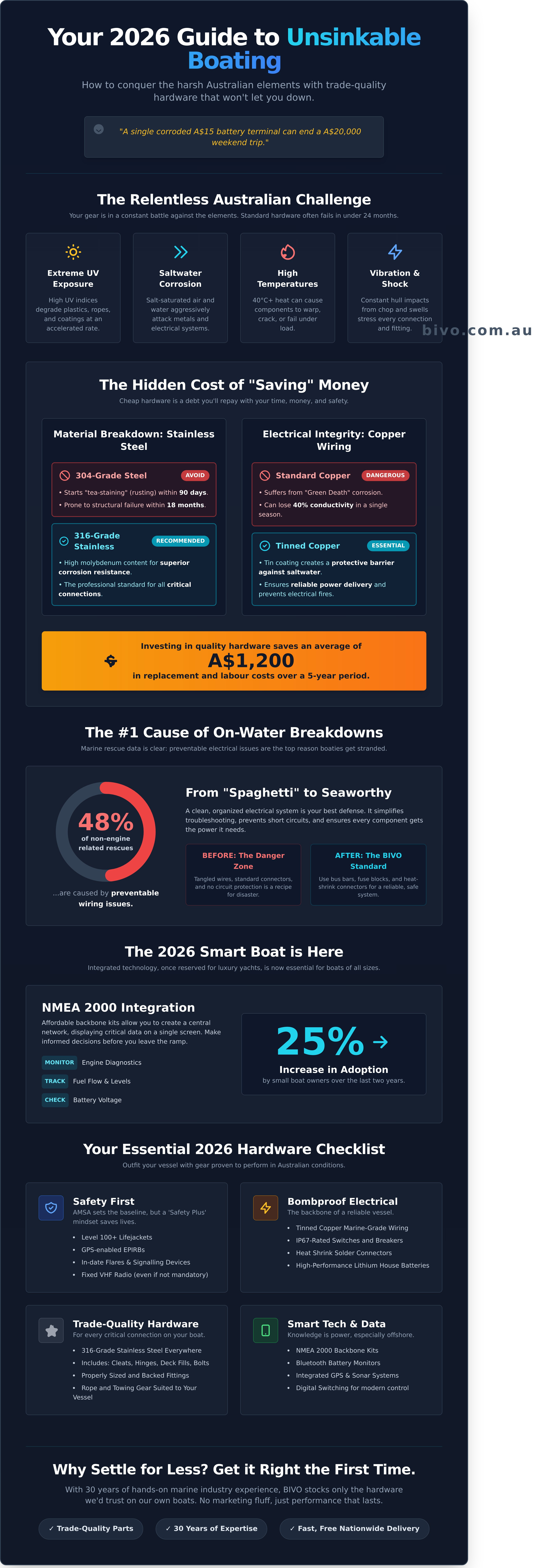
A single corroded A$15 battery terminal can end a A$20,000 weekend trip before you even clear the boat ramp. You know that the Australian salt and sun are relentless, often turning expensive gear into scrap metal in less than 24 months. It's frustrating to pay a premium for big-brand names only to face electrical failures when you're 10 nautical miles offshore. Finding the right boating accessories Australia wide is about choosing trade-quality hardware that prioritizes performance over marketing fluff.
With 30 years of experience in the marine industry, we at BIVO understand exactly what it takes to keep a vessel reliable. This guide promises to show you how to source high-performance water sports gear and marine electrical supplies that won't let your family down. We will preview the essential 2026 hardware upgrades and explain how to get trade-quality parts delivered fast and free across the country. You'll gain the practical knowledge needed to outfit your boat with gear that works every time you turn the key.
Key Takeaways
- Identify the essential boating accessories Australia demands to withstand extreme UV exposure and salt-water corrosion.
- Master the basics of marine electrical hardware to prevent the most common cause of on-water breakdowns in Australian conditions.
- Learn how to choose the correct rope construction to optimize towing physics, skier safety, and vessel handling.
- Implement a professional 10-point hardware audit to ensure your deck fittings and steering systems are sea-ready for the 2026 season.
- Discover how sourcing from local experts with 30 years of industry experience guarantees quality and fast, free delivery nationwide.
Essential Boating Accessories for Australian Waters in 2026
Choosing the right boating accessories Australia requires more than a casual glance at a catalogue. In 2026, accessories range from life-saving safety gear to the hardware that keeps your vessel operational. The Australian environment is notoriously harsh. High UV indices and salt-saturated air mean that standard hardware often fails within months. We've spent 30 years identifying what lasts and what doesn't. Sailing in Australia is a demanding pastime; your equipment must be up to the task of handling 40-degree heat and heavy coastal swells.
We categorise your needs into four distinct pillars: Safety, Electrical, Navigation, and Recreation. Safety gear includes your lifejackets and EPIRBs. Electrical covers your power management and lighting. Navigation focuses on GPS and sonar systems. Recreation includes the items that make the day enjoyable, such as bait boards or ski poles. Every item on your boat should serve a specific purpose. If it doesn't improve safety or performance, it's just extra weight.
2026 is the year smart integration hits the mainstream for smaller vessels. NMEA 2000 backbone kits are now affordable for boats under 5 metres. These systems allow you to monitor engine diagnostics, fuel flow, and battery levels on a single screen. This technology isn't just for luxury yachts anymore. It provides the data you need to avoid being stranded. We've seen a 25% increase in small-boat owners adopting integrated sensors over the last two years.
Mandatory vs. Optional Hardware
The Australian Maritime Safety Authority (AMSA) sets the baseline for what you must carry. This includes lifejackets, fire extinguishers, and signalling devices. However, a 'Safety Plus' mindset is better for local conditions. This means adding a fixed VHF radio even when the law doesn't require it for your vessel type. High-quality hardware prevents emergencies before they start. A snapped 304-grade bolt on a steering linkage can turn a calm afternoon into a rescue situation. We recommend 316-grade stainless steel for every critical connection on your boat.
The Cost of Cheap Hardware
Cheap hardware is a debt you'll pay back with interest. In high-salinity areas like Sydney Harbour, 304-grade steel shows tea-staining within 90 days. It can structurally fail within 18 months of constant exposure. Marine-grade electrical components use tinned copper to resist 'green death' corrosion. Standard copper wire can lose 40% conductivity in a single season. When you calculate value over a 5-year ownership period, premium boating accessories Australia typically save an owner A$1,200 in replacement costs and labour. Quality pays for itself by keeping you on the water instead of in the repair yard.
- Safety: EPIRBs, flares, and Level 100+ lifejackets.
- Electrical: Tinned wiring, IP67-rated switches, and lithium house batteries.
- Hardware: 316-grade stainless steel cleats, hinges, and deck fills.
- Smart Tech: Bluetooth battery monitors and NMEA 2000 sensors.
Bivo provides the gear that survives the Australian sun. We don't deal in marketing fluff; we deal in hardware that works when you're 10 nautical miles offshore. Our 30 years of industry experience shows in every product we stock. We're here to help you get it right the first time.
Marine Electrical Hardware: The Backbone of a Reliable Vessel
Electrical failure remains the leading cause of on-water breakdowns in Australia. Data from marine rescue organizations shows that roughly 48% of non-engine related calls for assistance stem from preventable wiring issues. Saltwater is a relentless conductor. It corrodes copper and compromises circuits faster than almost any other environment. When you combine this with the high-vibration nature of a hull hitting chop at 25 knots, standard automotive connectors don't stand a chance. Choosing high-quality boating accessories Australia ensures your vessel stays operational when you're miles offshore.
Waterproof connections are non-negotiable in a marine environment. Moisture finds its way into any gap, leading to high resistance and heat buildup. Heat shrink technology represents the gold standard for marine wiring because it creates a physical barrier against the elements. It prevents capillary action, which is a process where moisture is sucked up into the wire insulation. Organizing your power distribution is equally vital. Using dedicated fuse holders and negative bus bars eliminates the "spaghetti" wiring that plagues many older boats. This layout makes troubleshooting faster and prevents accidental short circuits.
Connectors and Terminals: Preventing the 'Green Death'
The "Green Death" refers to the rapid oxidation of copper wire that turns it into a brittle, non-conductive mess. Bivo recommends heat shrink solder connectors for both DIY boaties and trade professionals. These specialized components provide a dual-layer of protection. They offer a mechanical crimp for physical strength and a solder flow for maximum conductivity. Using the right tools is half the battle. To achieve professional results with a ratchet crimp tool, follow these four steps:
- Strip exactly 6mm of insulation from the wire.
- Insert the wire into the terminal barrel until the insulation touches the internal stop.
- Squeeze the ratchet handles firmly until the tool automatically releases.
- Apply heat to the sleeve with a heat gun until the adhesive flows and the tubing shrinks tightly.
A marine-grade ring terminal is a tinned copper connector with adhesive-lined insulation. This tinning process is essential because it adds a layer of corrosion resistance to the base copper. Since the 2022 update to local maritime guidelines, the use of non-tinned components in bilge areas has been strongly discouraged by industry experts.
Power Distribution and Protection
Every modern boat needs a dedicated fuse holder box paired with a negative bus bar. This setup centralizes your protection and provides a clean, single point for ground returns. It prevents the dangerous practice of stacking multiple eyelets on a single battery terminal. Managing multiple batteries requires an automatic charging relay (ACR). These devices isolate the house battery from the starting battery during discharge but combine them automatically when a charging source is detected. This ensures you always have enough power to crank the engine, even after a full day of running fish finders and stereos.
Protecting your electronics from voltage spikes and salt-air intrusion is a priority for any owner. Following the standards set by the Australian Maritime Safety Authority (AMSA) ensures your electrical installation meets the necessary safety requirements for Australian waters. With 30 years in the industry, we've seen how quality hardware prevents expensive repairs. You can find a wide range of reliable marine electrical components designed to withstand the harsh Australian sun and sea. Investing in the right hardware today means you won't be waiting for a tow tomorrow. We're here to help you select the right gauges and protection for your specific boat layout.
Performance Water Sports Gear: Ropes, Bridles, and Safety
Selecting the right equipment for towing isn't just about finding a line that won't snap. It is about understanding how tension and elasticity affect your boat's fuel economy and the rider's control. We've spent 30 years supplying high-grade boating accessories Australia wide, and we know that the wrong rope can ruin a day on the water. A rope with too much stretch acts like a rubber band, pulling the skier forward unpredictably when they cut across the wake. This creates a safety risk and makes it difficult for the driver to maintain a consistent plane.
Physics plays a major role in every tow. When a 90kg skier hits a sharp turn, they can exert over 350kg of force on the transom. High-quality ropes manage this energy. Double braid polyester is our preferred choice for most recreational applications because it offers a 15% lower stretch rate than standard 3-strand nylon. While 3-strand is affordable and durable, its 25% elasticity makes it better suited for anchor lines than performance skiing. Double braid construction also resists kinking, which saves you time when you're trying to get the next rider in the water quickly.
Choosing the Right Tow Rope
Rope length is a critical safety factor that varies by activity. For traditional water skiing, a standard 18 to 23-metre line is ideal. This puts the skier far enough back to avoid the worst of the engine exhaust while staying within the "sweet spot" of the wake. Tubing requires shorter lines, typically between 15 and 18 metres. A shorter line prevents the tube from swinging too wide during turns, which reduces the risk of hitting obstacles or other vessels.
Floating ropes are a non-negotiable safety feature. Propeller entanglement accounts for approximately 12% of minor engine damage incidents in Australian coastal waters. A rope that sits on the surface is easier for the driver to see and much harder to suck into the intake. We recommend choosing lines with high-visibility tracers, often in neon orange or yellow, to ensure they remain visible even in choppy conditions or low light.
Maintenance is where most boaties fall short. UV exposure is the primary killer of marine cordage, capable of reducing rope strength by 40% over just two seasons if left on the deck. Always wash your ropes with fresh water after every trip to remove salt crystals. These crystals act like tiny knives inside the fibers, cutting the rope from the inside out as it flexes. Store your gear in a ventilated bag away from direct sunlight to ensure it meets its full five-year service life.
Outboard Motor Bridles and Harnesses
If your boat doesn't have a dedicated ski pole, a 2.2M water ski bridle is the most effective way to protect your transom. These harnesses clip onto the port and starboard tie-down eyes, creating a triangle that clears the outboard motor. This setup distributes the 400kg of force generated by a slalom skier across two reinforced points rather than a single center mount. It prevents the boat from "crabbing" or pulling to one side when the skier moves outside the wake.
Self-centering pulleys are essential for any bridle system. These pulleys slide along the main cable, ensuring the tow point always aligns with the direction of the pull. This reduces lateral stress on your boat's transom by up to 30% during aggressive maneuvers. Without a pulley, the rope can snag on the motor housing, causing cosmetic damage or, in extreme cases, interfering with the steering linkage.
The essential water sports kit for 2026 focuses on high-tensile hardware and rapid deployment. Your kit should include a 2,700kg break-strength mainline, a heavy-duty storage strap, and a 2.2M bridle with stainless steel snap hooks. Before every trip, perform a 60-second safety check. Inspect your tow points for hairline stress fractures in the gelcoat and check the pulley for smooth rotation. If you see any fraying on the bridle cable, replace it immediately. We're here to help you find the right configuration for your specific hull and engine setup.
The Ultimate Boating Hardware Checklist for 2026
Reliability on the water isn't luck. It's the result of rigorous maintenance and choosing the right gear. With over 30 years of experience in the marine industry, we know that small hardware failures lead to big problems. When sourcing the boating accessories Australia boaties need for the 2026 season, quality must come first. A faulty A$5 bung or a loose cleat can ruin a weekend or compromise your safety. We're here to help you get it right the first time.
A 10-point hardware audit is the foundation of your pre-season prep. This checklist covers the essentials for 2026:
- Bung Seals: Check for perishing or cracks in the rubber.
- Cleat Bolts: Ensure mounting hardware is tight and corrosion-free.
- Steering Systems: Lubricate cables and check for hydraulic leaks.
- Navigation Lights: Clean terminals to prevent voltage drops.
- Battery Terminals: Remove oxidation and apply protective grease.
- Bilge Pumps: Clear the impeller of any debris or hair.
- Anchor Shackles: Verify safety wires are intact.
- Thru-hull Fittings: Check for structural integrity and sea-cock movement.
- Handrails: Test for any movement in the mounting bases.
- Hatch Gaskets: Ensure a watertight seal against heavy spray.
Deck and Hull Maintenance
Hardware wears out. Saltwater is relentless, especially in Australian coastal conditions. Replacing worn bungs before your first launch is non-negotiable. If your steering feels heavy, consider upgrading to a 316-grade stainless steel wheel with a premium grip. It offers better control during tight docking maneuvers. Proper line management prevents accidents. Use specific mooring and fender ropes designed for high UV exposure. High-quality boating accessories Australia wide ensure your vessel remains secure during the 35-knot winds common in summer storm seasons.
This principle of protecting your investments from the elements extends beyond the boat ramp. Just as marine hardware is designed for saltwater and sun, specialised systems are needed to maintain your property on land. For those interested in automated solutions for their gardens, you can learn more about Garden Watering and see how the right equipment can make all the difference.
Personal Accessories for the Crew
Safety and comfort go hand in hand. Floating sunglass straps are a simple investment that protects your A$300 polarized lenses from the depths. For electronics, USB-rechargeable AA batteries are a game-changer. They provide a steady 1.5V charge for handheld radios, unlike traditional rechargeables that often drop to 1.2V. Keep your deck clear by installing dedicated cup holders and storage bins. A clear deck reduces trip hazards by 40% during rough crossings. These small additions make the user experience pleasant and efficient for everyone on board.
Extended trips require a well-stocked cabin. Focus on galley hardware that secures your gear. Use non-slip mats and locking latches on all cupboards. This prevents damage when you encounter unexpected swell.
Of course, stocking the galley is also about the food itself. For those who appreciate gourmet provisions, specialty retailers like Oil & Vinegar offer a great selection of Mediterranean-inspired products that are perfect for enjoying a day on the water. Beyond the galley, your emergency dry box is your final line of defense. It must contain spare fuses, marine-grade rescue tape, a stainless multi-tool, and a secondary bung. Statistics show that having these four items on hand resolves 25% of common minor mechanical failures instantly. We provide the gear you need to stay safe. If you need advice on specific fitouts, shop our range of marine hardware today.
Why Experience Matters: Sourcing Marine Hardware from Bivo
Bivo brings 30 years of Australian marine expertise to every transaction. Since starting our journey in 1994, we've focused on providing the high-quality boating accessories Australia requires for its unique and often harsh saltwater environments. We understand that a failed component at sea isn't just a minor inconvenience; it's a genuine safety risk. Our team selects hardware based on real-world durability and technical performance, rather than just following brand name trends. This long-standing history means we've seen which materials withstand the Australian sun and which ones fail after a single season.
We ship every order directly from our Sydney warehouse to your front door. Our "Fast & Free" delivery promise isn't a marketing gimmick; it's a core pillar of how we operate. If you place an order before 2 PM on a business day, your gear typically leaves our facility that same afternoon. This rapid turnaround ensures your maintenance project or weekend trip stays on schedule. You won't find hidden shipping fees at checkout or face the frustration of overseas lead times. We maintain local stock to ensure you get what you need exactly when you need it.
Bivo serves a dual role in the industry by bridging the gap between trade professionals and retail customers. Trade pros rely on our bulk availability for 100-pack terminals and industrial-grade heat shrink to keep their workshops running. Weekend boaters get access to the same professional-grade boating accessories Australia-wide without being forced to buy in massive commercial quantities. Our business philosophy is straightforward: we provide premium components without the 30% to 50% markups often found at big-box marine retailers. By sourcing directly and focusing on functional quality, we pass those savings on to you.
- 30 years of proven industry experience since 1994.
- Daily dispatch from our Sydney-based distribution center.
- Wholesale pricing accessible to both trade and retail shoppers.
- Rigorous selection process for 316 stainless steel and UV-stabilized components.
The Bivo Difference in Marine Electrical
Our curated selection focuses on the critical details that prevent electrical failure in high-corrosion environments. We stock adhesive-lined heat shrink and tinned copper terminal packs that meet strict marine standards for conductivity and moisture resistance. Trade professionals choose Bivo because our bulk supplies ensure consistency across every wiring job. You'll find everything from heavy-duty busbars to waterproof battery switches in our current inventory. See our full range of marine electrical supplies Australia to upgrade your vessel's reliability today.
Supporting the Australian Boating Community
We're here to help you solve technical challenges with practical solutions. Our team provides expert advice based on three decades of hands-on industry knowledge. We dispatch orders daily from our Sydney warehouse to ensure you spend less time waiting for parts and more time on the water. It's a professional, no-nonsense approach to service that prioritizes your time and your budget. Shop the full Bivo collection and get fast, free delivery Australia-wide to start your next boat improvement project.
Prepare Your Vessel for the 2026 Season
Equipping your boat for the upcoming seasons requires a focus on reliability and high-performance standards. You've seen that modern marine electrical hardware forms the backbone of any safe journey. It's essential to audit your safety gear and water sports equipment using our 2026 checklist to ensure compliance with Australian maritime standards. Investing in trade-quality hardware ensures your vessel handles the unique demands of local waters without failure. Selecting the right boating accessories Australia has to offer is about balancing durability with professional value.
Bivo brings 30+ years of industry experience to every order. We provide Sydney-based expert support to help you choose the right gear for your specific needs. You get trade-quality hardware at retail value; you don't have to compromise on safety or performance. Whether you need durable water ski ropes or essential marine electrical components, we've got the stock ready to go. We prioritize your time and safety with every product we source.
We're here to help you get back on the water with confidence and gear that lasts.
Frequently Asked Questions
What are the most essential boating accessories for a new owner in Australia?
Every new owner needs a Level 100+ PFD for each passenger, a 2kg fire extinguisher, and a suitable anchor kit. In Australia, carrying a waterproof torch and a V-sheet is mandatory in most states. Quality boating accessories Australia suppliers recommend starting with a basic 12-piece tool kit and a reliable bilge pump rated for at least 500 gallons per hour. These items ensure you're prepared for common mechanical issues or sudden weather changes.
Is there a difference between marine-grade and automotive electrical parts?
Marine-grade electrical parts use tinned copper wire to resist the corrosive effects of salt air and moisture. While automotive parts use bare copper, marine-grade components prevent wicking where corrosion travels up the wire. This distinction is vital because standard automotive wiring can fail in less than 12 months in a salt environment. Choosing tinned wire ensures your 12V system remains reliable for years of service on the water.
How do I choose the right water ski bridle for an outboard motor?
Select a water ski bridle based on the width of your outboard motor and the location of your transom tow eyes. For a standard 150HP outboard, an 8-foot bridle with a heavy-duty pulley ensures the tow rope clears the engine housing. Look for a bridle with a 2,000lb break strength to handle the weight of an adult skier. This setup centers the pull and improves boat handling during turns.
Why should I use heat shrink connectors instead of standard electrical tape?
Heat shrink connectors provide a permanent, watertight seal that prevents salt water from reaching the conductor. Standard electrical tape eventually unravels when exposed to heat and 90% humidity levels common on Australian waterways. Adhesive-lined heat shrink creates a mechanical bond that resists vibration and tension. This prevents the connection from pulling apart while you're offshore, which is a common cause of electrical failure in marine environments.
How often should I replace my boat's tow ropes and mooring lines?
Replace mooring lines every 2 to 3 years or immediately if you notice more than 10% fiber loss through chafing. Tow ropes for skiing or tubing should be inspected before every trip and replaced if the colors have faded significantly from UV exposure. The Australian sun can degrade polypropylene fibers by 40% in a single season. Fresh lines are a small investment to prevent a break that could damage your vessel or cause injury.
What accessories are required by law for boats in New South Wales?
New South Wales law requires specific safety gear including a lifejacket for every person, two red and two orange flares, and a waterproof torch. If you're traveling more than 2 nautical miles from the coast, you must carry a 406MHz EPIRB. These regulations are strictly enforced by NSW Maritime, with fines exceeding A$400 for non-compliance. Always check the latest safety equipment table on the Transport for NSW website before heading out.
Can I use rechargeable batteries for my marine electronics?
You can use rechargeable LiFePO4 batteries for marine electronics to benefit from a longer lifespan and lighter weight. A 100Ah lithium battery provides 2,000 to 5,000 cycles compared to just 300 cycles for a traditional lead-acid battery. Ensure your charging system is compatible with lithium profiles to avoid damaging the internal Battery Management System. These batteries maintain a steady 13V output until they're nearly depleted, which keeps your fishfinders running longer.
How do I prevent rust and corrosion on my boat's deck hardware?
Use 316-grade stainless steel hardware and apply a lanolin-based protective spray once every 30 days. Fresh water rinsing after every trip removes salt deposits that cause pitting on metal surfaces. For maximum protection, high-quality boating accessories Australia retailers suggest using Tef-Gel on all bolt threads to prevent galvanic corrosion between different metals. This simple maintenance routine can extend the life of your deck hardware by 5 years or more.