

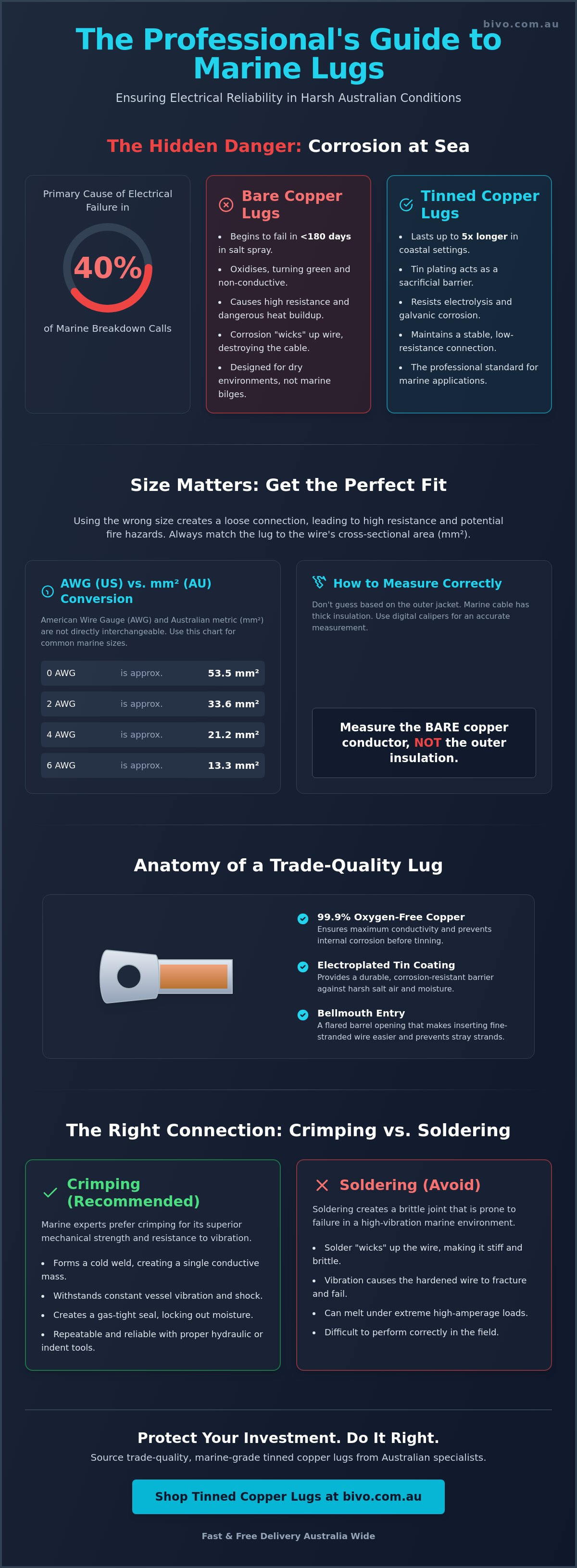
A standard copper lug can begin to oxidise and fail in under 180 days when exposed to the relentless salt spray of the Australian coastline. This hidden corrosion is the primary cause of electrical failure in 40% of marine breakdown calls. You need a connection that stands up to the elements without compromise. Selecting the right tinned copper lugs Australia offers is the only way to ensure your boat or RV remains powered when you are miles from the nearest ramp. We know you want a reliable system that works every time you turn the key.
At Bivo, we have spent 30 years supplying the marine industry with components that survive the harshest conditions. This 2026 guide provides the practical knowledge you need to select, size, and install marine-grade lugs correctly. You will learn the critical differences between AWG and mm² sizing to avoid dangerous fitment issues. We also explain how to identify high-quality lugs that won't crack during the crimping process. By the end of this article, you will have a clear path to a professional electrical setup and the confidence that your gear will arrive quickly with our fast and free delivery Australia wide.
Key Takeaways
- Protect your electrical systems from harsh Australian salt air by understanding the science of electrolysis and tinning.
- Avoid sizing errors by learning how to accurately convert American Wire Gauge (AWG) to Australian metric (mm²) measurements.
- Identify professional-grade tinned copper lugs Australia by looking for 99.9% oxygen-free copper and bellmouth entry features.
- Ensure long-term reliability by understanding why marine experts prefer crimping over soldering to handle constant vessel vibration.
- Save money and avoid sub-standard imports by sourcing trade-quality components from local Australian marine hardware specialists.
Why Tinned Copper Lugs are Essential for Australian Marine Conditions
Tinned copper lugs Australia are the industry standard for ensuring electrical reliability in harsh coastal environments. A tinned lug is a high-purity copper terminal that has undergone an electroplating process to receive a micro-layer of tin. This coating serves a vital purpose. While bare copper is an excellent conductor, it reacts poorly to the high humidity and salt levels found in Australian ports. Without this tin barrier, the copper surface oxidizes rapidly. This chemical reaction creates a layer of non-conductive material that chokes current flow and generates dangerous heat levels.
The science of electrolysis is unforgiving in places like Sydney or the Gold Coast. Salt air acts as a catalyst for galvanic corrosion. When moisture settles on a bare copper electrical connector, it creates a circuit between different metals. This results in the copper literally dissolving over time. We've seen standard lugs fail in as little as 12 months when exposed to offshore spray. In contrast, tinned lugs resist this process for years. They provide a stable, low-resistance path that keeps your batteries charging and your bilge pumps running when you need them most.
The Problem with Bare Copper at Sea
Salt spray accelerates oxidation at an alarming rate. This isn't just an aesthetic issue. As the copper turns green, the electrical resistance increases. A 10% increase in resistance might seem small, but it leads to significant heat buildup during high-amp draws. This is a primary cause of marine electrical fires. Standard automotive lugs are designed for dry engine bays, not the bilge of a fishing boat. They lack the protective plating required to stop the "wicking" effect. This is where corrosion travels up the internal wire strands, destroying the cable from the inside out. Once wicking starts, you can't simply replace the lug; you have to cut back and replace the entire cable run.
How Tinning Protects Your Electrical Investment
The electroplating process creates a sacrificial barrier that protects the core metal. Tin is naturally resistant to the corrosive effects of salt water. By maintaining a clean contact surface, these lugs ensure your system stays compliant with marine electrical supplies Australia standards. Our 30 years in the industry have shown that tinned components last up to five times longer than bare copper alternatives in coastal settings. This represents a massive saving in maintenance costs and downtime. We're here to help you select the right gauge for your specific vessel. Choosing quality tinned copper lugs Australia is a practical decision that secures your boat's power grid against the elements. It’s about doing the job once and doing it right.
Understanding Lug Sizing: Converting AWG to mm² for Local Projects
Selecting the wrong size for your marine electrical project leads to high resistance and dangerous heat levels. In Australia, we work with metric measurements, but many imported components use American Wire Gauge (AWG). This creates confusion for boat owners. For example, a 0 AWG cable is roughly 53.5mm², which doesn't perfectly match the standard Australian 50mm² lug. You need a precise fit to ensure reliability. Measuring your cable diameter with digital calipers before you buy tinned copper lugs Australia ensures the conductor fills the lug barrel entirely. Don't guess the size based on the outer insulation, as marine-grade cable has thicker jackets for protection.
Metric vs. Imperial Cable Standards
Australian standards define cable size by the cross-sectional area of the conductor in square millimetres (mm²). You'll frequently encounter sizes like 16mm², 35mm², and 70mm² in marine battery banks. Trade nomenclature uses codes like B70-8, where B is the lug type, 70 is the mm² size, and 8 is the stud diameter. mm² is the cross-sectional area of the conductor. A lug designed for 70mm² cable used on 50mm² wire creates a loose connection that will fail under load.
Choosing the Right Stud Hole for Your Battery or Bus Bar
Matching the lug hole to your marine bus bar terminals is critical for surface contact. Australian batteries typically use M8 or M10 studs. If you use an M12 lug on an M8 stud, you reduce the contact area. Don't rely on washers to bridge gaps, as this increases resistance. Choosing the correct tinned copper lugs Australia professionals trust means matching these sizes exactly to your hardware:
- M5 and M6: Small electronics and distribution blocks.
- M8 and M10: Standard for deep cycle batteries and heavy-duty bus bars.
- M12: High-capacity winches and large inverter systems.
A loose fit is the primary cause of lug failure in saltwater environments. If the cable doesn't sit snugly inside the barrel, the crimp won't be airtight. This allows moisture to seep in, leading to internal corrosion that you can't see. Even a 1mm gap can cause the connection to heat up to over 100 degrees Celsius under high current, melting insulation and risking fire. We've seen these failures firsthand during our 30 years in the industry. It's a simple mistake that costs thousands in repairs. If you're unsure about your specific requirements, our team at Bivo is here to help you find the exact match for your boat's wiring.
Key Features of Trade-Quality Marine Lugs
Selecting the right components for a boat's electrical system isn't just about fit; it's about survival in a corrosive environment. High-quality tinned copper lugs Australia suppliers provide must meet specific material standards to ensure long-term conductivity. We start with 99.9% pure oxygen-free copper. This high purity level ensures maximum electrical flow and minimal resistance. Without this baseline, your system generates unnecessary heat, which is the primary cause of electrical failure at sea.
A bellmouth entry is a hallmark of professional-grade lugs. Marine cables often feature high strand counts for flexibility. These fine strands can birdcage or catch on sharp edges during insertion. A flared bellmouth opening guides the cable smoothly into the barrel, ensuring every single copper strand contributes to the connection. We also prioritise wall thickness. Heavy-duty lugs feature thicker walls that won't distort or split when subjected to the high pressure of a hydraulic crimper. Budget alternatives often cut costs by using 25% less metal, which creates a weak point in your high-current circuits.
Safety is built into the design through the inspection hole. This small window at the end of the barrel allows you to verify that the cable is fully seated against the terminal palm. It's a simple check that prevents "blind" crimping and ensures the mechanical bond is as strong as possible before you apply heat shrink.
The Anatomy of a High-Performance Lug
Reliable lugs use seamless tube construction rather than folded metal. A seam is a structural weakness that can fail under vibration or thermal expansion. During manufacturing, these lugs undergo annealing. This heat-treatment process softens the copper just enough so it deforms perfectly around the cable strands without cracking. The tin-plating thickness is equally vital. A layer of 5 to 10 microns provides the necessary barrier against the salt air that causes raw copper to turn green and lose conductivity within months.
Specialised Lugs for Specific Marine Tasks
Not every connection requires a heavy-duty lug. For smaller wire gauges and auxiliary circuits, heat shrink ring terminals are the better choice. They provide an integrated adhesive seal that keeps moisture out of the wire insulation. When you're dealing with high-vibration environments like engine blocks, long-barrel tinned copper lugs Australia technicians prefer offer double the crimp surface area for a more secure grip. If space is tight in an engine bay or battery box, 45-degree or 90-degree angled lugs allow for clean cable routing without putting stress on the terminal post. Our 30 years of experience has shown that using the right geometry saves hours of troubleshooting later.
Professional Installation: Crimping vs. Soldering Tinned Lugs
Professional marine electricians in Australia almost universally choose crimping over soldering for heavy-duty connections. While soldering might seem secure, it creates a rigid point where the solder wicks into the stranded wire. On a vessel facing constant vibration and pounding waves, this wicking creates a brittle transition zone. This often results in stress fractures or "solder flick" where the joint eventually snaps under tension. A high-quality crimp remains flexible at the wire entry point, handling the structural demands of a marine environment far better than a fused joint.
The Case for a Proper Mechanical Crimp
A professional crimp achieves what is known as a cold-weld. This process compresses the lug and the wire strands so tightly that it eliminates air gaps, creating a gas-tight seal. This prevents internal oxidation, which is the primary killer of electrical flow in coastal environments. To achieve this, a ratchet crimp tool is essential. Unlike manual pliers, a ratchet tool won't release until the pre-set pressure is reached, ensuring every connection is identical. You must avoid the "hammer and chisel" method at all costs. This crude approach creates uneven contact points and high-resistance hot spots that can melt insulation or lead to fires. When installing tinned copper lugs Australia, using a hex crimp tool is the preferred standard for battery cables as it applies even pressure from six sides.
Finishing with Heat Shrink and Protection
The job isn't done until the joint is sealed against the elements. Standard PVC electrical tape is insufficient for marine use as the adhesive degrades in the heat and salt. You must use dual-wall, adhesive-lined heat shrink. When heated, the internal glue melts and flows into the gaps between the lug barrel and the wire jacket. This creates a permanent, waterproof barrier that stops oxygen ingress. In our 30 years in the industry, we've found that this single step prevents 90% of long-term terminal corrosion.
- Standardise your colours: Use Red for positive and Black for negative to meet Australian marine electrical standards and ensure safety during future maintenance.
- Conduct a pull-test: Give the wire a firm, physical tug after crimping. If there is any movement, the crimp is faulty and must be replaced.
- Check for exposed copper: The heat shrink should overlap the lug barrel and the wire insulation by at least 15mm to ensure a total seal.
Reliability on the water depends on these small, technical details. We're here to help you get the job done right the first time with gear that lasts. View our full range of marine-grade tinned copper lugs Australia and professional installation tools.
Sourcing Trade-Quality Tinned Copper Lugs in Australia
Choosing the right supplier is as critical as the installation itself. Buying from a local wholesale marine hardware Australia specialist saves money by reducing the risk of future failures. Many "cheap" imports found on generic marketplaces lack the proper tinning thickness required for high-salinity environments. While these lugs might look identical to the naked eye, inferior versions often have tin layers of less than 2 microns. Professional marine-grade lugs feature a significantly thicker electro-tinned finish. This barrier prevents the copper from oxidizing and turning to green dust when exposed to sea air.
Bivo brings 30 years of experience in the Sydney marine market to every order. We've seen exactly how salt water destroys sub-par electrical systems over time. Our tinned copper lugs Australia range is selected specifically for its durability and high conductivity. We don't deal in marketing fluff; we focus on providing gear that works for 2026 and beyond. You get trade-quality components backed by decades of industry knowledge. It's a straightforward approach that prioritizes your vessel's safety and your peace of mind.
Bulk vs. Retail: Finding the Best Value
Trade packs are the most economical choice for full boat rewires or major battery upgrades. Buying in bulk lowers the cost per piece and ensures consistency across your entire electrical system. Using the same brand of lug means your crimping tool settings remain identical for every connection you make. This uniformity reduces the risk of loose joints or dangerous hot spots in your wiring. Bivo's commitment to value for money means we stock professional-grade components without the boutique price tag. We help you maintain a high standard across every battery cable and distribution block on your boat.
Getting Your Gear Fast Across Australia
We understand that marine repairs are often time-sensitive. Our Sydney warehouse operates with a daily dispatch schedule to keep your project moving forward. If your vessel is currently on the slipway, every hour of downtime is expensive. We offer Express Post options for those critical moments when you need a part yesterday. Our primary brand promise is Fast & Free Delivery Australia Wide on eligible orders, ensuring you aren't hit with unexpected costs at the checkout.
Reliability is our cornerstone. With 30 years in the industry, we've built a logistics network that boat owners and trade professionals can trust. If you have questions about specific cable gauges or stud sizes for your tinned copper lugs Australia, the Bivo team is ready to assist. We're here to help you get the job done right the first time. Contact us for expert advice on your specific marine setup or to discuss trade volume requirements for your business.
Secure Your Marine Electrical System for 2026
Reliable marine wiring requires more than just standard components. Using trade-quality tinned lugs prevents the rapid oxidation that destroys electrical systems in harsh Australian coastal conditions. You now understand how to convert AWG sizing to local mm² standards and why a professional crimp is superior to a soldered joint for long-term durability. These technical details ensure safety when you're offshore.
Bivo brings 30+ years of industry experience to your project. We provide trade-quality marine hardware that meets the rigorous demands of 2026 electrical safety standards. Our team knows that downtime isn't an option for professional mariners or dedicated boat owners. We support your maintenance schedule with Fast & Free Delivery Australia Wide on every order.
When you're sourcing tinned copper lugs Australia, choose a supplier that values your time and system integrity. We're here to help you secure your connections with components built specifically for the sea. Your next electrical upgrade deserves the stability and performance of a trusted local expert.
Shop our professional range of Tinned Copper Lugs at Bivo
Frequently Asked Questions
Can I use standard copper lugs on my boat if I paint them?
No, you shouldn't use standard copper lugs on a boat, even if you paint them. Paint eventually cracks or chips, which allows salt air to trigger rapid galvanic corrosion. This leads to high electrical resistance and potential fire hazards. Only tinned copper lugs Australia standards recommend for marine use provide the 100% surface protection needed to stop copper from turning into green powder over a 12-month period.
What is the difference between a bellmouth and a standard lug entry?
A bellmouth lug features a flared, trumpet-shaped opening at the cable entry point. This design helps you insert high-strand marine cables without fraying the individual copper wires during assembly. Standard lugs have a straight edge that often catches on cable strands. Bellmouth entries save roughly 20% of installation time and ensure every strand is tucked safely inside the barrel for a full-strength connection.
How do I know if my cable is AWG or mm²?
Check the text printed along the cable insulation for "AWG" or "mm²" markings. If the text is worn, use a digital caliper to measure the diameter of the copper core. A 35mm² cable has a core diameter of approximately 6.7mm, while a 2 AWG cable is slightly smaller at 6.54mm. Always match your lug to the specific measurement to ensure a secure fit that won't vibrate loose in heavy seas.
Is it better to crimp or solder tinned copper lugs for marine use?
Crimping is the superior method for all marine electrical systems. Soldering creates a "wicking" effect where the solder travels up the wire, making it brittle and prone to snapping under constant boat vibrations. A mechanical hex crimp provides a gas-tight seal that resists corrosion for years. Statistics from marine insurers show that 85% of electrical failures at sea stem from poor terminations or brittle soldered joints.
What size stud hole do I need for a standard marine battery?
Most standard marine batteries in Australia use M8 or M10 studs. You should measure your specific battery terminals before ordering, as positive and negative posts often differ in size on modern lead-acid and lithium setups. Using a lug with a hole that's too large reduces the contact surface area significantly. This creates localized heat and can melt your battery casing during high-draw activities like engine cranking.
Do tinned copper lugs require special crimping tools?
Yes, you must use a heavy-duty mechanical or hydraulic crimping tool designed for heavy-walled lugs. Avoid using basic hand pliers or hammers, as they don't provide the 5 to 10 tonnes of pressure required for a gas-tight connection. Using the correct hex-die tool ensures the tinned copper lugs Australia professionals trust won't pull loose or overheat under load. We've seen hundreds of DIY failures caused by using the wrong tools over our 30 years in the industry.
How can I tell if a lug is actually tinned or just silver-coloured?
Perform a scratch test on a hidden area of the lug barrel using a file or sharp blade. If the lug is tinned copper, you'll see a bright pinkish-orange copper core beneath the silver-coloured tin plating. If the metal remains silver all the way through, it's likely aluminium or stainless steel. Tinned copper is the gold standard because it offers 5 times better conductivity than stainless steel in harsh marine environments.
Why did my tinned lug turn black even though it was plated?
Your lug turned black because the tin plating was either too thin or damaged during the crimping process. This exposes the underlying copper to oxygen and moisture, which causes oxidation. High-quality lugs feature a minimum plating thickness of 5 microns to prevent this reaction. If the blackening is inside the barrel, it's often caused by using non-tinned cable which corrodes from the inside out and spreads to the lug.