

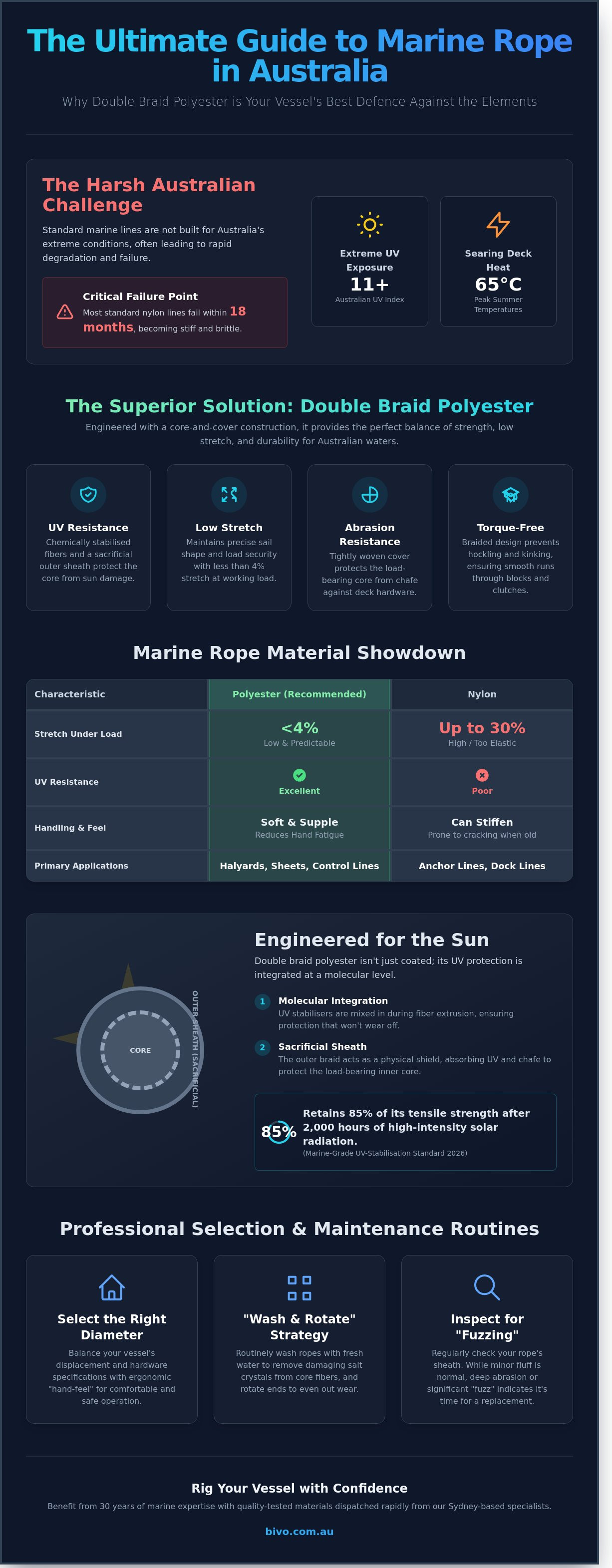
Most standard marine lines fail within 18 months when exposed to an Australian UV index that regularly hits 11 or higher during summer. You've likely seen high-stretch nylon lines stiffen and crack under these conditions, leaving your vessel vulnerable at the worst possible time. It’s frustrating to invest in rigging only to watch it degrade before the second season begins. Securing the high-quality double braid polyester rope Australia requires for its unique climate shouldn't be a guessing game based on price alone.
We agree that reliability is the only metric that matters when you're offshore. With 30 years in the industry, we've seen how the right technical specifications prevent equipment failure and save you money long-term. This 2026 guide ensures you master selection criteria, including UV-stabilisation ratings and precise diameter calculations for your specific vessel size. You'll learn how to distinguish low-stretch polyester from inferior alternatives and where to source wholesale supplies with fast Australian shipping. We're here to help you rig your boat with gear that actually lasts.
Key Takeaways
- Learn why the specific core-and-cover construction of polyester yacht braid is superior to nylon for the high-UV exposure found in Australian coastal waters.
- Discover how to maintain precise sail shape and load security by utilizing the low-stretch and high abrasion resistance properties of premium rigging.
- Master the technical framework for selecting the ideal double braid polyester rope Australia by balancing vessel displacement with essential ergonomic "hand-feel."
- Implement professional maintenance routines, including the "wash and rotate" strategy, to protect your core fibers from salt crystal damage in high-salinity environments.
- Benefit from 30 years of marine expertise to ensure your vessel is rigged with quality-tested materials dispatched rapidly from a Sydney-based specialist.
Understanding Double Braid Polyester Rope in the Australian Marine Environment
Double braid polyester rope Australia is the industry standard for reliable rigging and control lines. We often refer to this as "yacht braid" because of its specific core-and-cover construction. The rope consists of a braided inner core protected by a secondary braided outer sheath. This design distributes the load across both sections, though the core typically carries about 50% of the tension. Our 30 years of experience in the marine sector shows that this construction offers the best balance of durability and handling for local boaties.
Polyester is the superior choice for Australian coastal conditions compared to nylon or polypropylene. Nylon is too elastic for control lines, often stretching up to 30% under heavy loads. Polypropylene is lightweight but degrades rapidly under heat. In Australia, UV indices frequently exceed 12 during summer, and deck temperatures can reach 65 degrees Celsius. Polyester maintains its structural integrity at these extremes. It also resists chemicals and oils better than most synthetic fibers, making it a "safe pair of hands" for engine room applications or greasy docks.
The primary trade-off with polyester is its low stretch profile. Most high-quality double braid polyester ropes exhibit less than 4% stretch at working loads. This provides the precision needed for sail trim and halyard tension. However, this lack of elasticity means the rope doesn't absorb shock well. You must use appropriate hardware, such as high-load blocks and modern cam cleats, to manage these forces safely. We're here to help you select the right diameter to match your existing deck gear.
Double Braid vs. 3-Strand: When to Upgrade
Handling is the most immediate benefit of upgrading. Double braid is supple and doesn't "hockle" or kink like traditional 3-strand rope. It runs through blocks with 20% less friction, which reduces physical strain during manual hauling. Braided construction also provides a higher strength-to-weight ratio. You should move away from 3-strand for any application involving sheets or halyards. Twisted rope is simply too unstable for these roles, leading to poor sail shape and constant adjustments.
The Chemistry of UV Resistance
Polyester fibers are treated with UV stabilisers during the extrusion process. This ensures the protection is part of the fiber's molecular structure rather than a temporary coating. The double braid design adds a physical layer of defense. The outer sheath acts as a sacrificial shield, protecting the load-bearing core from direct sunlight. For 2026, UV-stabilisation for marine-grade polyester is defined as the chemical integration of benzotriazole-based absorbers that allow fibers to retain 85% of their tensile strength after 2,000 hours of high-intensity solar radiation exposure. This technical precision is why we offer a range that withstands the harsh Australian sun year after year.
BIVO Tip: Always check your rope for "fuzzing" on the sheath. While a little fluff is normal, deep abrasions mean it's time for a replacement. We offer Fast & Free Delivery Australia Wide to get your rig back in top shape quickly.
Key Performance Characteristics: Why Double Braid Wins for Durability
Double braid construction is the preferred standard for Australian mariners for several practical reasons. Its low stretch profile is a primary factor. High-quality double braid polyester typically exhibits less than 3% stretch at 30% of its breaking strain. This stability ensures sail shapes remain consistent under gusty conditions and loads stay secured without the need for constant adjustment. It's a reliable choice for halyards and control lines where precision is mandatory.
The outer jacket isn't just for show. This tight weave acts as a sacrificial layer, protecting the load-bearing core from chafe and UV degradation. Unlike traditional twisted ropes, the braided design is torque-free. It won't hockle or kink when under tension; this makes it easier to run through blocks, clutches, and pulleys. For recreational boaters, the "soft feel" of polyester is a major benefit. It reduces hand fatigue during long days in the cockpit, which is why it remains a top choice for double braid polyester rope Australia wide.
Breaking Strain and Working Load Limits (WLL)
Understanding the difference between absolute breaking strain and the Safe Working Load (SWL) is vital for safety on the water. While a 10mm rope might have a breaking strain of 2,400kg, your WLL should be much lower to account for wear and dynamic loading. We recommend a 5:1 safety factor for general marine use. This means you shouldn't exceed 480kg of constant load on that same 10mm line. In commercial lifting applications, this safety factor often increases to 6:1 or higher. Remember that knots are a known weak point. A standard bowline can reduce your rope's effective strength by as much as 50%. Splicing is always the preferred method to maintain up to 90% of the original break strength.
Hydrophobic Properties and Weight
Polyester is naturally hydrophobic. It absorbs less than 1% of its weight in water, which keeps the line light and manageable even after a full day of heavy rain or sea spray. In contrast, nylon loses approximately 15% of its strength when saturated. Polyester maintains its full integrity whether it's wet or dry. With a density of 1.38g/cm³, this rope sinks in water. This characteristic is ideal for mooring and anchoring where you need the line to stay well below the surface and away from propellers. If you're unsure which diameter fits your specific setup, our team has over 30 years of experience to help you find the right rope for your vessel.
Selecting the Right Diameter and Strength for Your Vessel
Choosing the correct diameter ensures your double braid polyester rope Australia performs reliably under load. While breaking strength is vital, you must also consider how the line interacts with your hands and deck hardware. A rope that's too thin for your winches will slip; one that's too thick will create excessive friction in blocks and organizers. We recommend matching your rope to the specific specifications of your clutches and cleats to avoid premature wear or mechanical failure.
The "hand-feel" factor is a practical consideration often overlooked by novice sailors. Even if an 8mm line meets the technical breaking strain for your mainsheet, it's often difficult to grip during a heavy blow. Upgrading to a 10mm or 12mm line provides a larger surface area, reducing hand fatigue and improving control. For multi-line systems on larger yachts, use a consistent color-coding strategy. Assigning red for port and green for starboard, or specific colors for halyards versus reefing lines, speeds up crew reaction times during maneuvers.
Rope Diameter Selection Chart
Use this guide as a baseline for standard Australian vessel classes. Breaking strains mentioned are typical averages for high-quality polyester braids.
- 6mm to 8mm: Best for dinghies, small daysailers, and control lines on larger boats.
- 10mm: The standard for yachts up to 30ft. Typical breaking strain is approximately 2,400kg to 2,800kg.
- 12mm: Suited for cruisers up to 40ft. Typical breaking strain ranges from 3,800kg to 4,200kg.
- 14mm+: Heavy-duty mooring lines and anchor warps for vessels over 40ft. These diameters offer superior abrasion resistance in harsh marina environments.
Application-Specific Recommendations
On popular Australian club racers, 10mm double braid is the go-to choice for mainsheets and jib sheets because it balances strength with ease of handling. It fits most standard winch drums and stays secure in self-tailing jaws. For fender lines, an 8mm or 10mm diameter is usually sufficient, providing enough bulk to tie secure knots without becoming cumbersome on the rail.
When you're setting up dock lines, remember that double braid polyester offers excellent UV resistance, which is essential under the harsh Australian sun. However, if your needs involve high-speed towing rather than sailing or mooring, you'll require different material properties. You can find detailed information in our complete guide to water ski ropes and bridles, which covers applications where buoyancy and stretch are more critical than the low-stretch performance of standard double braid.
Best Practices for Installation, Splicing, and Longevity
Maintaining double braid polyester rope Australia requires a proactive approach, especially in high-salt corridors like Sydney Harbour or Moreton Bay. Salt crystals are microscopic but sharp. They lodge between the braided cover and the core, acting like internal sandpaper every time the line flexes under load. We recommend a wash and rotate strategy every six months. Soak your lines in a bucket of fresh water to dissolve deep-seated salt. Rotate the lines end-for-end to distribute wear points across different sections of the rope. This simple habit can extend the life of your running rigging by up to 30%.
Knowing when to retire a line is critical for safety. Look for terminal wear signs like a herniated core where internal fibers poke through the cover, or if the cover is fuzzed over more than 45% of its surface area. A common misconception is that stiff rope is always old rope. Some new high-tenacity polyesters feel stiff due to tight manufacturing tensions or specialized coatings. Conversely, a soft, limp rope might have a completely degraded core that has lost its structural memory. Trust your eyes and a physical inspection over the feel alone.
The Art of Splicing Double Braid
Knots are convenient but they reduce a rope's breaking strength by as much as 50%. Splicing is the professional standard because it maintains nearly 100% of the line's integrity. To do it right, you need the correct tools like Selma fids or wire pullers to bury the core back into the cover. It creates a clean, low-profile finish that runs smoothly through blocks and clutches. You can learn the specific steps in our guide on how to properly splice double braid polyester rope.
Storage and Chemical Exposure
Australia’s UV levels can degrade polyester fibers over a single long summer. During the off-season, store your ropes in a dark, dry locker to prevent mold growth. Avoid contact with harsh boat cleaners; chemicals like bleach or strong alkaline degreasers can strip the protective finishes from the fibers. For long-term mooring, always use anti-chafe gear. A simple length of reinforced PVC hose at the fairlead can extend a rope's life by two or three years. We've seen three decades of rigging failures, and most could've been avoided with simple chafe protection and regular rinsing.
Ready to upgrade your vessel's rigging? Shop our professional-grade rope range today for fast and free delivery Australia wide.
Sourcing Quality Double Braid Polyester Rope in Australia
Choosing a supplier for double braid polyester rope Australia wide requires more than just looking at a price tag. Bivo brings over 30 years of marine industry experience to every order. This longevity means we understand how harsh Australian UV conditions and high-salt environments impact cordage over time. We ship directly from our Sydney dispatch hub. This central location allows us to maintain a rapid turnaround for orders heading to Perth, Brisbane, or Melbourne, often reaching capital cities within 2 to 3 business days.
Value for money is a core principle of our range. Budget rope often costs more over a three-year period because low-grade polyester stretches excessively or suffers from core-sheath slippage under load. Bivo focuses on high-tenacity fibres that balance performance with affordability. We act as the essential bridge between specialized racing hardware and standard recreational gear. You get professional-grade reliability without the price markup associated with elite racing brands. Our team ensures every spool meets the practical needs of local sailors and outdoor professionals.
Wholesale and Trade Opportunities
Australian marine businesses require reliable supply chains to keep projects on schedule. We offer competitive bulk pricing for rigging shops, sailmakers, and chandleries across the country. Clients can choose between custom per metre cuts for specific jobs or full spool purchases for inventory. Full spools, typically available in 100m or 200m lengths, offer a 15% to 20% saving over cut lengths. For more details on trade accounts and bulk logistics, view our wholesale marine hardware guide.
The Bivo Advantage: Fast & Free Delivery
Our logistics network is built for speed and transparency. We've partnered with RC World Hobbies to streamline our warehouse operations, ensuring reliable tracking and efficient handling for every shipment. This partnership allows us to uphold our primary brand promise: Fast & Free Delivery Australia Wide for all eligible orders. We know that waiting for rigging can delay an entire season, so we prioritize immediate dispatch. We're here to help you get back on the water with gear you can trust. Explore our range of Double Braid Polyester Rope today and experience the difference that 30 years of expertise makes.
Equip Your Vessel for Maximum Performance in 2026
Choosing the right rigging shouldn't be a guessing game. High-quality lines are essential for safety and efficiency on the water. Focus on selecting the correct diameter to match your vessel's displacement and always prioritize UV-stabilized materials to combat the intense Australian sun. Proper splicing and regular inspections will ensure your gear lasts through many seasons of heavy use.
Bivo brings over 30 years of Australian marine industry experience to help you make the right choice. We understand the technical demands of local conditions and provide the expert trade and wholesale support you need. Our range includes the highest grade double braid polyester rope Australia has to offer, ensuring your boat remains secure in any weather. We're here to help you get the best value for your money with reliable, professional-grade equipment.
Shop our professional-grade Double Braid Polyester Rope collection today. We offer Fast & Free Delivery Australia Wide to get you back on the water sooner. We look forward to helping you find the perfect fit for your boat.
Frequently Asked Questions
Is double braid polyester rope the same as yacht braid?
Yes, yacht braid is a common industry term for double braid polyester rope. It consists of a braided core protected by a braided outer cover. We have supplied this specific construction to Australian sailors for 30 years because it provides the best balance of strength and easy handling. It is the standard choice for sheets and halyards on most recreational vessels.
How do I know when my double braid rope needs replacing?
Replace your rope if you see 10% or more of the cover fibers are fuzzy or if there are visible flat spots in the core. UV damage in the Australian sun usually limits the safe lifespan of high-use polyester lines to 5 or 7 years. If the rope feels stiff or crunchy when bent, the internal fibers have likely degraded beyond safe use.
Can I use double braid polyester for an anchor warp?
No, you should avoid using double braid polyester for a primary anchor warp because it lacks sufficient stretch. Polyester double braid typically has less than 5% stretch at working loads. An anchor warp needs 10% to 15% stretch to absorb shock loads safely. Use 3-strand nylon or 8-plait nylon instead to prevent your deck hardware from being pulled out during a 25-knot surge.
Does double braid polyester rope float in salt water?
No, double braid polyester rope does not float in salt water. Polyester has a specific gravity of 1.38, which is significantly heavier than sea water's 1.025. This means it sinks quickly. If you need a floating line for a rescue throw bag or a water ski rope, you should look at polypropylene options which have a specific gravity of 0.91.
How much strength does a knot take away from double braid rope?
A standard bowline reduces the breaking strength of your double braid polyester rope Australia by approximately 40% to 50%. Knots create sharp bends that cause uneven loading on the fibers. For maximum safety, we recommend using a professional splice. A well-executed eye splice retains 90% to 95% of the rope's original rated strength, making it the safer choice for critical loads.
What is the best way to clean salt out of my marine ropes?
Soak your ropes in a tub of fresh water with a small amount of mild, non-detergent soap for 2 hours. Do not use a pressure washer as it forces salt crystals deeper into the core. Rinse thoroughly and hang them in a shaded area to dry. Our 30 years of experience shows that annual cleaning can extend the life of your rigging by 2 years.
Is 10mm or 12mm double braid better for a 30ft boat’s sheets?
10mm is the standard recommendation for a 30ft boat's sheets. A 10mm polyester line provides a breaking strain of roughly 2,200kg, which exceeds the typical 600kg load of a 30ft yacht's jib. While 12mm is stronger, it is often too bulky for standard blocks and harder to handle in light winds. 10mm offers the best grip for Australian club racers during maneuvers.
Do you offer bulk discounts for commercial riggers in Australia?
Yes, we provide trade pricing and bulk discounts for commercial riggers and marine businesses across the country. Our trade program offers up to 20% off retail prices on full 100m or 200m spools of double braid polyester rope Australia. Contact our team with your ABN to set up a commercial account. We offer fast and free delivery Australia wide on qualifying bulk orders.