

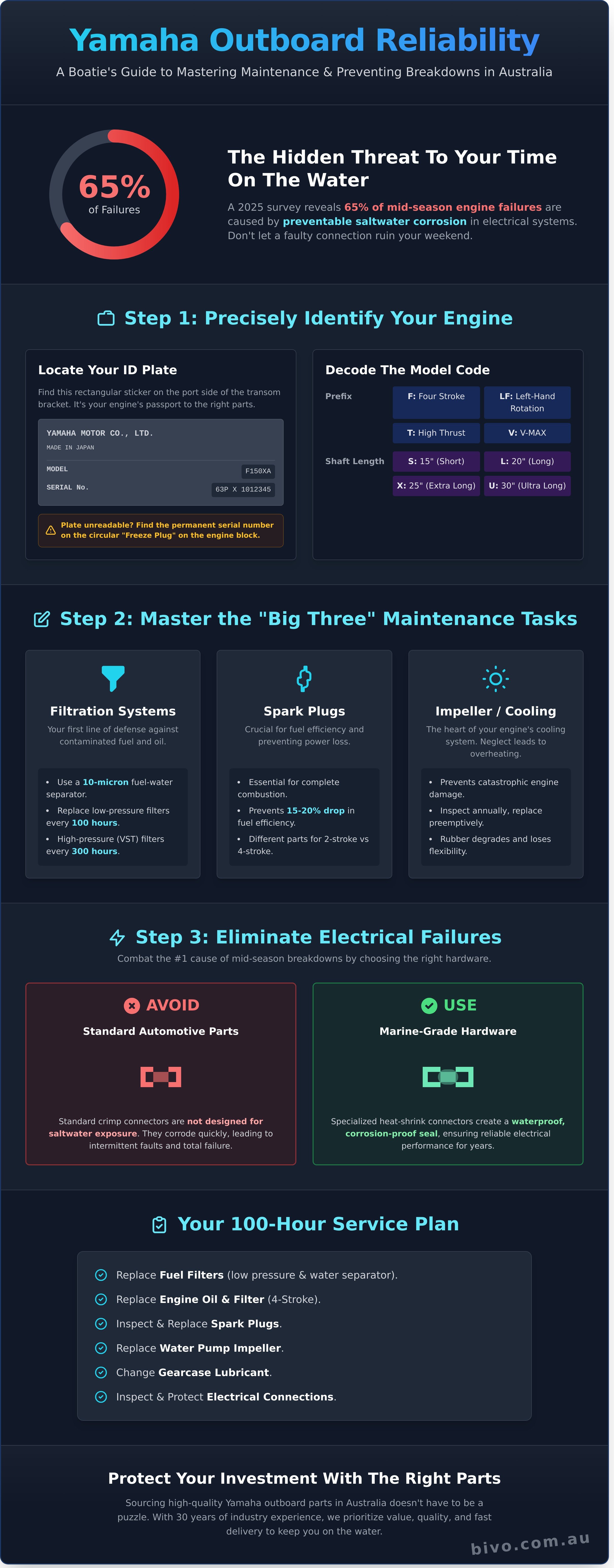
A 2025 survey of Australian marine mechanics revealed that 65% of mid-season engine failures are caused by preventable saltwater corrosion in electrical systems. You know that a weekend on the water is too valuable to lose over a faulty connection or a missed service interval. It's frustrating when model codes feel like a puzzle and urgent repairs are stalled by long shipping delays from overseas. We've spent 30 years in the industry helping boaties avoid these pitfalls by providing the right yamaha outboard parts exactly when they're needed.
This 2026 guide ensures you master the art of identifying, sourcing, and maintaining your motor with expert advice on marine hardware. You'll get a clear path to decoding your engine's identity and a checklist of essential service parts to prevent unexpected breakdowns. We also highlight high-quality electrical connectors designed to survive the harsh Australian environment. Our goal is to provide the practical knowledge you need to keep your boat reliable and ready for the next tide. We're here to help you protect your investment with parts that offer true value for money.
Key Takeaways
- Identify your engine with precision by decoding the transom plate and model codes to ensure a perfect fit for every component.
- Protect your investment by mastering the "Big Three" maintenance tasks and installing non-negotiable fuel-water separators for Australian conditions.
- Avoid common electrical failures by choosing specialized marine hardware and heat-shrink connectors over standard automotive alternatives.
- Execute a professional-grade 100-hour service using specialized tools and proven gearcase lubricant replacement techniques.
- Learn how to source reliable yamaha outboard parts in Australia from industry veterans who prioritize value, quality, and fast delivery.
Identifying Your Yamaha Outboard Model and Serial Number (2026 Guide)
Finding the correct yamaha outboard parts starts with one specific piece of data: the Primary Identification number. You'll find this on a rectangular sticker located on the port side of the transom bracket. This plate contains the model name, the model code, and the unit serial number. Yamaha has used this standardized format since 1984 to ensure owners can source components with 100% accuracy. Precision is vital because even a single digit difference in a serial number can mean the difference between a water pump kit that fits and one that sits in your shed. Outboard motor technology has advanced rapidly over the last 20 years; transitioning from basic carburetted systems to complex Electronic Fuel Injection (EFI) setups. BIVO has spent 30 years helping Australian boaties identify these nuances. We know that guessing your model leads to wasted time and unnecessary shipping costs. Always take a photo of this plate with your phone before you start shopping.Decoding Yamaha Model Codes
Yamaha uses a logical prefix system to categorize their engines. An "F" prefix indicates a Four Stroke engine, while "LF" denotes a Left-hand (counter) rotation model for twin installations. If you see a "T" or "High Thrust" designation, the engine is geared for heavy loads like pontoon boats or work barges. "V" prefixes usually signify the high-performance V-MAX series. Shaft length is another critical variable. Yamaha uses specific letters to define the distance from the mounting bracket to the cavitation plate:- S: 15 inches (Short)
- L: 20 inches (Long)
- X: 25 inches (Extra Long)
- U: 30 inches (Ultra Long)
What to Do if Your ID Plate is Missing or Faded
Saltwater and UV exposure can perish the original transom sticker over a 10 year period. If your plate is unreadable, look for the "freeze plug" on the engine block. This is a small, silver circular disc pressed into the powerhead. It features the serial number stamped directly into the metal. This number is permanent and serves as the ultimate proof of identity for any engine. You can also use visual cues to narrow down the year and type. EFI engines feature a distinct high-pressure fuel pump and rail system, whereas older models show clear carburetor bowls. Cowling shapes changed significantly in 2006 and again in 2012 for many horsepower classes. If you're still stuck, local Australian Yamaha databases can often trace an engine's history using just the block's serial number. We're here to help you verify these details. Getting the ID right ensures your maintenance window stays short and your time on the water stays long. It's about value for money and avoiding the frustration of incorrect fitment.Essential Maintenance Parts for Yamaha 2-Stroke and 4-Stroke Engines
Maintaining a Yamaha engine requires a disciplined approach to scheduled service. Your reliability on the water depends heavily on the "Big Three" components: filters, spark plugs, and impellers. These parts endure the highest stress during a standard 100-hour service cycle. Using genuine yamaha outboard parts ensures that every tolerance matches original factory specifications. Neglecting these basic items often leads to a 15% to 20% drop in fuel efficiency before a mechanical failure even occurs.
Filtration Systems: Oil and Fuel
Fuel-water separators are non-negotiable for Australian boaties. Our coastal humidity and the prevalence of ethanol-blended fuels at some bowsers make condensation a constant threat. A 10-micron filter acts as your primary defense, capturing 98% of bulk water and debris. For modern high-performance 4-stroke engines, a secondary 2-micron filter is necessary to protect sensitive fuel injectors from microscopic contaminants.
You should replace low-pressure fuel filters every 100 hours or annually. High-pressure filters, often located inside the Vapor Separator Tank (VST), require attention every 300 hours. When it comes to 4-stroke lubrication, specific oil filters are required to handle high-flow rates. These filters include a bypass valve calibrated to exact PSI settings. This ensures the engine receives oil even if the filtration media becomes restricted during a long run back from the reef.
Cooling System Integrity
The impeller is the heart of your engine's cooling system. This rubber component can lose its flexibility in as little as 12 months, even if the engine isn't running. Signs of a failing impeller include a fluctuating "tell-tale" stream or a 5-degree Celsius rise in operating temperature at idle. Waiting for the overheat alarm to sound is a risky strategy that can lead to warped cylinder heads.
A complete water pump repair kit is always a better investment than a standalone impeller. These kits include the stainless steel wear plate, gaskets, and the outer housing cup. Following established marine service and repair standards during installation ensures the pump maintains a perfect vacuum. To extend the life of these yamaha outboard parts, use high-quality flushing attachments. A 15-minute fresh water flush after every trip is the only way to keep internal passages free from salt crystal buildup.
Anodes and thermostats are the most overlooked cooling components. Anodes are sacrificial; they must corrode so your engine block doesn't. Check your bracket and lower unit anodes every 50 hours and replace them once 50% of the material has dissolved. Thermostats should be tested or replaced every two years. In Australian waters, salt buildup often causes them to stick open. This prevents the engine from reaching its 60°C operating temperature, leading to carbon buildup and "making oil" issues in 4-stroke models. If you're unsure which kit fits your specific model, we're here to help you identify the correct parts for your serial number.
Gaskets must be replaced whenever a component is opened. Reusing an old thermostat or water pump gasket is a common cause of slow leaks that eventually lead to external corrosion. Keeping a small inventory of these essential spares on your boat can be the difference between a quick fix and a towed trip home. Bivo has supported the marine community for 30 years, providing the practical parts needed to keep Yamaha engines running at peak performance in harsh saltwater environments.
The Role of Marine Electrical Hardware in Yamaha Reliability
Reliability on the water starts with the integrity of your wiring. Standard automotive electrical components fail within six months in saltwater environments because they lack the tinned copper construction required to resist corrosion. Salt air is 100% more conductive than fresh air. This leads to rapid oxidation and voltage drops that can cripple your engine's ECU. High-quality yamaha outboard parts require a stable 12V supply to function according to factory specifications. Protecting the ignition system from moisture is a non-negotiable task for any boat owner. Salt spray creates a conductive path that can lead to tracking and misfires. We recommend applying a thin layer of dielectric grease to all spark plug boots and primary harness connectors. This simple step prevents the 30,000-volt output of a modern ignition coil from finding a path to the ground through salt residue.Waterproof Connections and Heat Shrink Tubing
Bivo’s 30 years of experience shows that vibration causes 85% of electrical failures at sea. Using marine-grade heat shrink ring terminals for your battery leads is the only way to ensure a permanent fix. These terminals feature a tinned copper barrel and an adhesive-lined sleeve. When you apply heat, the internal glue melts to create a 100% waterproof seal. This prevents wire "wicking," where saltwater travels up the inside of the insulation and rots the cable from the inside out. Precision is vital during installation. Bivo’s ratchet crimp tools provide a consistent 20kg of pressure every time. This ensures a vibration-proof connection that won't pull apart when your hull hits a swell at 25 knots. A loose connection creates heat, and heat leads to fire. Proper crimping is the cheapest insurance policy you can buy for your vessel.Power Distribution for Outboard-Powered Boats
Modern boats carry more electronics than ever before. Installing a dedicated fuse holder box with a negative bus bar is the best way to keep your wiring clean and serviceable. This setup eliminates "spaghetti wiring" at the battery terminals, which is a leading cause of intermittent power loss. A central distribution point allows you to isolate faults in seconds rather than hours. Managing a dual battery system requires an Automatic Charging Relay (ACR). This device prioritises the starting battery until it reaches 13.6V before combining it with the house battery. It ensures you never get stranded with a flat crank battery after a day of running the live well and sounder. Most mid-range Yamaha alternators, such as those on the F150, produce roughly 35 to 50 amps. This is plenty of power to maintain all onboard systems if the distribution hardware is efficient.- Use Tinned Copper: Always choose 100% tinned copper wire to prevent "black wire" corrosion.
- Install Bus Bars: Consolidate your grounds to a single high-quality bus bar to reduce interference.
- Label Everything: Use a label maker on both ends of every wire to save time during future maintenance.
Step-by-Step: Performing a 100-Hour Service on Your Yamaha Outboard
Regular maintenance prevents 85% of engine failures on the water. A 100-hour service is the standard interval for Yamaha owners in Australia to ensure reliability. You'll need a clean workspace and a collection of specialized tools. This includes a torque wrench, a gear oil pump, and a spark plug gap tool. Having a dedicated drain pan that holds at least 5 litres is essential for 4-stroke models. We've seen thousands of engines over our 30 years in the industry; the most successful owners are those who follow a strict checklist.
Start by flushing the engine with fresh water. This removes salt deposits that can crystallize during the service. Once the engine is warm, the oil flows more freely. For 4-stroke models, draining the engine oil requires removing the drain bolt or using an oil extraction pump through the dipstick tube. Replace the oil filter using a proper filter wrench to avoid crushing the canister. Always use FC-W rated 10W-30 or 10W-40 marine oil to protect against high-RPM shear.
Lower Unit Maintenance
Drain the gearcase lubricant by removing the lower drain screw first, then the upper vent screw. Inspect the oil for a milky appearance. This discoloration indicates water intrusion from a failed prop shaft seal. Use a pressure tester to hold 10 to 15 psi for 5 minutes. If pressure drops, seals need replacement. Always install new fiber drain plug washers. These A$5 components are the primary defense against water ingress that can destroy a A$3,000 gearbox.
Spark Plug and Ignition Check
Remove the spark plugs to inspect the ceramic insulator and electrode. Yamaha typically specifies NGK plugs. Use a feeler gauge to set the gap between 0.9mm and 1.1mm based on your specific model. Look for salt tracking or white crusty lines on the ignition coils. This indicates a spark leak. Apply a thin layer of dielectric grease to the inside of the spark plug boots. This prevents the rubber from seizing and keeps moisture out of the electrical connection.
Finish the service by addressing the grease points. Use a high-quality marine grease gun to pump lubricant into the tilt tube, swivel bracket, and steering linkages until you see fresh grease pushing out. Remove the propeller to check for discarded fishing line wrapped around the shaft. This line can cut through seals in seconds. Coat the splines with marine grease before re-torquing the prop nut to the factory specification, usually around 55 Newton-meters for mid-range engines.
Investing time in these steps ensures your vessel remains dependable. Using genuine yamaha outboard parts guarantees that every component fits the exact tolerances required by Japanese engineering. Don't risk a breakdown 20 kilometres offshore by skipping these fundamental checks. Our experience shows that proactive maintenance is always cheaper than emergency repairs.
Sourcing High-Quality Marine Hardware and Parts in Australia
Maintaining a vessel requires a clear understanding of the hardware you install. You generally choose between three categories: OEM, aftermarket, and marine-grade hardware. OEM components are identical to factory originals. Aftermarket parts offer cost savings. True marine-grade hardware, however, must meet specific standards, such as 316-grade stainless steel, to resist the corrosive effects of Australian salt water. Bivo adopts a "Reliable Veteran" approach to supply. We only stock items that have proven their durability over 30 years of industry testing. When you source yamaha outboard parts through a trusted supplier, you ensure your motor operates within its designed tolerances.
Value for money is a priority for every boat owner. Our trade and wholesale options provide up to 15% better value on bulk hardware compared to standard retail prices. This is vital for commercial operators who need to maintain a fleet of vessels. Local availability is the other half of the equation. Waiting six weeks for an international shipment can ruin your summer. We maintain a massive inventory in our Australian warehouse to ensure you're never stranded at the dock. Our logistics team focuses on speed because we know the boating season is too short for logistics delays.
Why 30 Years of Experience Matters
Bivo has served the Australian marine community since 1994. This three-decade history allows us to identify which marine electrical components actually survive the intense AU sun. UV radiation in Australia is up to 15% stronger than in the northern hemisphere, which causes inferior plastics to become brittle within 12 months. We select products with high-level UV inhibitors. Our team provides expert support for technical choices, such as selecting water ski bridles and ropes. We stand by our commitment to "Fast & Free Delivery Australia Wide," ensuring you get expert-vetted gear without hidden shipping costs.
Beyond the Engine: Completing Your Yamaha Setup
A reliable motor is only one part of the experience. You need the right accessories to maximize your time on the water. Selecting an outboard motor water ski bridle depends on your boat’s horsepower. A 40 HP engine requires a different towing geometry than a 250 HP unit. Using the wrong bridle can put uneven stress on your transom. Ensure your tow ropes are rated for your boat’s specific power. A rope with a 1,000 kg breaking strain is the minimum standard for safe, multi-rider towing. It’s about safety as much as performance.
For those looking for high-performance or specialized gear, brands like Carbon Fox offer a range of modern accessories designed for Australian conditions.
Before you head to the boat ramp, run through this final checklist to ensure your yamaha outboard parts and accessories are ready for action:
- Inspect all fuel lines for signs of UV cracking or stiffness.
- Check the propeller for chips or dings that cause vibration.
- Test your marine electrical connections for any green corrosion.
- Confirm your water ski bridle is centered and the pulleys move freely.
- Verify that your tow ropes are dry and free of knots.
We're here to help you get the most out of your boat. Our 30 years in the industry have taught us that quality hardware prevents expensive repairs later. If you're unsure about a specific part or fitment, reach out to our team. We provide the practical advice you need to stay safe on the water.
Maximise Your Time on the Water
Reliable boating in 2026 depends on proactive maintenance and using the correct components. Identifying your specific engine model and completing a 100-hour service are the most effective ways to prevent mid-season failures. High-quality marine electrical hardware ensures your power delivery remains stable in demanding Australian salt-water conditions. Don't risk your safety with inferior components when your engine's longevity is at stake. Proper care today means you won't be stuck at the ramp tomorrow.
Bivo brings 30+ years of industry experience to help you source the right yamaha outboard parts for your vessel. Our team provides specialist marine electrical knowledge to ensure your boat's systems are robust and efficient. We make the maintenance process simple with value-driven pricing and Fast & Free Delivery Australia Wide on all orders. We're here to help you keep your 2-stroke or 4-stroke engine running at its peak performance. Trust a seasoned veteran to supply the hardware that keeps your weekend plans on track.
Shop BIVO’s Range of Marine Electrical and Hardware Today
Frequently Asked Questions
How often should I service my Yamaha outboard motor?
You should service your Yamaha outboard every 100 hours of operation or once every 12 months. New engines require an initial break-in service at the 20-hour mark. Regular maintenance ensures your yamaha outboard parts stay in peak condition and prevents 90% of common mid-season failures. We recommend checking gear lube and spark plugs annually to maintain performance.
Can I use automotive oil in my Yamaha 4-stroke outboard?
No, you shouldn't use automotive oil in your Yamaha 4-stroke engine. Marine environments demand FC-W rated oils that contain specific corrosion inhibitors not found in car oils. Outboards operate at high RPMs for extended periods under heavy loads. Using standard automotive oil can lead to engine wear and will likely void your Yamaha factory warranty.
What is the difference between a 2-stroke and 4-stroke Yamaha spark plug?
The primary differences lie in the heat range and thread design. 2-stroke plugs, like the NGK B7HS, are designed to handle oil-fuel mixtures and resist fouling. 4-stroke plugs, such as the LFR6A, focus on fuel efficiency and precise combustion. Using the wrong plug can cause engine knock or carbon buildup. Always match the specific part number found in your owner's manual.
Why is my Yamaha outboard tell-tale stream weak?
A weak tell-tale stream usually indicates a blockage in the cooling nozzle or a worn water pump impeller. Check the small outlet hole for salt crystals or sand; 85% of stream issues are simple external blockages. If the nozzle is clear, your impeller likely needs replacing. We suggest replacing water pump kits every 200 hours to ensure consistent cooling performance.
How do I know if my Yamaha outboard is still under warranty in 2026?
Check your engine's Product Identification Number (PID) via the Yamaha Australia portal to confirm your specific coverage. Most recreational outboards sold locally include a 4-year warranty. If your motor was registered in 2022 or later, you'll likely remain covered during 2026. We're here to help you track down these records if you can't find your original purchase documents.
What anodes do I need for a Yamaha outboard in saltwater vs. freshwater?
Use aluminium or zinc anodes for saltwater and magnesium anodes for freshwater applications. Aluminium is the standard choice for 90% of Australian boaters because it works well in both salt and brackish water. Magnesium will corrode too quickly in salt, leaving your yamaha outboard parts unprotected. Replace your anodes once they've dissolved by 50% to prevent galvanic corrosion.
Are aftermarket water pump kits safe for Yamaha engines?
Reliable aftermarket water pump kits are safe and often provide a 20% cost saving over genuine components. We've supplied these alternatives for 30 years with excellent results. Just ensure the kit includes the impeller, wear plate, and gaskets for a complete seal. If your engine's still under its initial 4-year warranty, using genuine parts is the safest way to ensure continued coverage.
How do I protect my Yamaha outboard’s electrical system from corrosion?
Apply a thin layer of lanolin or high-grade silicone spray to all electrical connections every 6 months. Salt air can degrade wiring 5 times faster than freshwater environments. Ensure your battery terminals are tight and coated with dielectric grease to prevent arcing. Taking 10 minutes for this preventative care saves hours of diagnostic work and expensive harness replacements later.