

An electrical failure at sea is more than an inconvenience-it’s a serious safety risk. In the harsh Australian marine environment, salt, spray, and constant moisture are relentless enemies of your boat’s wiring. They turn standard connections into a corroded, unreliable mess, leading to flickering lights, dead equipment, and the constant worry of being left powerless. Wasting money on parts that fail is frustrating, but the solution is simpler than you think. It all comes down to choosing the correct waterproof electrical connectors for boats from the start.
With over 30 years in the industry, we know what it takes to build a reliable marine electrical system. This guide cuts through the confusion. We will show you exactly how to select the right connector for any job, from your bilge pump to your navigation system. You’ll learn the professional techniques to install them correctly, ensuring every connection is secure, corrosion-proof, and built to last. It’s time to master your marine wiring and enjoy complete peace of mind on the water.
Key Takeaways
- Learn why the harsh marine environment destroys standard wiring and why a waterproof seal is critical for safety and reliability.
- Discover the pros and cons of different marine connectors, from heat shrink terminals to Deutsch plugs, to choose the right type for the job.
- Confidently select the correct waterproof electrical connectors for boats by matching them to your specific wire gauge, amperage, and onboard location.
- Master a professional, step-by-step technique for creating a perfectly sealed and vibration-proof connection that will never let you down.
Why Standard Electrical Connectors are a Liability on a Boat
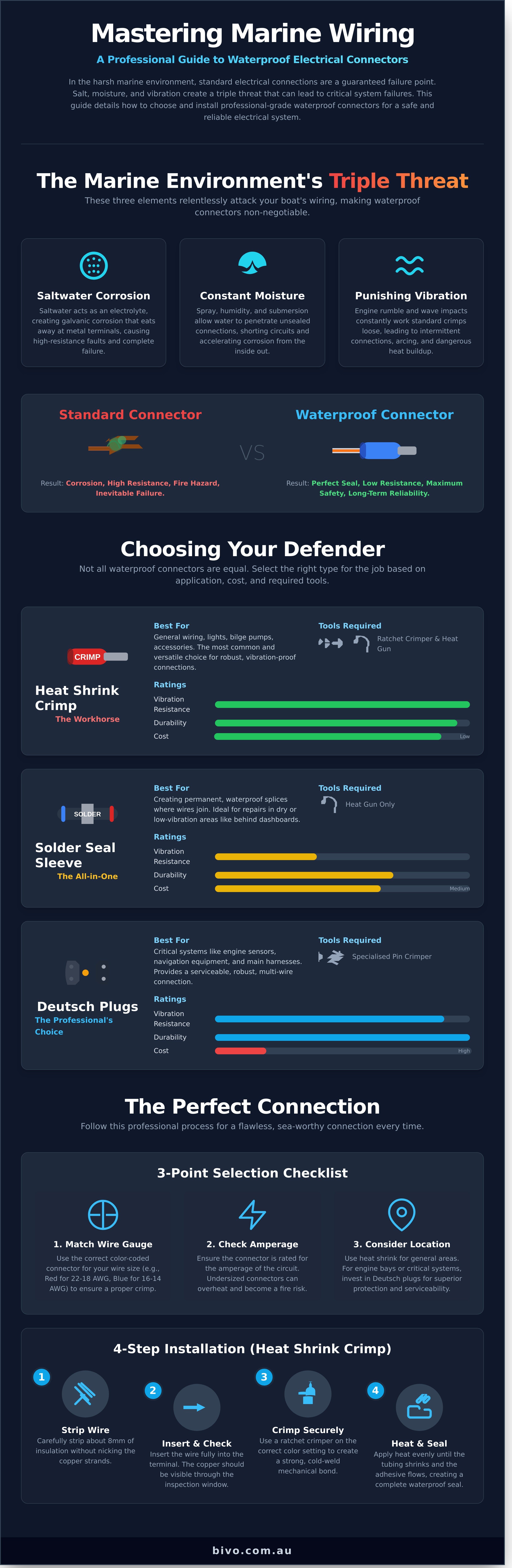
Your boat's electrical system faces a relentless assault from the marine environment. Unlike the wiring in your car or home, it is exposed to a triple threat: corrosive saltwater, constant moisture, and punishing vibration. Using standard, non-marine connectors in this setting isn't just a poor choice; it's a significant risk to your vessel and your safety. These components are simply not built to withstand the conditions, making eventual failure a certainty.
The consequences of a single failed connection range from inconvenient to catastrophic. Imagine a dead bilge pump during a heavy downpour, a failed navigation light at night, or a loss of power to your GPS miles from shore. Even worse, a poor connection can generate heat, becoming a serious fire hazard. This is why investing in quality waterproof electrical connectors for boats is non-negotiable.
The Science of Saltwater Corrosion
Saltwater is a highly effective electrolyte. When it gets into a standard connection, it creates a small electrical circuit between the different metals-like a copper wire and a brass terminal. This process, known as galvanic corrosion, rapidly eats away at the metal, turning a solid connection into a crumbling, high-resistance fault. Before you know it, power is interrupted. Failure isn't a matter of 'if', but 'when'.
Vibration: The Silent Killer of Connections
Every wave slam and engine rumble sends vibrations through your boat's hull. This constant movement works standard crimp connectors loose over time, a process that can go unnoticed until a critical system fails. A loose connection doesn't just stop working; it creates arcing and electrical resistance, which generates dangerous heat. Adhering to proper electrical wiring safety standards is crucial, and that includes accounting for vibration. Quality marine connectors provide superior strain relief to ensure the connection remains mechanically and electrically sound.
The only reliable solution is to use connectors specifically engineered for the job. Marine-grade, sealed, and built to last, proper waterproof electrical connectors for boats protect your equipment and ensure your time on the water is safe and secure.
Types of Waterproof Marine Connectors: A Head-to-Head Comparison
When it comes to your boat’s wiring, 'waterproof' is a non-negotiable term. But not all connectors are created equal. A connection that fails under spray or submersion can lead to equipment failure or worse. With over 30 years of experience, we've seen what works and what doesn't. We'll break down the three main types of waterproof electrical connectors for boats used by marine professionals to help you make the right choice for the job.
| Connector Type | Best Use Case | Tools Required | Relative Cost |
|---|---|---|---|
| Heat Shrink Crimp | General wiring, lights, pumps, accessories | Ratchet Crimper & Heat Gun | Low (A$0.50 - A$2 per piece) |
| Solder Seal Sleeve | Permanent splices in low-vibration areas | Heat Gun | Medium (A$1 - A$3 per piece) |
| Deutsch / Multi-Pin Plugs | Engine bays, critical electronics, harness plugs | Specialised Crimper | High (A$10 - A$50+ per plug set) |
Heat Shrink Crimp Connectors: The Workhorse
This is the most common and reliable choice for most marine applications. The connector consists of a nylon-insulated terminal covered by an adhesive-lined heat shrink tube. The process is simple: you crimp the wire for a strong mechanical bond, then use a heat gun to shrink the tubing. The heat activates an internal glue, creating a tough, watertight seal that protects against moisture and corrosion.
- Pros: Excellent durability, superior vibration resistance, and provides strain relief for the wire.
- Cons: Requires two separate tools (a quality ratchet crimper and a heat gun) for proper installation.
Solder Seal (Solder Sleeve) Connectors: The All-in-One
Solder seal connectors offer a clever, all-in-one solution. Each connector is a transparent heat shrink tube containing a ring of low-temperature solder and two thermoplastic sealing rings. As you apply heat, the tube shrinks, the sealing rings melt to create a waterproof barrier, and the solder melts to form a permanent, conductive joint. No separate soldering iron is needed.
- Pros: Creates a strong, soldered connection and a waterproof seal in a single step.
- Cons: The rigid solder joint can be brittle and may crack in high-vibration environments like near an engine.
Deutsch Connectors & Multi-Pin Plugs: The Heavy-Duty Solution
For critical systems where failure is not an option, professionals turn to Deutsch-style plugs. These are robust, multi-pin connectors with rugged housings, individual wire seals, and secure locking mechanisms. They provide a fully sealed, yet disconnectable, plug perfect for engine harnesses, navigation equipment, and complex electronic systems. This level of protection aligns with the highest industry benchmarks, such as requirements outlined in federal electrical installation standards for moisture and corrosion resistance.
- Pros: Extremely durable, environmentally sealed, and ideal for connections that need to be separated for service.
- Cons: Significantly higher cost per connection and require specialised, expensive crimping tools for correct assembly.
How to Choose the Right Waterproof Connector for Any Job
Selecting the correct waterproof electrical connectors for boats is fundamental to a reliable and safe wiring system. Matching the connector to the specific application ensures a durable, corrosion-resistant seal that will not fail when you need it most. Key factors like wire gauge, amperage load, and the connector's location on the boat dictate the right choice. A high-amperage connection for a bilge pump in a wet environment requires a different solution than a low-voltage data cable for a GPS unit inside a dry console.
This guide will help you make the right decision for every job on your vessel.
Matching Wire Gauge and Connector Colour
Standard marine connectors use a simple colour-coding system to match the terminal to the correct wire size (AWG - American Wire Gauge). Using the wrong size connector is a common mistake that leads to failed connections, overheating, and potential fire hazards. A connector that is too large will not crimp securely, while one that is too small will damage the wire strands.
- Red: Suits 22-18 AWG wire
- Blue: Suits 16-14 AWG wire
- Yellow: Suits 12-10 AWG wire
Always use these connectors with high-quality, marine-grade tinned copper wire, which provides the best defence against corrosion in a saltwater environment.
Location, Location, Location: Bilge vs. Console
The environment is the most critical factor in choosing a connector type. A connection's exposure to moisture, salt spray, vibration, and UV light will determine the level of protection it needs.
- Wet & Damp Areas: For locations like the bilge, anchor locker, or under the gunwales, adhesive-lined heat shrink crimp connectors are the best choice. They create a fully waterproof and strain-relieved seal.
- Dry & Protected Areas: Inside a console or cabin, where moisture is not a primary concern, solder seal connectors can be an effective and fast option.
- Frequent Disconnection: For electronics like sounders or radios that may be removed, weatherproof multi-pin plugs and sockets provide a secure, sealed connection that can be easily disconnected.
- On-Deck Exposure: For any wiring on deck, ensure the connector's housing is UV-stable to prevent it from becoming brittle in the harsh Australian sun.
Tooling Up: What You Actually Need
The best waterproof electrical connectors for boats are only as good as the tools used to install them. Investing in the right equipment is not an optional expense; it is essential for safety and reliability. A poor crimp is a guaranteed point of failure.
A quality ratcheting crimper is non-negotiable. It applies consistent, correct pressure every time, ensuring a solid mechanical and electrical bond. For heat shrink terminals, a professional heat gun provides the even, controlled temperature needed to shrink the sleeve and melt the adhesive lining without scorching the wire. Avoid using cheap pliers, which create weak crimps, or an open flame from a lighter, which can damage the connection. Find professional-grade crimp tools and connectors here.
Step-by-Step: How to Make a Perfect Waterproof Connection
Using quality parts is essential, but technique is what guarantees a connection will last. A poor installation can fail just as quickly as a cheap connector, leaving you with electrical gremlins at the worst possible time. Follow this professional, three-step process to create a joint that is mechanically strong, corrosion-resistant, and completely sealed from the harsh marine environment. This is how you correctly install waterproof electrical connectors for boats.
For this guide, we will use a heat shrink butt connector, one of the most reliable and common terminals used in marine applications.
Step 1: Prepare the Wires
Proper preparation is the foundation of a reliable connection. A clean, correctly stripped wire ensures maximum electrical contact and a solid crimp. Don't rush this stage; it's critical for success.
- Use a quality wire stripper. Avoid using knives or pliers, which can nick and weaken the copper strands.
- Strip to the correct length. Remove about 8-10mm of insulation. This is enough for the wire to fully seat inside the metal barrel without exposing bare wire after crimping.
- Ensure no stray strands. Check that all copper strands are intact and none are bent back or broken.
- Twist the strands tightly. A tight, clockwise twist keeps the strands together, making it easy to insert them cleanly into the connector.
Step 2: Crimp for Mechanical Strength
The crimp creates the physical bond. It’s what holds the wires together against constant vibration and strain on the water. A weak crimp is a point of failure waiting to happen. For this, a ratcheting crimper is highly recommended over basic pliers.
- Insert one wire. Push the twisted wire into one end of the butt connector until it hits the centre stop.
- Use the correct die. Match the colour of the connector (red, blue, or yellow) to the corresponding die on your ratcheting crimper.
- Crimp firmly. Squeeze the crimper handles until the tool's ratchet mechanism releases automatically. This ensures the correct pressure has been applied.
- Perform a 'pull test'. Give the wire and connector a firm tug. If it holds fast, you have a solid mechanical connection. Repeat for the other wire.
Step 3: Heat to Seal the Connection
This final step provides the environmental seal. The heat-activated adhesive lining inside the connector melts and flows, creating a waterproof and corrosion-proof barrier around the wire. Use a heat gun, not an open flame like a lighter, for even and controlled heating.
- Start in the middle. Begin applying heat to the centre of the connector, working your way outwards to the ends.
- Rotate for even heat. Keep the heat gun moving and rotate the wire to shrink the tubing evenly on all sides.
- Watch for the adhesive. You will see the clear adhesive flow out from the ends of the tubing. This is your visual confirmation that a complete seal has been made.
- Let it cool. Allow the connector to cool down completely before handling or bundling it into a loom. This ensures the adhesive sets properly.
Once cooled, you have a perfect, permanent connection that won't let you down. This professional standard is what we've trusted for over 30 years in the industry. For a full range of quality marine-grade connectors and tools, visit us at bivo.com.au. We're here to help you get the job done right.
Why Trust BIVO for Your Marine Electrical Supplies?
Your boat’s electrical system is its lifeline. Its safety and reliability depend entirely on the quality of the components you choose. A single failed connection out on the water can lead to critical equipment failure, leaving you stranded. At BIVO, we understand exactly what’s at stake because we're boaters too. We provide the professional-grade hardware you need to get the job done right, the first time.
Experience and Expertise You Can Rely On
With over 30 years in the marine industry, we’ve learned what works and what fails in harsh Australian conditions. Our team brings decades of hands-on experience, which is why we have a simple rule: if we wouldn't use it on our own boats, we don't stock it. This commitment to quality has made us a trusted supplier for marine trade professionals and passionate DIY boaters across Australia. When you need the right waterproof electrical connectors for boats, you get practical advice from a local expert, not just a product from a box.
Quality Products and Unbeatable Service
Every product in our inventory, especially our heat shrink connectors, is sourced for maximum durability. They are built to withstand constant exposure to saltwater, humidity, UV rays, and engine vibration, creating a secure and corrosion-proof seal that lasts. We offer a comprehensive selection of marine electrical supplies, from tinned copper cable and bus bars to switches and lighting. We are your one-stop shop for reliable boat wiring components.
We back our quality products with service you can count on. Enjoy fast and free delivery Australia-wide on most orders, ensuring you get the parts you need without delay. We're here to make your experience pleasant and helpful.
Ready to build a safer, more reliable electrical system? Browse our full range of waterproof connectors now.
Protect Your Investment with the Right Connections
On the water, every detail matters. As we've covered, standard electrical connectors are a liability, unable to withstand the constant exposure to moisture and salt. Choosing the right connector for the job and ensuring a perfect, sealed installation are not just best practices-they are essential for the safety and long-term reliability of your vessel's electrical systems.
Investing in high-quality waterproof electrical connectors for boats is one of the smartest decisions a boat owner can make. It's a straightforward way to prevent frustrating electrical gremlins, costly repairs, and dangerous failures when you're far from shore.
With over 30 years of hands-on marine industry experience, BIVO is the trusted supplier for trade professionals and boating enthusiasts across Australia. We stock only professional-grade components that we know will perform. Ready to get the job done right?
Shop our full range of professional-grade waterproof connectors today and enjoy Fast & Free Delivery Australia Wide. Secure your wiring, protect your boat, and enjoy peace of mind on every trip.
Frequently Asked Questions
Can I just use electrical tape and silicone to waterproof a connection on my boat?
This is a common but unreliable short-term fix. Electrical tape adhesive fails in marine environments due to salt and UV exposure. Silicone can trap moisture against the connection, accelerating corrosion instead of preventing it. For a safe and lasting repair, you must use purpose-built, marine-grade heat shrink connectors or terminals. Doing the job correctly once saves you time, money, and potential system failures on the water.
What is the difference between tinned and untinned copper wire for boats?
Tinned copper wire is essential for all marine electrical work. The thin tin coating over the copper strands provides excellent protection against corrosion from saltwater and moisture. Untinned, or bare, copper will quickly oxidise and turn black in a marine environment. This corrosion increases resistance, generates heat, and ultimately leads to connection failure. Always insist on tinned copper wire for safety and durability on your vessel.
What IP rating should I look for in waterproof marine connectors?
For most applications, look for a rating of IP67 or higher. An IP67 rating ensures the connector is completely dust-tight and protected against temporary immersion in water up to one metre deep. For connections that will be permanently submerged, such as for bilge pumps or underwater lights, an IP68 rating is required. Choosing the right IP-rated waterproof electrical connectors for boats is critical for system reliability and safety.
How do I correctly identify the gauge (AWG) of the wire I'm working with?
The wire gauge, or American Wire Gauge (AWG), is typically printed on the wire's outer insulation jacket. If the markings have worn off, you can use a wire stripper tool that has marked, sized holes. Gently close the tool on the stripped copper conductor until you find the hole it fits snugly into. Using the correct size connector for your wire gauge is vital for a secure and safe electrical connection.
Are waterproof heat shrink connectors reusable after they have been installed?
No, heat shrink connectors are strictly a single-use product. The heat-activated adhesive inside the tubing melts and flows to create a permanent, environmentally sealed bond. To remove the connector, it must be cut off, destroying it in the process. Always use a new, high-quality heat shrink connector for every new connection or repair to ensure a reliable and waterproof seal every time.
Is it better to crimp or solder wires on a boat?
Crimping is the accepted industry standard for marine electrical systems. A proper crimp with a quality ratcheting tool creates a strong mechanical bond that withstands the constant vibration and flexing on a boat. Solder can create a stiff, brittle point in the wire that is prone to cracking and failure from vibration. For maximum reliability and longevity, always use high-quality crimp connectors.