

Spending A$1,200 on a pro-model carbon fiber deck won't help you stay in the pocket if the shape doesn't match your boat's 2026 ballast configuration. It's a common mistake. It usually leads to more time in the water than on the wave. You want gear that performs without the confusing jargon. You don't want to overpay for pro-level tech you won't use. After 30 years in the industry, we've seen how the wrong wakesurf board can stall a rider's progress. We understand the frustration of trying to decipher weight limits while just wanting a reliable, high-quality ride.
This guide helps you master the technical nuances of board shapes, construction, and fin setups. We'll show you how to match a board to your boat's specific wake and your personal weight limits. You'll gain the confidence to select a style that fits your goals. You'll understand the maintenance required for modern materials. We'll also help you optimize your setup with the right fins and ropes. We're here to help you find the best value for your money so you can enjoy a pleasant and successful season on the water.
The philosophy of seeking expert guidance on high-quality equipment is universal across all action sports. Premier pro shops make all the difference, whether on the water or in the mountains. For those interested in how top-tier retailers operate in other environments, you can learn more about Avalanche Pro Shop, a leading store in the Swiss Alps.
Key Takeaways
- Understand why buoyancy and rail engagement make a dedicated wakesurf board superior to traditional ocean surfboards for boat wakes.
- Distinguish between surf and skim styles to find the right balance of powerful carving and playful, 360-degree technical tricks.
- Compare the durability of compression-molded construction against the lightweight responsiveness of vacuum-sealed epoxy.
- Master fin configurations to transition your board from a stable, predictable ride to a fast and loose setup for effortless spins.
- Learn why using a specialized, thick-knotted rope is essential for safety and easy recovery when surfing behind your boat.
Understanding Wakesurf Board Anatomy: More Than Just a Shape
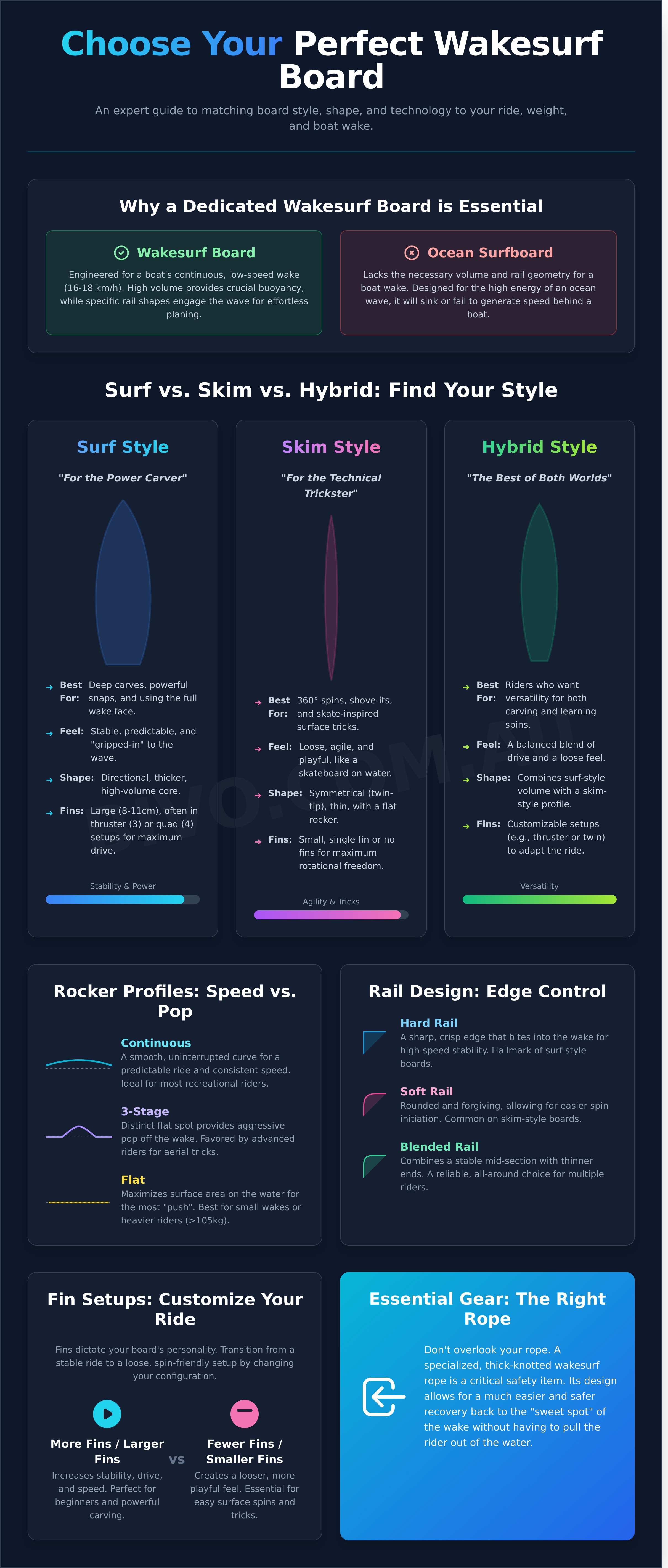
A purpose-built wakesurf board is a high-volume, finned tool engineered specifically for the continuous push of a boat wake. While it looks like a shrunken ocean surfboard, the physics are entirely different. Ocean boards generally fail behind a boat because they lack the buoyancy and rail geometry required for low-speed planing. An ocean board relies on the energy of a breaking wave to generate speed. In contrast, a wakesurf board must create its own drive from a wake moving at 16 to 18 kilometres per hour. Without the correct volume and rail engagement, you'll find yourself constantly sinking or falling out of the "sweet spot" behind the swim platform. Volume is the most critical specification for any rider. It's measured in litres and dictates how high the board sits in the water. For a rider weighing 90kg, a board with 25 to 30 litres of volume provides the necessary lift to stay afloat in the pocket. If you weigh over 100kg, you'll need a higher-volume board to prevent the tail from dragging. Drag is the enemy of momentum. In our 30 years of industry experience, we've found that beginners often struggle because they choose boards with insufficient volume for their weight class. The signature of your boat's wake also dictates your choice. A 20-foot boat typically produces a shorter, steeper wake. This requires a board with a shorter profile and more "pop" to stay in the power zone. Larger 23-foot or 25-foot V-drive boats produce a long, mellow wake. These conditions allow for longer boards that can plane over a greater surface area. Matching your board to your boat's specific wake shape is the fastest way to improve your ride quality.Rocker Profiles: Speed vs. Maneuverability
The rocker is the curve of the board from nose to tail. A continuous rocker features one smooth, uninterrupted arc. It offers a predictable ride and helps you maintain speed through turns. This is the standard for most recreational riders. A three-stage rocker has two distinct break points in the curve. It provides an aggressive pop and helps advanced riders achieve vertical growth for tricks. If you're dealing with a small wake or weigh over 105kg, a flat rocker is the best choice. It provides the maximum amount of "push" by keeping more of the board's surface in contact with the water.Rail Design and Edge Control
Rails are the edges of your wakesurf board, and they determine how it cuts through the water. Hard rails feature a sharp, crisp edge that bites into the wake. This design offers high-speed stability and is the hallmark of surf-style boards. Soft or rounded rails are more forgiving. They allow the board to sit deeper in the water, making it easier to initiate spins and transitions. This is common in skim-style boards. For families with multiple riders, blended rails are the reliable choice. They combine a stable mid-section with thinner ends, offering a balance that suits everyone from the kids to the seasoned veterans on the boat.Surf vs. Skim vs. Hybrid: Which Style Fits Your Ride?
Selecting the right wakesurf board requires understanding how different shapes interact with the wake. Your choice defines your entire experience on the water. Bivo has provided expert advice to Australian boaters for 30 years. We know that board style is just as critical as physical dimensions. Most riders fall into one of three categories based on their goals and previous board sports experience.
Surf Style: For the Power Carver
Surf style boards are designed for those who love the feel of ocean surfing. These boards feature a directional shape, thicker rails, and high-buoyancy EPS cores. Most models use a thruster or quad fin setup with fins reaching 8 to 11 centimetres in height. This configuration generates significant drive and speed. It allows you to perform deep carves and powerful snaps off the lip. While they offer the most stability for beginners, their gripped-in feel makes them harder to spin on the water surface. They are the best choice if you want to use the entire face of the wake to generate momentum.
Skim Style: For the Technical Trickster
Skim style boards cater to the technical trickster. They are significantly thinner than surf models and feature a symmetrical twin-tip design. With smaller fins and a flatter rocker, these boards are incredibly agile. They're built for 360-degree spins, shove-its, and skate-inspired maneuvers. Riders with a skateboarding background often prefer this loose, playful feel. According to competitive standards set by the World Wake Association, skim boards are the primary tool for technical surface-based tricks. They require more precise foot placement but offer unmatched freedom for rotation.
Hybrid Style: The Best of Both Worlds
Hybrid boards offer a middle ground for riders who want versatility. These boards combine the volume and "push" of a surf style board with the profile and fin options of a skim board. A hybrid is often the best value for money if you only want to carry one wakesurf board on the boat. It provides enough stability for a 90kg adult to learn while remaining light enough for a teenager to practice surface spins. You can often swap the fins out to change the board's personality. Removing the side fins can make a hybrid feel more like a skim board for trick sessions.
Matching your style to your intent is the final step. Are you chasing big air or technical surface tricks? If you want to launch off the lip of the wake, you need the speed and tracking of a surf style board. If you want to master the 360 spin, a skim board is your best bet. High-quality performance boards in Australia typically range from A$700 to A$1,200 depending on construction materials. If you are unsure which profile matches your boat's wake, we're here to help you find the perfect fit. We offer Fast & Free Delivery Australia Wide to get you on the water sooner. Our 30 years in the industry ensures you get gear that lasts and performs as promised.
- Surf Style: Best for big carves, beginners, and riders over 90kg.
- Skim Style: Best for spins, shove-its, and riders with skate experience.
- Hybrid Style: Best for families and all-around versatility.
Material Science: Durability and Performance on the Water
The construction of a wakesurf board determines how it reacts to the wake and how long it survives the rigours of boat life. Compression molded boards represent the most durable option for new riders. These boards are built like tanks to withstand the rough environment of a boat's swim platform. They use a dense foam core wrapped in a thick, protective shell. While they are heavier, they resist the cracks and dings that occur during beginner sessions. High-performance riders usually opt for vacuum sealed epoxy. This process uses a vacuum to pull excess resin out of the fiberglass during curing. It results in a wakesurf board that is significantly lighter and more responsive than entry-level versions.
Advanced riders look for carbon fiber inlays. These strips of carbon add rigidity and provide a specific "snap" or rebound when popping off the wake. This material allows the board to return to its original shape faster after flexing; this is vital for landing 360s or air tricks. Internal construction also plays a role. Traditional boards use wood stringers for longitudinal strength. Modern high-end designs might use pure foam cores to shave off every possible gram. A stringer-less board feels more flexible, while a wood stringer provides a more predictable, stable ride over its five to seven year lifespan.
The Durability Trade-off
Beginners should start with compression molding. It is frustrating to spend A$1,200 on a high-end epoxy board only to ding it against the metal tower during the first launch. Epoxy boards require strict maintenance. The Australian sun often reaches UV index levels of 12 or higher in January, which can weaken resin and yellow the board. Always store your equipment in a padded bag and keep it out of direct sunlight when on the deck. Delamination is the separation of the board’s outer fiberglass skin from its internal foam core, and it is the primary cause of failure for high-end wakesurf boards.
Traction Pads and Grip
EVA foam is the industry standard for traction because it provides a soft, non-slip surface that stays grippy when wet. Look for specific features like kick tails and arch bars to improve your control. A 20mm kick tail at the rear allows you to leverage the wakesurf board for aggressive turns. Arch bars sit under your mid-foot to help with lateral placement and balance. In 2026 models, integrated pads are becoming the benchmark for quality. These are recessed into the board surface during the manufacturing process. They offer a lower profile and better board feel than traditional stick-on pads that often peel at the edges after a single season of heavy use.
Bivo has spent 30 years in the industry providing gear that stands up to local conditions. We understand that value for money matters as much as performance. Whether you are looking for a trade-quality entry board or a carbon-inlayed weapon, we are here to help you make the right choice. Our commitment to the Australian market includes Fast & Free Delivery Australia Wide on all qualifying orders.
Fin Setups: Customising Your Board’s Personality
The fin configuration on your wakesurf board dictates how the tail interacts with the water. It is the primary factor in whether a board feels "locked in" or "loose." At Bivo, we have spent 30 years testing these setups to ensure our customers get the right performance for their specific wake size.
- Single Fin: This setup provides a stable, predictable ride that mimics a traditional longboard. It is the best choice for beginners because it tracks straight and resists wobbling during the initial learning phase.
- Twin Fin: By removing the center fin, you eliminate the "anchor" effect. Twin setups are fast and highly maneuverable. They allow the tail to break free easily, which is essential for riders looking to master 360-degree spins.
- Thruster (3 Fins): This is the most versatile configuration found on the modern wakesurf board. It utilizes two outer fins for speed and a smaller center fin for stability. It offers a balanced feel that suits 85 percent of recreational riders.
- Quad Fin: Featuring four fins, this setup offers the highest level of "drive." The increased surface area provides maximum grip on the face of the wave. This makes it the preferred choice for generating speed on massive wakes over 3 feet in height.
How Fin Size Changes the Ride
Fin surface area directly impacts your control. Large fins, typically around 4.5 inches in depth, provide significant stability and "drive" out of turns. They make the board feel stiff but reliable. Smaller fins, often 2 inches or less, increase agility. These require the rider to use their edges more effectively to maintain a line. Our "Reliable Veteran" tip for progressing riders is to start with a full Thruster setup. Once you feel comfortable staying in the pocket, remove the center fin to experience a faster, looser Twin fin feel without buying a new board.
Fin Boxes and Compatibility
Understanding fin box standards prevents costly mistakes when upgrading your gear. The industry primarily uses FCS (two-tab) or Futures (single-long-base) systems. These are not interchangeable. FCS fins are secured with two grub screws, while Futures use a single screw at the front of the base. For those who value efficiency on the boat, tool-less systems are a game-changer. These allow you to swap fins in under 30 seconds without searching for a hex key.
If you are looking at the Ronix 2026 range, note that they have refined their attachment methods. While Ronix previously relied heavily on the proprietary S-System, many 2026 performance models have transitioned toward standard fin boxes to allow for greater customisation with aftermarket fins. Always verify the box type before purchasing a carbon-fibre upgrade. We have seen a 15 percent increase in riders switching to tool-less setups this year to save time during rider transitions.
Ready to upgrade your ride with the right hardware? Shop our range of wakesurf board fins and experience the difference that 30 years of industry expertise makes to your performance on the water.
Beyond the Board: The Essential Wakesurf Setup
Choosing the right wakesurf board is only half the battle. To ensure your sessions are safe and your gear lasts more than a single season in the harsh Australian sun, you need a specific supporting setup. Unlike wakeboarding, where you are 20 metres behind the boat, wakesurfing happens in close proximity to the transom. This proximity changes the safety requirements for every piece of hardware you use.
Never use a standard wakeboard or water ski rope for surfing. These ropes are too long and the handles are too wide. If you fall while holding a full-sized handle, your arm or neck can easily become entangled in the excess line. Bivo recommends a thick, 10 metre knotted rope designed specifically for the surf. These ropes allow you to "climb" the line to find the sweet spot of the wave before tossing the rope back into the boat or over the opposite side of the wake. Professional riders prefer a knotted grip because it provides more leverage than a slick plastic line when the rope is wet.
The Role of the Rope and Bridle
A dedicated surf rope features a 10 inch handle. This is significantly narrower than a standard 15 inch wakeboard handle. The smaller profile reduces the risk of a limb passing through the handle during a wipeout. Safety standards are critical here; you can refer to The Ultimate Guide to Water Ski Bridles & Ropes for a breakdown of load ratings and material durability. Ensure your rope has high-visibility floats. These keep the line on the surface and away from your propeller when the rider drops the rope, preventing costly engine repairs and downtime.
Storage and Longevity
Australian conditions are unforgiving on marine gear. Saltwater and high UV levels will degrade a wakesurf board and its traction pads if they aren't maintained. Always rinse your board, rope, and marine hardware with fresh water after every session in the salt. For storage, horizontal racks are often preferred to prevent "rocker warping," which can happen if a heavy board sits vertically on its tail for months in 40 degree heat. Using a padded board bag or a UV-rated board sock is essential for transport. Data shows that 85% of board damage occurs during transport or storage rather than on the water. A minor ding from a loose fin in the back of the ute can lead to water delamination, ruining an A$900 investment instantly.
Safety extends to how you manage the boat. Always surf on the side the propeller rotates toward to keep the face of the wave clean. Ensure your passengers stay away from the "surf side" gunwale to maintain a consistent wake shape and prevent the boat from dipping too low. Bivo has spent 30 years in the industry helping Australians get the most out of their water sports. We prioritize practical gear that works under pressure.
Ready to hit the water? Shop Bivo’s range of heavy-duty tow ropes and marine hardware today to complete your setup with professional-grade equipment.
Ready Your Gear for the 2026 Season
Choosing the right wakesurf board comes down to understanding how shape, material, and fin setups interact with your boat's wake. A well-selected board provides the stability you need for progression while maintaining the durability required for frequent Australian sun exposure. Focus on technical specs that match your weight and skill level to ensure you get the best value for your money.
Bivo provides an expert-backed product selection based on 30+ years of marine industry experience. We don't believe in marketing fluff; we focus on equipment that works when you're out on the water. Our team is here to help you navigate the technical details of your marine setup with ease and professional confidence.
Enjoy the convenience of Fast & Free Delivery Australia Wide on your orders. Upgrade your boat setup with Bivo’s professional marine hardware to ensure your vessel is equipped for peak performance. We're here to help you enjoy every moment on the water.
Frequently Asked Questions
Can I use a regular ocean surfboard for wakesurfing?
You shouldn't use a regular ocean surfboard for wakesurfing because they're too long and lack the required buoyancy for a boat wake. Ocean boards typically exceed 180cm, making them difficult to maneuver in the tight pocket of a 10-foot wake. Using one also risks damaging your boat's swim platform. A dedicated wakesurf board is engineered with specific rockers and rails to handle the continuous push of a motorized wave.
What size wakesurf board do I need for my weight?
Your weight determines the surface area needed to keep you afloat and on the wave. For riders under 70kg, a wakesurf board between 127cm and 137cm is ideal. Those weighing between 70kg and 90kg should look for boards in the 137cm to 152cm range. If you're over 90kg, choose a board 152cm or longer. These dimensions ensure the board has enough volume to maintain momentum without sinking.
Is a skim style or surf style board better for beginners?
Surf style boards are better for beginners due to their increased volume and larger fin configurations. These boards provide a stable platform that helps 85% of new riders find their balance within the first 3 sessions. Skim style boards are thinner and use smaller fins, which makes them feel slippery and harder to control. Starting with a surf style board allows you to master the basics of the wave before attempting technical spins.
How much should I expect to spend on a quality wakesurf board in 2026?
You should expect to spend between A$850 and A$1,650 for a quality board in 2026. Entry-level compression-molded boards start around A$600, while high-performance carbon-fiber models often exceed A$1,900. Investing in a mid-range board ensures better durability and higher resale value. Prices in the Australian market have remained steady over the last 2 years, making A$1,100 the average price point for recreational riders.
Do I need a special rope for wakesurfing?
Yes, you must use a dedicated wakesurf rope to ensure safety and performance. These ropes are shorter, typically 6 to 7.5 meters long, and feature a thick, padded handle. Never use a standard water ski rope; these are too thin and pose a significant risk of rope burn or limb entanglement. A proper 10-inch handle with a spiral braid construction provides the grip needed to pull yourself into the wave's sweet spot safely.
How do I prevent my wakesurf board from delaminating in the sun?
You prevent delamination by keeping your board out of direct sunlight when it's not in the water. Temperatures on a boat deck can reach 60 degrees Celsius, causing the internal core to expand and pull away from the fiberglass skin. Always store your wakesurf board in a padded, UV-reflective board bag. We recommend a 5mm padded bag to provide both heat protection and impact resistance during transport across Australian waterways.
What is the best fin setup for a beginner?
A thruster setup, which consists of three fins, is the best choice for beginners. This configuration provides the most stability and helps the board track straight, making it easier to stay in the wave. The center fin acts as an anchor, while the two side fins provide lift and drive. As your skills progress, you can remove the center fin to create a twin-fin setup for more speed and less drag.
Can I wakesurf behind any boat?
No, you can only wakesurf behind boats with an inboard or V-drive engine where the propeller is tucked under the hull. It's extremely dangerous to surf behind an outboard or sterndrive boat because the propeller is exposed. In 2024, safety regulations across Australia continue to emphasize that surfers must stay at least 3 meters away from any exposed propeller. Stick to wake-specific boats to ensure a safe and legal experience on the water.