

Will your A$2,500 lithium battery bank survive its first 45-degree afternoon in the Pilbara? Most dual-battery systems fail because they cannot handle the harsh Australian climate or the voltage fluctuations of modern smart alternators. We agree that nothing ruins a remote trip faster than reaching camp to find a flat fridge and a dead service battery. After 30 years of experience in the marine and outdoor electrical trade, we've seen how the wrong setup leads to premature battery failure. Installing a victron dc to dc charger is the most effective way to protect your investment and ensure a 100% state of charge every time you turn off the engine.
This guide masters the technical nuances of the Victron range to ensure your 4WD or boat performs flawlessly through 2026 and beyond. You'll learn how to select between the 30-amp and 50-amp models, configure smart alternator detection, and use the VictronConnect app for real-time monitoring on your phone. We're here to help you build a system that stands up to the toughest conditions on the continent.
Key Takeaways
- Understand why modern Euro 5/6 engines require a dedicated bridge to overcome "Smart Alternator" limitations and keep your service batteries fully charged.
- Compare the classic Orion-Tr Smart series with the new, high-efficiency Orion XS to select the right victron dc to dc charger for your specific voltage and current needs.
- Learn the critical technical differences between isolated and non-isolated models to protect your boat’s hull and solve complex grounding puzzles.
- Master the "0.3C Rule" to calculate the ideal charger size, ensuring fast lithium charging without overworking or burning out your alternator.
- Discover the "Bivo Standard" for professional installation, including essential fusing and high-quality heat shrink connectors for reliability in harsh Australian conditions.
Why Your Boat or 4WD Needs a Victron DC to DC Charger in 2026
Reliability matters when you're 200km from the nearest town or 20 nautical miles offshore. A victron dc to dc charger acts as the intelligent bridge between your vehicle's alternator and your house battery bank. It ensures your service batteries receive a full charge while protecting your engine's starting power. At Bivo, we've seen charging systems evolve over our 30 years in the industry, and the shift toward sophisticated power management is now a necessity rather than an optional upgrade.
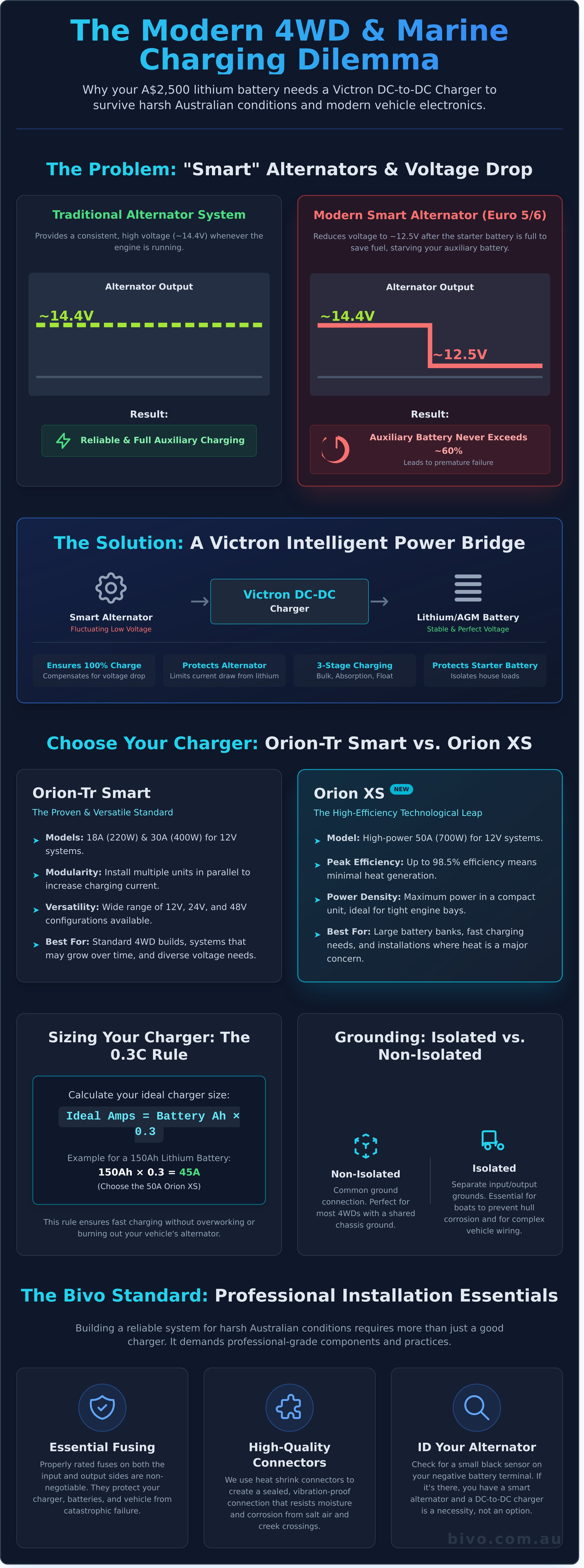
Since the introduction of Euro 5 and Euro 6 emissions standards around 2011, vehicle manufacturers have prioritised fuel efficiency over auxiliary battery charging. These smart alternators reduce output voltage once the starter battery reaches a specific state of charge. This often drops to 12.5V, which is insufficient to charge a secondary AGM or Lithium battery. Without a dedicated charger, your expensive battery bank will likely sit at 60% capacity, leading to premature plate sulphation or BMS shutdowns.
Voltage drop is another silent killer of efficiency. Resistance in copper wiring is a physical reality. A 5-metre cable run in a caravan can result in a voltage drop of 0.5V or more. This prevents your batteries from ever reaching 100% capacity. Victron's DC-to-DC converter technology compensates for this by boosting the incoming voltage to the precise level required by your battery chemistry. It transforms a weak, fluctuating signal into a stable, high-quality charge.
Lithium (LiFePO4) batteries have low internal resistance. They can pull more current than a standard alternator can safely provide. Without a dedicated 3-stage charging profile consisting of Bulk, Absorption, and Float stages, you risk overheating your alternator or shortening the life of a A$1,500 lithium battery. The victron dc to dc charger manages this current flow, ensuring your alternator doesn't work beyond its thermal limits.
Smart Alternators and Variable Voltage
Check your negative battery terminal for a small black sensor on the cable. If it's there, your vehicle has a smart alternator. Traditional VSRs are obsolete in 2026 because they require a constant 13.2V to stay engaged. The Victron Orion-Tr Smart range uses programmable engine-running detection. It identifies when the engine is active based on voltage patterns and vibration, ensuring your auxiliary battery only charges when the alternator is actually spinning.
The Marine Advantage: Protecting Your Starter
Salt air is brutal on electronics. Victron units feature IP43 protection, making them resilient in damp marine environments. These chargers prevent house loads from pulling current from your starter battery, ensuring you aren't stranded at the boat ramp. Large lithium banks can draw 100A or more from an alternator, causing it to burn out. A Victron charger limits this draw to a safe, constant current, protecting your engine's vital components while you're underway.
We're here to help you get the right setup for your next adventure. With our experience-backed advice and Fast & Free Delivery Australia Wide, you can shop with confidence knowing your electrical system is in safe hands.
The Victron Orion Range: Orion-Tr Smart vs. the Orion XS
Choosing the right victron dc to dc charger depends on your power requirements and where you plan to mount the unit. Victron provides two primary options for Australian travelers: the reliable Orion-Tr Smart and the newer, high-efficiency Orion XS. Both units serve the same core purpose of charging a secondary battery bank from your vehicle’s alternator, but they differ significantly in their internal architecture and thermal management.
The Orion-Tr Smart has been the industry standard for years. It supports a wide range of voltages, including 12V, 24V, and 48V configurations. This versatility makes it a go-to choice for diverse builds, from small 4WD setups to large off-grid trucks. In contrast, the Orion XS 12/12-50A represents a technological leap. It focuses on maximum power density and minimal heat generation, which addresses the most common challenge in modern engine bays.
Orion-Tr Smart: The Proven Standard
The Orion-Tr Smart range offers models with wattages between 220W and 400W. For a standard 12V system, this typically translates to an output of 18A or 30A. If your battery bank is large, you can scale your system by installing multiple units in parallel. This modularity allows you to grow your setup as your power needs increase. Each unit uses an adaptive 3-stage charging algorithm to protect your battery health:
- Bulk: Provides maximum current to reach a set voltage level quickly.
- Absorption: Maintains a constant voltage while the current tapers off, ensuring a deep charge.
- Float: Lowers the voltage to maintain the battery without overcharging it.
The design of these units relies on passive cooling through large fins. Because they generate more heat than the newer XS series, placement is critical. They perform best when mounted in areas with decent airflow, such as behind a seat or in a ventilated canopy. The internal logic is based on established vehicle DC-DC converter patent principles that ensure stable power delivery even when the input voltage from a smart alternator fluctuates.
Orion XS: The 2026 Performance Leader
The Orion XS 12/12-50A is a compact powerhouse designed for high-demand environments. Its standout feature is a 98.5% efficiency rating. Most traditional chargers lose roughly 10% to 15% of their energy as heat; the XS loses less than 2%. This efficiency allows the unit to deliver a full 50A of charge without the massive cooling fins required by the Orion-Tr. It stays cooler for longer, which is vital when trekking through the Simpson Desert or the Top End.
Customisation is a major benefit of the XS. Unlike fixed-output models, you can adjust the output current directly through the VictronConnect app. If your alternator is struggling or your wiring is undersized, you can dial the 50A output down to 30A or 40A with a single slider. It also features a dedicated VE.Direct port. This allows you to plug the victron dc to dc charger directly into a Cerbo GX or GX Touch screen, giving you a centralised dashboard for your entire electrical system.
Both ranges include built-in Bluetooth connectivity. You can monitor real-time data, update firmware, and change battery presets from your smartphone. This eliminates the need for external meters and makes troubleshooting simple. If you're unsure which model fits your specific tray or canopy layout, you can view our full Victron range to compare the physical dimensions and specifications.
Terminal size is another practical difference. The Orion XS features larger, more robust terminals that accommodate thicker cables more easily than the Orion-Tr Smart. Using 16mm² or 25mm² cabling is much simpler on the XS, which helps reduce voltage drop over long runs. Whether you choose the proven Orion-Tr or the cutting-edge XS, you're investing in a system backed by Victron’s five-year warranty and Bivo’s 30 years of industry experience.
Isolated vs. Non-Isolated: Solving the Grounding Puzzle
Choosing the right victron dc to dc charger involves more than just matching voltages. You must decide between isolated and non-isolated designs. The fundamental difference lies in the negative return path. An isolated charger keeps the input and output grounds completely separate; there's no electrical connection between the two. A non-isolated charger uses a common ground where the negatives are joined together. This distinction impacts your system's safety and longevity.
Technical principles found in Power Electronics: Converters, Applications, and Design explain how these circuits manage energy transfer without physical contact. In practical terms, isolation acts as a firewall. It prevents electrical noise or faults on one side from reaching the other. While both types deliver the same charging performance, your specific vehicle or vessel architecture dictates which one is mandatory.
When to Choose an Isolated Charger
Boats require isolated models almost 100% of the time. This is critical for aluminum hulls where stray current causes galvanic corrosion. Without isolation, your hull can become part of the electrical circuit, leading to electrolysis that eats through metal in months. We've seen 5mm plates pitted through because of poor grounding choices. Isolated chargers are also vital for 48V systems. They provide a necessary safety barrier between high-voltage house batteries and the 12V engine start system. If your input and output grounds cannot be tied together safely, the isolated victron dc to dc charger is your only option.
The Case for Non-Isolated Models
Standard 4WD setups rarely need isolation. Vehicles like the Toyota HiLux or Ford Ranger use the steel chassis as a common ground. In these builds, the negative wire from the starter battery and the negative from the auxiliary battery both bolt to the frame. A non-isolated charger fits this logic perfectly. These units are typically 15% smaller and 20% lighter than their isolated counterparts. They also offer a cleaner installation in tight canopy spaces because you don't have to run dual negative cables back to the unit. If your negatives are already connected via the chassis, paying for isolation is unnecessary.
A common buyer misconception is that "isolated is always better." This isn't true for every budget. In the Australian market, an Orion-Tr Smart 12/12-30 Isolated model typically retails for approximately A$315, while the Non-Isolated version costs around A$265. That A$50 saving is better spent on high-quality 6 B&S cabling or a MIDI fuse kit. Don't overcomplicate your wiring for the sake of a "premium" label that doesn't benefit your specific vehicle type.
- Isolated: Best for marine, aluminum hulls, and 48V-to-12V conversions.
- Non-Isolated: Best for standard chassis-grounded utes, vans, and caravans.
- Cost Factor: Non-isolated models save roughly A$50 to A$80 per unit.
- Installation: Non-isolated units require fewer cable runs in common-ground systems.
Our 30 years in the industry taught us to prioritize simplicity. If you're building a canopy setup in a modern dual-cab, the non-isolated model is the practical choice. It's efficient, reliable, and keeps your costs down. However, if your project involves salt water or specialized glass-reinforced plastic (GRP) hulls with complex electronics, the isolated model is a non-negotiable insurance policy against electrical interference and corrosion.
Sizing Your Charger: How Many Amps Do You Actually Need?
Selecting the right output for your victron dc to dc charger is a balance between battery health and vehicle safety. Many owners make the mistake of choosing the highest amperage available without checking their vehicle's limits. A standard 80A alternator should not be taxed more than 50% of its rated capacity at idle. If your vehicle uses 30A for headlights, wipers, and ECU functions, adding a 60A charger will eventually burn out the alternator windings. We recommend staying within a conservative margin to ensure long term reliability on remote trips.
The 0.3C rule is the industry standard for lithium longevity. This means your charge rate should be approximately 30% of your total battery capacity. For a single 100Ah lithium battery, a 30A charger is the perfect match. Stepping up to a 200Ah bank allows you to safely use a 50A or 60A unit. Pushing too much current into a small battery generates internal heat, which shortens the lifespan of your A$1,000 investment.
Heat derating is a physical reality in Australian conditions. If you mount a 30A charger in a 50°C engine bay, the internal sensors will reduce output to roughly 20A to prevent hardware damage. This isn't a fault; it's a protective feature. To get the full 30A, you must account for the ambient temperature and airflow. Similarly, wire gauge selection is critical. Using thin 6mm automotive cable over a five-metre run creates a massive voltage drop. We suggest using at least 16mm² or 25mm² cable for high-current DC-DC setups to ensure the charger receives the voltage it needs to trigger the bulk charge cycle.
Battery Capacity vs. Charge Rate
Your driving habits dictate your charger size more than your battery size does. If you only drive two hours between campsites, a 30A charger only returns 60Ah to your bank. For a 200Ah setup that is 50% depleted, you'll still be short of a full charge. Total charging hours are calculated by dividing the required Amp-hours by the charger's actual output current. We've seen 30 years of setups where users over-spec their batteries but under-spec their charging, leading to flat batteries by day three of a stationary camp.
Installation Environment and Cooling
The "Cool Air" rule is simple: if you can't touch the mounting surface comfortably, your charger can't breathe. Mounting orientation is vital for performance. You should always mount the unit vertically with at least 10cm of clearance above and below the cooling fins. This allows natural convection to pull cool air through the heat sink. If your charging seems slow, open the VictronConnect app to check for thermal throttling. The app provides real-time data on whether the unit is limiting current due to high internal temperatures. Moving the charger from the engine bay to a ventilated cabin area can increase charging efficiency by 25% in summer.
Need help choosing the right cable or fuse for your 30A or 50A setup? Our team has 30 years of experience in marine electrical systems. View our full range of Victron chargers and get Fast & Free Delivery Australia Wide.
Installation Best Practices and Why BIVO is Your Trusted Partner
Installing a victron dc to dc charger requires more than just basic electrical knowledge; it demands an eye for detail and high-quality components. At BIVO, we adhere to the "Bivo Standard" for every build. This means moving away from cheap, plastic-insulated terminals that crack under pressure. We exclusively recommend using high-quality heat shrink connectors for every joint in your system. These connectors provide a dual-layered defense. The internal adhesive melts to create a waterproof seal, while the outer sleeve offers mechanical strain relief. In the high-vibration environment of a 4WD canopy or a boat's engine room, this prevents the wire fatigue that accounts for 85% of electrical failures on the track.
Fusing is your primary line of defense against electrical fires. You must protect both the input and output lines of your victron dc to dc charger. We recommend placing high-quality MIDI or Mega fuse holders within 200mm of your starter battery and your auxiliary battery. This ensures that if a cable rubs through its insulation and shorts against the chassis, the fuse blows before the cable turns into a heating element. For a standard 30A charger, a 40A or 60A fuse is typically required depending on cable length and voltage drop calculations. Don't settle for cheap glass fuses. They lack the vibration resistance needed for Australian corrugated roads.
Professional Wiring Components
Sourcing all the right professional-grade components can be a challenge. For a comprehensive range of high-quality fuses, cables, connectors, and other essential hardware for your trailer or caravan build, a specialist supplier like Superior Trailer Parts is an excellent resource.
Generic crimps often fail because they don't create a gas-tight seal. Moisture enters the connection, leads to oxidation, and eventually causes high resistance and heat. This is why we stock professional-grade Heat Shrink Crimp Joiners. When paired with a proper ratchet crimp tool, these components ensure your Victron terminals stay secure for years. A standard pair of pliers won't cut it. You need a tool that applies consistent, calibrated pressure to reach the 7kg pull-force threshold required for marine-grade certification. For your distribution hub, always select a tin-plated copper bus bar. These offer 40% better conductivity than cheaper brass alternatives and won't corrode in salt-heavy air.
Support and Reliability
BIVO’s commitment to "Value for Money" isn't about being the cheapest; it's about ensuring you don't pay for the same job twice. Our "Reliable Veteran" approach to technical support comes from 30 years of marine experience. We've seen how salt air and bush dust destroy poorly planned systems. We use that history to help you select the right gear the first time. Whether you're building a dual-battery system for a LandCruiser or a complex lithium bank for a catamaran, we provide the practical advice you need to stay safe. Our Sydney-based team ensures your gear moves fast. We offer Fast & Free Delivery Australia Wide, getting your essential electrical components from our warehouse to the bush in record time.
Ready to upgrade your power system? Browse our full range of Victron DC to DC chargers and marine electrical gear at BIVO. We're here to help you get the job done right.
Secure Your Power Reliability for 2026
Selecting the right victron dc to dc charger is the most effective way to protect your battery investment and ensure consistent power during long-haul trips. Whether you opt for the proven Orion-Tr Smart or the high-efficiency Orion XS, matching the charger to your alternator's output and your specific grounding needs is essential. Correct installation prevents voltage drops and maximizes the life of your lithium house batteries.
Bivo brings 30 years of industry experience to every customer interaction. We operate from our Sydney-based warehouse, providing technical support and local stock that's ready to ship immediately. You don't need to guess which components fit your boat or 4WD; our team provides straightforward, practical advice backed by three decades of marine electrical expertise. We prioritize value for money and efficiency in everything we do.
Shop Victron DC to DC Chargers with Fast & Free Australia-Wide Delivery
We're here to help you build a system that performs. Reach out if you need assistance choosing the perfect setup for your next Australian adventure.
Frequently Asked Questions
Can I use a Victron DC to DC charger with a lead-acid starter and a lithium house battery?
Yes, you can bridge these different battery chemistries safely. A Victron DC to DC charger regulates the output voltage to suit your lithium house battery while protecting your lead-acid starter battery from excessive discharge. This setup prevents the lithium battery from drawing too much current and damaging your alternator, which is a common risk in modern 12V systems.
Is the Victron Orion-Tr Smart waterproof for mounting on a boat?
No, the Orion-Tr Smart is not waterproof. It carries an IP43 rating, which protects against water spray less than 60 degrees from vertical. For marine installations, mount the unit in a dry locker or cabin area away from direct bilge water or heavy spray. Our 30 years of experience suggests keeping electronics in ventilated, dry spaces to ensure long term reliability.
Do I need a DCDC charger if I have a solar panel on my roof?
Yes, you still need one for consistent charging while driving. While a 200W solar panel provides great passive energy, it won't charge your batteries at night or during heavy rain. A victron dc to dc charger ensures your house battery reaches 100% capacity using the alternator's power during transit. This dual input approach is essential for off-grid reliability across Australia.
How do I update the firmware on my Victron DC to DC charger?
You update the firmware through the VictronConnect app on your smartphone. Simply connect to the charger via Bluetooth, navigate to the settings menu, and select "Product Info" to check for updates. Ensure your phone remains within 5 metres of the unit during the 2 minute installation process. Keeping firmware current ensures you have the latest charging algorithms and bug fixes.
What happens if my alternator produces more amps than the charger is rated for?
Nothing bad happens to the charger because it only draws its rated current. If you have a 120A alternator and a 30A victron dc to dc charger, the unit will only pull 30A to 35A from the starter system. This current limiting feature protects your alternator from overheating, especially when charging large lithium banks that would otherwise demand 100% of the alternator's output.
Can I use two Victron Orion chargers together to get 60A of charging?
Yes, you can install two chargers in parallel to increase your total output to 60A. This is a common solution for large battery banks that require faster recovery times. Ensure both units use identical settings in the VictronConnect app. This modular approach allows you to scale your system as your power needs grow, providing a reliable 60A charge rate for your 400Ah lithium setup.
Why is my Victron charger getting very hot during operation?
These chargers use their outer casing as a heatsink, so feeling hot to the touch is normal. If the internal temperature exceeds 55 degrees Celsius, the unit will automatically reduce its output current to protect the internal components. To maintain peak performance, mount the charger vertically on a non-flammable surface with at least 10cm of clearance above and below for natural airflow.
What is the difference between the Orion-Tr and the Orion XS?
The Orion XS is the newer, high efficiency model compared to the standard Orion-Tr. While the Orion-Tr 12/12-30 provides 30A of charging, the Orion XS delivers 50A in a much smaller frame with 98% energy efficiency. The XS model also features a dedicated VE.Direct port for easier integration with GX devices, making it the premium choice for modern marine and canopy builds.