

The constant cycle of buying and binning disposable batteries is a drain on your wallet and the environment. It’s a common frustration, but there is a smarter, more sustainable solution. Making the switch is a practical decision, yet navigating the market for rechargeable batteries Australia can feel unnecessarily complex. With terms like NiMH, Lithium-ion, and varying capacities, choosing the right power source for your specific needs is often a challenge.
This guide provides the clear, straightforward answers you need. We explain the essential differences between battery types and help you choose the correct capacity for any application, from high-drain cameras to low-use TV remotes. You will learn how to get the most value from your purchase and discover practical tips to maximise the charge cycles and overall lifespan of your investment.
It's time to power your devices reliably, save significant money in the long term, and make a more responsible choice. Consider this your complete, no-nonsense guide to finding the right rechargeable batteries for your gear.
Key Takeaways
- Calculate the true long-term cost of disposable vs. rechargeable batteries to see exactly how much you can save.
- Learn the simple, practical differences between battery types to make an informed choice without complex jargon.
- Match the battery to the device. Learn how to select the right rechargeable batteries Australia for high-drain electronics versus low-power items.
- Implement proper charging and storage practices to protect your investment and significantly extend battery lifespan.
Why Make the Switch to Rechargeable Batteries?
For any serious outdoor enthusiast or busy household, the question of disposable versus rechargeable batteries comes up often. While the initial cost of disposables is low, the long-term value is not. Making the switch is a practical decision that delivers significant savings, superior performance, and a much smaller environmental impact. When searching for quality rechargeable batteries Australia-wide, the benefits quickly become clear.
The Long-Term Cost Savings: A Simple Breakdown
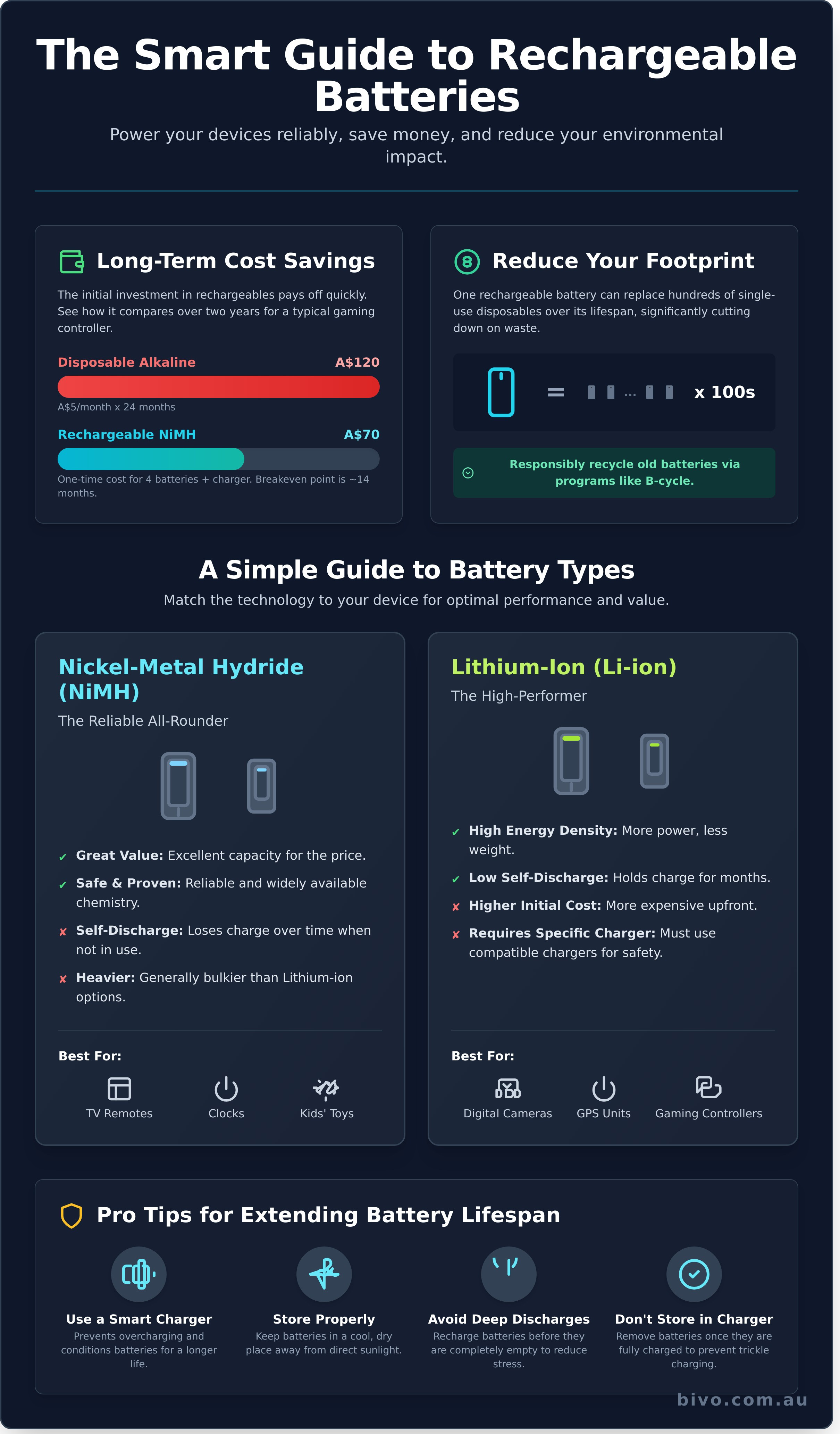
The maths is straightforward. Consider a typical household with gaming controllers that use four AA batteries, replaced monthly. With disposable alkaline batteries costing around A$15 for a 12-pack, you would spend A$60 per year. Over two years, that's A$120 spent on batteries destined for landfill.
In contrast, an initial investment in a set of four high-quality rechargeable AA batteries and a reliable charger is about A$70. Your break-even point is just over a year, after which your power is effectively free for hundreds of subsequent charge cycles. The long-term savings are undeniable.
Reducing Your Environmental Footprint in Australia
The environmental cost of single-use batteries is significant. According to Planet Ark, Australians dispose of thousands of tonnes of batteries in landfill each year, where they can leak harmful materials. One quality rechargeable battery can replace hundreds of disposables over its lifespan. This drastically cuts down on manufacturing, packaging, and shipping resources. When your rechargeables eventually reach the end of their life, they can be responsibly recycled through programs like B-cycle, available at many local retailers.
Beyond the cost and environmental benefits, modern rechargeables offer superior performance, especially in high-drain devices. The technology inside a modern Rechargeable battery, particularly NiMH (Nickel-Metal Hydride) types, maintains a more consistent voltage under load. This means your high-powered LED torch, digital camera, or GPS unit will run at peak performance for longer. Finally, there is the simple convenience of always having a fresh power source on hand. Just put them on the charger, and you're ready for the next adventure without a last-minute trip to the store.
A Simple Guide to Rechargeable Battery Types
Choosing the right battery can feel complex, but it comes down to matching the technology to the task. Before we dive in, let's clarify "capacity." Measured in milliamp-hours (mAh), capacity is a simple indicator of runtime. A battery with 2500mAh will last longer than one with 1000mAh in the same device. Understanding this helps you get the best value and performance. Here’s a practical breakdown of the most common battery types.
Nickel-Metal Hydride (NiMH): The Reliable All-Rounder
NiMH batteries are the dependable workhorses for most household devices. Found in common AA, AAA, and 9V sizes, they offer a straightforward and cost-effective way to move away from single-use batteries. They represent excellent value for money and are a safe, proven technology.
- Pros: Widely available, safe chemistry, and great capacity for the price.
- Cons: Can suffer from self-discharge (losing charge over time), and are generally heavier than lithium options.
- Best For: TV remotes, wireless keyboards, kids' toys, and digital cameras.
Lithium-Ion (Li-ion): High Power, Modern Performance
Lithium-Ion is the standard for high-performance electronics where weight and power matter most. From powerful headlamps to specialty 18650 cells for torches, Li-ion delivers superior performance. While more expensive upfront, their long lifespan and efficiency often pay off. When sourcing quality rechargeable batteries Australia-wide, Li-ion is the premium choice for demanding gear.
- Pros: High energy density (more power, less weight), very low self-discharge, and no "memory effect."
- Cons: Higher initial cost and require specific, compatible chargers to operate safely.
A popular modern format is the USB-rechargeable AA/AAA battery, which combines convenience with Li-ion performance.
Deep Cycle (AGM & Lithium): For Serious Power Needs
For adventures that require more than just powering a torch, you need a deep cycle battery. These are the heart of any 12V system in a boat, caravan, or off-grid setup. Their purpose is not a short burst of energy, but to provide sustained, reliable power over many hours.
Common types include AGM (Absorbent Glass Mat), which is a durable lead-acid variant, and deep cycle Lithium (LiFePO4), which offers significant weight savings and a longer lifespan. These are built for repeated discharging and recharging.
Choosing the right deep cycle battery is a critical decision. For detailed advice on marine electrical systems, we recommend viewing our specialist guides or contacting our team for assistance.
How to Choose the Right Rechargeable Battery for Your Needs
Choosing the right battery isn't about finding the most powerful option; it's about matching the power source to the task. A one-size-fits-all approach often leads to wasted money and poor performance. The key is to consider your device's power demand. A TV remote has very different needs from a high-powered headlamp used on a night passage. Understanding this difference ensures you get the best value and performance every time.
For High-Drain Electronics
High-drain devices are electronics that use power quickly and require a strong, consistent current. Think of digital cameras, powerful LED torches, gaming controllers, and RC hobbies. For these applications, standard batteries will fail quickly. We recommend high-capacity Lithium-ion (Li-ion) or low self-discharge (LSD) NiMH batteries to deliver the sustained power your equipment demands. Find powerful USB rechargeable batteries for your gear.
For Everyday Low-Drain Devices
Low-drain devices sip power slowly, often lasting for months. This includes TV remotes, wall clocks, wireless mice, and many small electronic toys. Using expensive, high-performance batteries here is unnecessary. Standard NiMH rechargeable batteries offer the most cost-effective solution, providing reliable power for household items without the premium price tag. Save your money for where performance truly matters.
For Marine & Outdoor Adventures
When you're offshore or deep in the bush, equipment failure is not an option. Your GPS, headlamp, and emergency safety equipment demand absolute reliability. For these critical tools, robust Li-ion batteries are the superior choice. They perform well in extreme temperatures and have a very low self-discharge rate, meaning they'll be ready when you need them most. When selecting rechargeable batteries Australia's harsh conditions demand quality you can trust.
Best Practices for Charging and Extending Battery Life
Purchasing quality rechargeable batteries is an investment. Proper care ensures you get maximum value and performance from your equipment. Following a few simple guidelines for charging and storage will significantly extend the life of your batteries, keeping your gear powered for years to come.
Smart Charging: Tips for Safety and Efficiency
Safe and efficient charging is the foundation of battery health. Always use the charger designed for your specific battery type and chemistry. Using an incompatible charger can lead to damage, poor performance, or safety hazards. We recommend a 'smart charger' that automatically stops when the battery is full, preventing the damaging effects of overcharging.
- Do: Use a compatible, quality charger for your battery type.
- Don't: Leave batteries in a basic charger indefinitely after they are full.
- Do: Remove batteries from the charger once charging is complete, unless using a smart charger with a maintenance mode.
- Don't: Mix different battery types, brands, or capacities in the same charging bay.
Proper Storage for Long-Term Health
How you store your batteries is just as important as how you charge them. For long-term storage (more than a month), avoid leaving them fully charged or completely drained, as both extremes stress the battery's internal components. Aim for a partial charge of around 40-60%. Store them in a cool, dry place away from direct sunlight and metal objects. A dedicated battery case is a small price to pay to prevent accidental short circuits.
Understanding Battery Lifespan (Charge Cycles)
The lifespan of a rechargeable battery is measured in 'charge cycles,' not just years. A charge cycle is one full discharge and recharge. Quality NiMH and Li-ion batteries are typically rated for 500 to 1,000 cycles. For most users powering cameras, GPS units, or torches, this translates to many years of reliable service. When you buy quality rechargeable batteries Australia-wide, you are investing in a durable power source that will outlast countless disposable cells.
With over 30 years in the industry, we've seen how proper care makes all the difference. If you need advice on the best charging solutions for your setup, explore our range. We're here to help you power your adventure.
Make the Smart Switch to Rechargeable Power
Making the switch to rechargeable batteries is a practical decision for both your budget and the environment. You now have the knowledge to distinguish between key battery types, select the right capacity for your devices, and apply best practices for charging to significantly extend their lifespan. This ensures you get consistent, reliable performance every time you power on.
When you're ready to invest in quality rechargeable batteries Australia, choosing a trusted specialist is essential. As a proud Australian-owned and operated business, BIVO brings over 30 years of hands-on industry expertise to every product we offer. We are committed to providing practical, dependable power solutions that deliver exceptional value and reliability, without the marketing fluff.
Ready to find the right solution for your needs? Shop our range of high-quality power solutions, backed by 30 years of experience.
Make the change today and enjoy the long-term savings and convenience of sustainable power. With our Fast & Free Delivery Australia Wide, upgrading your home, workshop, or outdoor gear has never been easier.
Frequently Asked Questions
Are rechargeable batteries really cheaper than disposables in the long run?
Yes, the value is significant over time. While the initial investment in a charger and a set of four quality rechargeable batteries might be around A$40-A$60, this one-time cost replaces hundreds of disposable batteries. A single pack of disposable AAs can cost A$10-A$15. By just the third or fourth cycle, your rechargeable set has already paid for itself, saving you a substantial amount of money throughout the life of the batteries.
How many times can you actually recharge a battery before it needs replacing?
The lifespan depends on the battery's chemistry and quality. A modern, high-quality NiMH (Nickel-Metal Hydride) battery can typically be recharged between 500 and 1000 times under optimal conditions. Performance will gradually decrease with age and use, but they provide years of reliable service. Investing in quality from the start ensures you get the maximum number of charge cycles and better overall performance for your devices.
Can I use rechargeable batteries in any device that takes standard disposable ones?
Almost any device. Rechargeable NiMH batteries work exceptionally well in high-drain devices like digital cameras, torches, and gaming controllers. However, their slightly lower voltage (1.2V vs 1.5V for alkaline) may cause issues in some low-drain electronics like smoke alarms or certain clocks, which are designed for the full 1.5V. For most common uses, they are a direct and superior replacement for single-use batteries.
What is the real difference between a NiMH and a Lithium-ion AA battery?
The key differences are voltage, capacity, and intended use. NiMH batteries have a 1.2V nominal voltage and are the standard, safe replacement for disposable AAs in most devices. Lithium-ion AAs often have a higher 1.5V or 3.7V, are lighter, and hold charge longer. However, their higher voltage may not be suitable for all electronics. For general-purpose use across Australia, NiMH offers the best combination of compatibility, safety, and value.
How should I safely dispose of old rechargeable batteries in Australia?
You must not place old batteries in your household rubbish or recycling bin, as they can cause fires and leak harmful chemicals. In Australia, you can take them to a designated B-cycle drop-off point. Major retailers like ALDI, Bunnings, Officeworks, and Woolworths have collection bins in-store. This ensures your old batteries are recycled safely, protecting the environment and recovering valuable materials.
Do rechargeable batteries lose their charge when not in use?
Yes, all batteries experience some level of self-discharge. However, modern technology has greatly reduced this issue. Look for "low self-discharge" (LSD) or "pre-charged" NiMH batteries. These advanced cells can retain up to 85% of their charge even after a full year in storage. This makes them a practical and reliable power source, ready to go whenever your adventure calls. Older types would lose their charge much faster.
What do I need to look for in a good quality battery charger?
A good charger protects your investment. Look for a "smart" or "intelligent" charger that analyses each battery individually. Key features include individual channel charging, automatic shut-off to prevent overcharging, and bad-cell detection. These features extend the life of your batteries and ensure a safe, efficient charge every time. Simple, cheap chargers can overcharge and damage your batteries, reducing their lifespan and costing you more in the long run.