

A flickering navigation light miles from shore. A dead bilge pump in a heavy swell. These are the moments every Australian boat owner dreads, and they often start with a single, failed electrical connection. Salt air and constant moisture are relentless enemies of your boat’s wiring, quickly turning cheap crimps into sources of corrosion and failure. It’s a frustrating cycle that costs you money and, more importantly, your peace of mind on the water.
The professional solution is a permanent, waterproof connection built to last. This is where a quality heat shrink solder connector proves its worth. This all-in-one technology solders, insulates, and seals your wiring in one simple action, creating an IP67-rated bond that resists vibration, salt, and moisture. No more awkward soldering in tight hulls or using connectors that just can't handle the conditions.
In this complete guide, we draw on our 30 years of industry experience to show you exactly how to master this technique. You will learn to create a clean, professional-grade wiring harness that won't let you down. It's time to wire your vessel for ultimate reliability.
Key Takeaways
- Understand why standard crimps fail in salty air and how to prevent moisture from destroying your boat's wiring.
- Discover how a quality heat shrink solder connector creates a waterproof, soldered, and strain-relieved join in one simple step.
- Compare the mechanical strength and long-term maintenance costs of solder versus traditional crimp connections for marine use.
- Master the correct installation technique for a permanent seal, from wire preparation to the professional "intermesh" method.
The Marine Wiring Challenge: Why Standard Connectors Fail
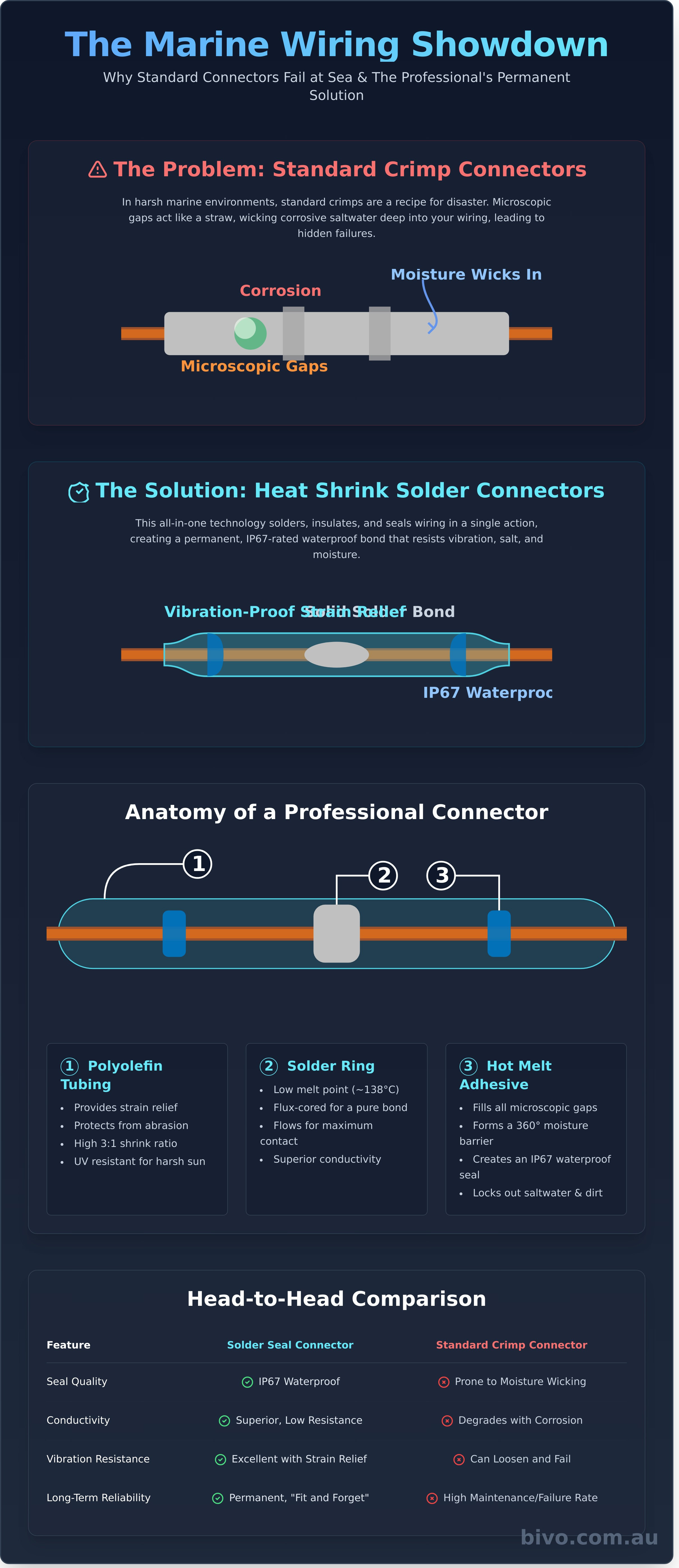
Marine wiring faces a relentless enemy: moisture. In a salt-rich environment, standard crimp-and-seal connectors often become the weakest link. The issue is capillary action, a process where microscopic gaps in the crimp act like a straw, wicking corrosive salt water deep into the copper strands of your wire. This happens silently, hidden beneath the insulation, leading to intermittent faults and frustrating failures that are difficult to trace.
A proper connection is not just about joining two wires; it's about creating a permanent, environmentally sealed splice. This is where the heat shrink solder connector excels, offering a 3-in-1 solution in a single component:
- Solder: Creates a superior electrical bond with minimal resistance.
- Sealant: A heat-activated adhesive lining forms an IP67-rated waterproof seal.
- Strain Relief: The tough outer tubing protects the joint from physical stress.
Modern marine electronics, from GPS and sonar to digital switching systems, are more sensitive than ever. They demand stable voltage and clean power, which is only possible with connections that offer the highest conductivity and lowest resistance. A standard crimp, once compromised by moisture, simply cannot deliver this level of performance.
Electrolytic Corrosion: The Silent Boat Killer
When salt water bridges the gap between the copper wire and a tinned terminal, it creates a galvanic cell-essentially a tiny, destructive battery. This electrolytic corrosion eats away at the metals, leaving behind the dreaded green or white crust that signals a high-resistance fault. A perfectly flowed solder joint eliminates this risk by creating a single, homogenous metallic bond. The adhesive lining in a modern solder sleeve then provides the final defence, creating an impenetrable barrier against any moisture.
Vibration vs. Rigidity in Marine Electrical Systems
It's a common myth that soldered joints are too rigid and will crack under vibration. While an unsupported solder joint can be a point of failure, the design of a solder sleeve connector masterfully solves this problem. The tough, cross-linked polyolefin Heat-shrink tubing extends well past the solder joint, providing exceptional mechanical strain relief. It acts as a built-in shock absorber, securing the wire and preventing flex at the critical junction point. This is vital on an offshore vessel, where vibration is constant and multi-directional-a far harsher reality than the conditions faced by a stationary vehicle.
Anatomy of a Professional Solder Seal Wire Connector
A quality connection depends on quality components. Not all solder seal connectors are created equal, and understanding what goes into a professional-grade product is the first step toward a reliable, long-lasting electrical repair. Each part is engineered to perform a specific function, working together to create a bond that is both mechanically strong and environmentally sealed.
The Science of the Solder Ring
The core of the technology is the precisely engineered, flux-cored solder ring. The flux is an essential cleaning agent that activates with heat, stripping away surface oxides from the copper wire to ensure a pure metallic bond. As the solder melts, it flows deep into the individual wire strands through capillary action. This process creates a solid, unified core with maximum surface area contact, delivering superior conductivity and pull-out strength. For a deeper look into the mechanics, expert sources provide excellent detail on How Solder Seal Connectors Work, confirming the efficiency of this design.
The ideal solder melts at a low temperature, approximately 138°C, to ensure a strong electrical bond without damaging the wire's insulation.
Polyolefin Tubing and Hot Melt Adhesive
The outer tubing of a heat shrink solder connector is more than just a cover. It is a dual-wall system designed for total protection.
- The Outer Shell: Made from tough, semi-rigid polyolefin, this layer provides excellent strain relief and protection against abrasion and vibration. A high shrink ratio, typically 3:1, ensures it conforms tightly over various wire sizes for a secure fit. For Australian conditions, high UV resistance is critical to prevent the tubing from becoming brittle under the harsh sun.
- The Inner Adhesive: Lining the inside is a ring of hot-melt adhesive. When heated, this glue liquefies and flows to fill any microscopic gaps, creating a 360-degree moisture barrier. Once cooled, it forms a complete, waterproof seal that locks out saltwater, dirt, and corrosion.
To ensure you select the correct size, connectors are universally colour-coded based on the wire gauge they accept. The standard is simple and effective:
- Red: Suits 22-18 AWG (0.5-1.0mm²) wire
- Blue: Suits 16-14 AWG (1.5-2.5mm²) wire
- Yellow: Suits 12-10 AWG (4.0-6.0mm²) wire
When installed correctly, this system achieves an IP67 waterproof rating. This certifies it as completely dust-tight and capable of withstanding immersion in one metre of water for 30 minutes. For critical marine wiring in bilges, on decks, or under trailers, this level of protection is not a luxury-it is a necessity.
Solder vs. Crimp: Choosing the Right Marine Joiner
The debate between soldering and crimping wires on a boat is as old as marine electronics. The truth is, both methods have a place. A high-quality crimp provides excellent mechanical strength, while a heat shrink solder connector offers superior electrical conductivity and a fully sealed defence against corrosion. The best choice depends entirely on the job at hand.
When comparing the two, consider these key factors:
- Mechanical Strength: A properly executed crimp from a quality ratchet tool creates a cold weld that is incredibly strong against pull-outs. Solder provides a strong bond, but it can become brittle under constant, severe vibration if not properly supported with strain relief.
- Installation vs. Maintenance: Crimping is generally faster per connection. However, a single failed crimp in a critical system can lead to costly and time-consuming fault finding later. The slightly longer time taken to apply heat to a solder seal can be a sound investment in long-term reliability.
- Tool Requirements: A professional ratchet crimper can cost anywhere from A$50 to A$150, while a basic butane torch or electric heat gun is often more affordable and versatile for other onboard jobs.
The Reliability Factor
For wiring in hard-to-reach or high-moisture areas, many trade professionals now prefer solder seal connectors. A common point of failure for crimps is improper tool use, leading to a connection that looks secure but fails under vibration. With a solder seal, you can visually confirm the solder has flowed correctly, creating a solid, void-free join. While some standards, like the ABYC recommendations on solder connectors, advise against solder as the sole means of mechanical connection, the environmental seal provided is second to none.
Consider the wiring for a bilge pump-a critical safety component in the wettest part of the boat. A standard crimp, even with a heat shrink cover, can trap moisture and corrode. A solder seal creates a fully waterproof, encapsulated connection that resists both vibration and corrosion, making it the superior choice for reliability in harsh conditions.
Space and Weight Considerations
Modern boats are packed with electronics, and space inside conduits is at a premium. Solder connectors have a much slimmer profile than bulky insulated crimps, reducing the size of multi-wire harnesses. This is especially useful when installing modern MFDs that require numerous connections in a tight space behind the helm.
While a heat shrink solder connector is ideal for in-line splices, many terminals still require a mechanical crimp. For connecting to bus bars or switches, a high-pressure crimp is essential. For those jobs, you can check out our Ratchet Crimp Tools for terminals that still require mechanical pressure.
Step-by-Step Guide: How to Install Heat Shrink Solder Connectors
A reliable electrical connection is non-negotiable, especially in marine environments. Following the correct installation procedure for a heat shrink solder connector ensures a durable, waterproof joint that will last. With over 30 years in the industry, we know that technique is just as important as the product itself. Here is our practical, no-nonsense guide.
- 1. Preparation: Strip approximately 8-10mm of insulation from each wire end. Be careful not to nick the copper strands. Select the correct colour-coded connector for your wire gauge. A connector that is too large will not create a proper seal.
- 2. The "Intermesh" Technique: Slide the connector onto one of the wires. Instead of simply twisting the wires together, push the two exposed ends into each other, intermeshing the individual strands. This creates a stronger mechanical bond and better electrical contact. Slide the connector back over the join, ensuring the solder ring is directly over the copper.
- 3. Heating Strategy: Apply heat to the centre of the connector first. Focus on the solder ring until it completely liquefies and flows into the wire strands. Once the solder has flowed, move the heat outwards to shrink the tubing and melt the adhesive rings at each end. This sequence pushes air out and creates a perfect waterproof seal.
- 4. Visual Verification: A successful joint is easy to spot. The solder will appear as a solid, shiny silver band that has fully penetrated the copper strands. The coloured tubing will be tightly shrunk, and you should see a small, clear ring of adhesive sealant pushed out at both ends.
- 5. Cooling and Testing: Allow the connection to cool completely for at least 60 seconds. Do not apply force while it is still warm. Once cool, give the wires a firm tug to confirm the joint is secure.
Tools of the Trade: Heat Guns vs. Butane Torches
For professional and consistent results, a quality heat gun with a deflector nozzle is the best tool. It provides even, indirect heat that prevents scorching. Avoid using butane torches or lighters; their open flame can deposit soot, burn the insulation, and create hot spots that ruin the joint. In Australian workshops, a temperature setting between 350°C and 400°C provides the control needed for a perfect connection every time. Ensure you have the right tools for the job; we stock a full range of professional-grade supplies at bivo.com.au.
For those building a comprehensive DIY toolkit, online retailers like Klevaro also offer a wide selection of heat guns, wire strippers, and other home improvement essentials.
Common Mistakes to Avoid
Getting it right the first time saves time and money. Watch out for these common errors:
- Overheating: If the tubing turns dark brown or smells burnt, you have applied too much heat. This makes the plastic brittle and compromises the waterproof seal.
- Incorrect Sizing: Using a connector that is too large for the wire gauge is a critical failure. The tubing will not shrink enough to grip the wire insulation, allowing moisture and corrosion to enter.
- Incomplete Solder Flow: If the solder ring melts but doesn't flow into the wire strands, the electrical connection is weak. Ensure you hold the heat on the solder long enough for it to fully liquefy and penetrate the copper.
The BIVO Advantage: Quality Marine Connectors for 2026
Proper technique is only half the battle; the quality of your components is critical for long-term electrical safety on the water. A faulty connection isn’t just an inconvenience-it can be a serious hazard. With over 30 years of direct experience in the Australian marine industry, BIVO understands the harsh conditions your boat faces. We supply marine electrical gear that is built to last, providing reliable, waterproof connections that won't fail when you need them most.
For any boater, our BIVO 100 Mixed Pack is an essential part of a well-stocked tool kit. It contains four standard sizes (White, Red, Blue, and Yellow) to handle common wire gauges from 26 to 10 AWG. It's the perfect, value-for-money solution for wiring navigation lights, bilge pumps, fish finders, and other onboard electronics. Based in Sydney, we get your gear to your dock quickly.
Fast & Free Delivery Australia Wide.
Bulk Savings for Trade Partners
We are committed to supporting Australian marine businesses with quality products and expert advice. If you are a boat builder, marine electrician, or operate a repair workshop, our trade program is designed for you. Benefits include:
- Exclusive wholesale pricing on marine electrical components.
- Customised packs tailored to your specific boat building or repair projects.
- Direct access to expert support for technical specifications. We're here to help you.
The BIVO Quality Guarantee
We stake our reputation on the quality of our products. Every BIVO heat shrink solder connector is sourced for performance, using high-grade polyolefin tubing with an excellent shrink ratio for a tighter seal. The precisely measured ring of low-temperature, high-flux solder ensures a strong, conductive connection without damaging the wires.
Each type of heat shrink solder connector we stock is rigorously tested to perform in the demanding Australian environment. Our connectors are proven to resist saltwater corrosion, UV degradation, and mechanical stress, guaranteeing a fully waterproof and durable splice that lasts season after season.
Don't compromise on your boat's electrical system. Choose the components trusted by Australian marine professionals for three decades. Shop the Heat Shrink Solder Connector 100 Mixed Pack Today.
Finalise Your Marine Wiring with Confidence
The marine environment demands electrical connections that are strong, waterproof, and durable. As we've seen, standard connectors often fall short, leaving your vessel vulnerable to corrosion and failure. A professional-grade heat shrink solder connector provides an all-in-one solution, creating a soldered, sealed, and strain-relieved join that stands up to the harshest conditions. Proper installation is straightforward and ensures a permanent, reliable fix for your critical systems.
With over 30 years of industry experience, BIVO is the trusted choice for Australian marine trade professionals. We provide quality components that deliver lasting value. Don't let faulty wiring cut your time on the water short. Upgrade your boat wiring with BIVO’s Professional Solder Connectors and enjoy Fast & Free Delivery Australia Wide.
Invest in the right components today for a safer, more reliable vessel tomorrow. Your boat deserves the best protection.
Frequently Asked Questions
Are heat shrink solder connectors better than crimping?
Both methods have their place. Solder connectors provide a soldered joint and a waterproof seal in one action, which is excellent for marine environments where preventing moisture ingress is critical. Crimping offers a strong mechanical connection and is often faster. For long-term reliability in wet or corrosive conditions, a properly installed heat shrink solder connector is generally the superior choice for protecting your wiring.
Do I need a special tool to use solder seal wire connectors?
A quality heat gun is the best tool for the job. It delivers consistent, even heat to melt the solder and shrink the tubing without burning the wire insulation. While a small butane torch can work if used with extreme care, it can easily overheat the connector. A heat gun provides the control needed for a professional, reliable, and secure connection every time. We do not recommend using an open flame like a lighter.
Can I use these connectors for 240V AC house wiring?
No. Absolutely not. These connectors are designed for low-voltage DC systems, such as those found in vehicles, boats, and electronics. All 240V mains wiring in Australia must be completed by a licensed electrician and adhere to strict Australian Standards (AS/NZS 3000). Using these connectors for household wiring is non-compliant, extremely dangerous, and poses a significant fire and electrocution risk.
How do I know if the solder has properly melted?
The transparent tubing allows for easy inspection. As you apply heat, you will see the silver-coloured solder ring liquefy and flow. A successful connection is made when the solder has completely flowed into and visibly "wetted" the copper strands of the wires. Once the solder has flowed and the adhesive-lined tubing has fully shrunk around the wire, the connection is secure and sealed.
Are these connectors truly waterproof for underwater use?
When heated correctly, the adhesive lining inside the tubing melts and creates a strong waterproof seal. This makes them ideal for marine applications like bilge pumps and trailer lights where they are exposed to water, salt spray, and moisture. While they are suitable for temporary or shallow immersion, for applications involving permanent deep submersion, we recommend consulting the product's specific IP rating for suitability.
What size connector do I need for standard marine wire?
You must match the connector to your wire gauge or cross-sectional area (mm²). Check the specifications printed on your wire’s insulation. For example, common 4mm² tinned marine cable typically uses the blue connectors (rated for 1.5-2.5mm² / 16-14 AWG). Using the wrong size will result in a poor electrical connection and an ineffective seal. Always check the wire and connector specifications.
Can I use a hair dryer to shrink these connectors?
No, a standard hair dryer does not produce enough heat. The solder inside the connector requires a temperature of around 138°C to melt and flow correctly. A hair dryer will not reach this temperature. It may partially shrink the outer tube, but it will fail to create the essential soldered electrical connection, resulting in a joint that will eventually fail. A heat gun is required for a proper installation.
What happens if I overheat the connector?
Overheating can cause significant damage. The transparent tubing can burn or melt, which compromises its strength and the integrity of the waterproof seal. More importantly, excessive heat can travel down the wire and damage its insulation, making it brittle and prone to cracking. Always keep the heat gun moving and apply heat evenly to avoid damaging the connector or the wire itself.