

You’re five kilometres offshore when your fishfinder starts flickering and the VHF radio cuts out just as the swell picks up. This isn't just bad luck; it’s often the result of a single corroded connection hidden within a "spaghetti" mess of tangled wires. We agree that your 12V system should be the most reliable part of your vessel, not a source of constant frustration. Installing a high-quality marine bus bar is the most effective way to centralise your power and eliminate the voltage drops that plague unorganised boats.
At BIVO, we’ve spent 30 years helping boaties build electrical systems that stand up to the harsh Australian salt air. This guide will show you how to transform a cluttered battery box into a professional-grade electrical locker that delivers consistent power to every accessory. You’ll learn how to choose the correct amperage ratings and mount your hardware for maximum durability. We’re here to help you simplify your wiring so you can spend less time troubleshooting and more time on the water.
Key Takeaways
- Eliminate messy wiring by using a central hub to safely manage multiple power and ground connections.
- Select the right marine bus bar for your vessel by matching amperage ratings to your electrical load and allowing room for future upgrades.
- Stop the dangerous practice of terminal stacking to prevent overheating, melted battery posts, and potential electrical fires.
- Follow expert installation tips for Australian boaters, including optimal mounting locations and the use of corrosion-resistant tinned copper components.
- Rely on Bivo’s 30 years of industry experience to source heavy-duty, trade-quality electrical supplies that stand up to harsh marine environments.
What is a Marine Bus Bar and Why Does Your Boat Need One?
A bus bar is a solid metallic strip or bar, typically manufactured from tin-plated copper or brass, that serves as a central hub for electrical current. In a marine environment, it acts as a high-capacity junction point where multiple wires connect to a single power or ground source safely. Bivo has spent 30 years in the industry, and we have seen how a well-installed marine bus bar transforms a chaotic wiring loom into a professional, reliable system.
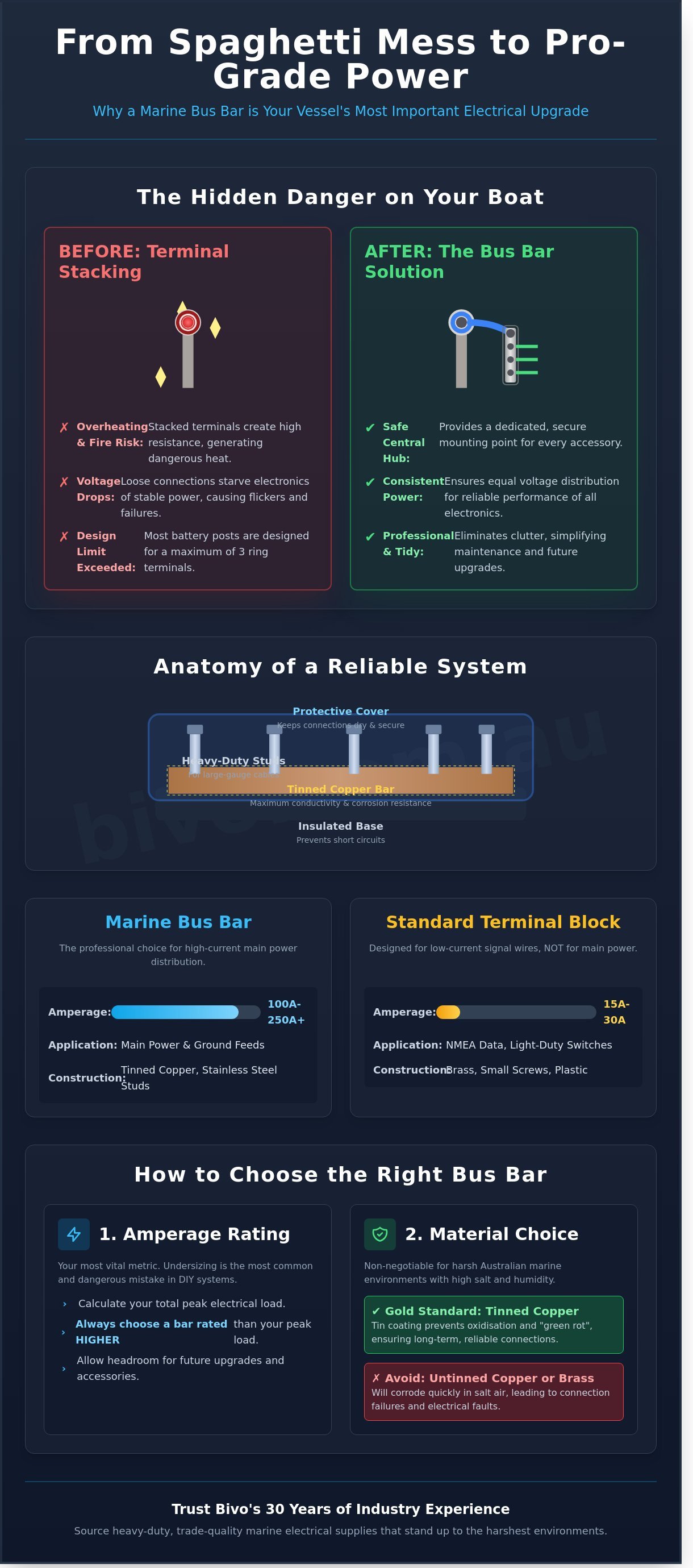
Reliability on the water is non-negotiable. Modern Australian vessels often run 8 to 15 separate electronic circuits, including high-draw items like fish finders, live well pumps, and LED light bars. Connecting every one of these directly to your battery terminals is a recipe for disaster. Most battery posts are designed to hold no more than 3 ring terminals. Attempting to stack 5 or 6 wires on a single terminal leads to loose connections, increased resistance, and potential fire hazards. A marine bus bar eliminates this risk by providing a dedicated mounting point for every accessory.
The physical layout of your boat’s electrical system benefits immediately from this hardware. By moving the connection point away from the battery, you reduce the physical clutter at the battery box. This makes it easier to inspect your batteries and perform routine maintenance. Industry experience shows that 80% of marine electrical failures are caused by corrosion or poor connections at the power source. Using a bus bar with a protective cover keeps your connections dry and secure, preventing the vibration-induced loosening that occurs during high-speed transit in choppy Australian swells.
The Role of a Bus Bar in Power Distribution
Think of the bus bar as the main distribution hub for your 12V or 24V system. It acts as a common point for either positive or negative (ground) connections, ensuring that every piece of gear receives a stable feed. When you wire multiple devices to a single bar, you create a path of least resistance. This setup is essential for maintaining consistent performance across all your gear, from your VHF radio to your fridge.
Voltage drop is a common enemy for boat owners. By using a heavy-duty bar, you ensure equal voltage distribution across all connected devices. This stability is vital for sensitive electronics like side-scan sonar units which can reboot if the voltage dips during engine cranking. Additionally, a bus bar simplifies future upgrades. If you decide to add a new underwater light or a secondary GPS unit next season, you simply crimp a ring terminal and bolt it to an empty spot on the bar rather than fighting with a crowded battery terminal.
Bus Bar vs. Standard Terminal Blocks
It's easy to confuse a bus bar with a standard terminal block, but the technical differences are significant. Standard terminal blocks or "barrier strips" are designed for low-current signal wires, often rated for only 15 to 30 Amps. They are perfect for NMEA 2000 data lines or light-duty switch panels. However, they cannot handle the heavy current loads required for main power distribution.
A quality marine bus bar is built for high-amperage applications, with common ratings ranging from 100A to 250A or higher. They feature heavy-duty stainless steel studs, usually 6mm or 8mm in diameter, which allow you to secure main power feeds using large-gauge battery cables. This robust construction ensures the bar can handle the heat generated by high-draw accessories without warping or failing. For any boat owner looking for value for money and long-term reliability, choosing a high-amp bus bar over a flimsy terminal strip is the only professional choice.
Choosing the Right Marine Bus Bar for Your Setup
Selecting the correct marine bus bar is a critical safety decision for any boat owner. It isn't just about tidying up wires; it's about managing electrical current without generating heat. Heat is the primary enemy of marine electronics and the leading cause of vessel fires. After 30 years in the industry, we've seen that undersized components are the most frequent point of failure in DIY electrical systems.
Amperage rating is your most vital metric. You must never undersize your bar. If your total potential load exceeds the bar's rating, the metal will heat up, causing the insulation on your cables to melt. This case study on busbar replacement highlights how replacing inadequate factory components with properly rated bars ensures long-term reliability. Always choose a bar rated higher than your calculated peak load.
Material choice is non-negotiable for Australian conditions. Our coastal environments are high-salt and high-humidity. Tinned copper is the gold standard because the tin coating prevents the copper from oxidising. Plain brass or untinned copper bars will develop "green rot" within months, leading to high resistance and connection failure. We recommend only using tinned copper for any marine bus bar installation in local waters.
Beyond specialized marine suppliers, it's often worth exploring providers of industrial automation components. These parts are typically built to withstand harsh factory environments, making them exceptionally durable for marine use. For Australian boaters, a supplier like instrodirect.com.au offers a wide range of genuine, high-grade electrical equipment that can meet or exceed marine specifications.
Calculating Your Amperage Requirements
To find your required rating, total the maximum current draw of every accessory connected to the bar. If you have a bilge pump drawing 10A, a fridge drawing 5A, and lighting drawing 10A, your total is 25A. You must apply a safety margin of at least 20% for continuous loads to prevent overheating. For main feeders coming off a battery bank, common ratings include 150A, 250A, or even 600A for heavy-duty setups. Most secondary distribution circuits perform well with a 100A or 150A rated bar.
Selecting Connection Stud Sizes
Matching the stud size to your cable lug is essential for a secure electrical bond. Standard marine sizes range from 4mm (M4) screws for small electronics up to 10mm (M10) studs for heavy battery cables. A loose connection creates resistance, which creates heat. Many modern bars now offer a "mix-and-match" configuration. These features include two large 8mm studs for the main feed and six smaller 4mm screws for individual branch circuits. This design keeps your wiring loom compact and professional.
Physical protection is the final consideration. You should always use covered bus bars for positive connections. An accidental drop of a spanner across an uncovered positive bar and a nearby ground will cause a dead short and immediate sparks. Protective insulating covers are a simple way to prevent these accidents. For negative or ground bars, covers are less critical but still help keep the terminals clean and free from physical damage. If you're unsure which configuration fits your hull, you can browse our range of heavy-duty bus bars to see the different stud and cover options available.
Don't just buy for the accessories you have today. Always select a bar with more connection points than you currently need. Adding a new GPS or a VHF radio in 12 months is much easier when you have two spare terminals ready to go. Planning for a 30% expansion capacity is a standard trade practice that saves you from ripping out and replacing your entire distribution block later.
The Danger of Terminal Stacking: Why Bus Bars are Safer
Terminal stacking occurs when a boat owner piles multiple ring terminals onto a single battery post or electrical stud. It is a shortcut that compromises the entire vessel. In our 30 years of industry experience, we have identified this practice as a leading cause of electrical fires and melted battery terminals on Australian boats. While it seems convenient to add just one more accessory wire to the battery, the physical reality of electricity makes this a dangerous gamble.
When you stack terminals, you create a tower of metal that is inherently unstable. The connection at the bottom of the pile must carry the current for every wire above it. If that bottom connection is even slightly loose, the electrical resistance spikes. This is not just a theoretical concern; we regularly see battery boxes where the plastic casing has literally melted away due to the heat generated by these poor connections.
How Resistance Leads to Heat and Fire
Poor contact between stacked lugs creates a bottleneck for current. Every additional terminal in the stack introduces a new layer of resistance. This resistance generates heat at the bottom of the stack where the load is highest. In a marine environment, moisture gets trapped between these stacked metal surfaces. This leads to internal corrosion that is invisible from the outside. Heat is the enemy of boat safety. When a connection reaches temperatures exceeding 100 degrees Celsius, insulation melts and fire risks become a reality.
A stacked connection is also mechanically unstable. As you add more terminals, the amount of thread remaining on the stud decreases. This makes it nearly impossible to tighten the nut to the required torque. Vibration from the engine or hull impact eventually loosens the connection. A loose connection is a high-resistance connection. This cycle of heat and loosening is why we recommend moving these connections to a dedicated marine bus bar.
The "Rule of Four" in Marine Electrical
Standard safety guidelines, such as the ABYC E-11 standards used by global experts, suggest no more than four terminals per stud. This is the absolute limit for a safe installation. However, professional installers in Australia prefer a maximum of two terminals for long-term reliability. Limiting the stack ensures that the nut has full thread engagement and the contact area remains large enough to handle the current without overheating.
If your setup requires connecting five or more wires to a single power source, a marine bus bar is the only professional solution. It provides a solid, flat surface for each terminal to make maximum contact. This layout allows for several key benefits:
- Clearer identification: You can see every circuit at a glance.
- Proper torque: You can apply the correct tension to every individual nut.
- Reduced strain: It removes the heavy weight of multiple cables from your battery terminals.
- Easier maintenance: Troubleshooting a single circuit doesn't require dismantling the whole stack.
Using a bus bar ensures your electrical system remains cool and efficient. It eliminates the messy cluster of wires that often clutters battery boxes. We have seen 100% of professionally wired offshore vessels move toward bus bar distribution to prevent avoidable failures at sea. This simple hardware upgrade protects your investment and your crew.
Installation Best Practices for Australian Boaters
Installing a marine bus bar correctly is the difference between a reliable vessel and a breakdown at sea. Saltwater environments are unforgiving. Over our 30 years in the industry, we've seen that 90% of onboard electrical failures stem from poor installation or creeping corrosion. You need a system that withstands the vibration of a hull hitting chop at 30 knots while resisting constant salt spray.
Select a mounting point at least 300mm above the highest bilge water line. Never mount your bus bar in the bilge or low-lying lockers where moisture pools. Aim for a dry, ventilated area like the back of a console or a dedicated electrical cupboard. Accessibility is vital for maintenance. If you can't reach the terminals with a spanner in under 30 seconds, the location is wrong. Ensure the mounting surface is non-conductive and rigid to prevent the bar from flexing under load.
Standard copper wire corrodes 5 times faster than tinned copper in saltwater. Always use high-quality tinned copper lugs to prevent electrolysis from eating your connections. Safety dictates that you must protect the main feed. Install a marine-grade circuit breaker within 175mm of the battery terminal to comply with safety standards. This protects the marine bus bar from a catastrophic short. Once the physical installation is complete, apply a lanolin-based or silicone anti-corrosion spray. This creates a hydrophobic barrier that stops salt air from reaching the metal surfaces. It's a simple step that adds years to the life of your electrical system.
Wiring and Crimping for Longevity
Reliable power depends on gas-tight connections. Don't use standard pliers for your lugs. Use a professional ratchet crimp tool to ensure the wire and lug become one solid piece of metal. Use 3:1 ratio adhesive-lined heat shrink on every terminal. When the glue oozes out the end, you know salt air is locked out. Label every wire. A simple wrap-around label prevents hours of frustration during future upgrades. We've found that clear labeling reduces troubleshooting time by 60% during emergency repairs.
Positive vs. Negative Bus Bar Placement
Physical separation prevents disaster. Mount your positive and negative bars at least 150mm apart to reduce the risk of a dropped tool creating a dead short. Use color-coded covers, red for positive and black for negative, to make the system intuitive. We recommend mounting bars vertically. This orientation ensures any condensation runs off the terminals instead of pooling around the base of the studs. It's a practical solution we've used for three decades to stop terminal rot in humid Australian climates.
Ready to upgrade your vessel's wiring? Browse our range of marine electrical supplies for trade-quality components delivered fast across Australia.
BIVO: Your Trusted Source for Marine Electrical Supplies
BIVO has served the Australian marine and outdoor industry for over 30 years. Since our start in 1994, we've focused on one thing: providing gear that doesn't fail when you're out on the water. We understand that a marine bus bar is the literal backbone of your boat's electrical system. If that component fails due to corrosion or poor conductivity, your entire electronics suite goes dark. That's why we specialise in a range of heavy duty bus bars and fuse holders designed for high-amperage loads and high-salt environments.
Logistics shouldn't slow down your project. We operate from a fully stocked Sydney warehouse to ensure Fast & Free Delivery Australia Wide. Most orders are processed and dispatched within 24 hours, meaning you spend less time waiting for parts and more time on the water. We don't just cater to DIY enthusiasts. We provide specialized trade and wholesale pricing for professional boat builders and marine electricians. If you're managing a commercial refit or building a new hull, our bulk rates ensure you maintain your margins without sacrificing component quality.
- 30+ years of technical experience in Australian marine conditions.
- Heavy duty, tin-plated copper bus bars for maximum conductivity.
- Fast & Free Delivery Australia Wide from our local Sydney hub.
- Dedicated support and wholesale accounts for industry professionals.
The BIVO Advantage: Quality and Value
The Australian sun and sea are notoriously harsh on electrical components. UV radiation and constant salt spray can perish standard automotive gear in months. At BIVO, we only stock components that survive these specific conditions. We've spent three decades testing products to ensure they meet the standards required for the Southern Ocean and the Top End. You won't find flimsy, unrated plastics in our catalogue. We prioritize tinned copper and reinforced bases because we know they last.
Expertise is part of the package. We’re here to help you get your wiring right. If you're unsure about the current rating for your marine bus bar or need advice on circuit protection, our team provides grounded, practical guidance. We act as a one-stop shop for your entire project. Beyond distribution blocks, we stock the essential tools and consumables needed for a professional finish. This includes high-ratio heat shrink, heavy duty crimpers, and marine-grade power distribution hubs. We aim to make your shopping experience pleasant and efficient.
Shop Our Popular Marine Electrical Range
Our inventory is curated for performance and space efficiency. One of our most popular items is the Fuse Holder Box with Negative Bus. It’s a perfect solution for compact center consoles or smaller vessels where space is at a premium. It integrates your positive fused circuits and your negative return path into a single, tidy unit. This reduces the "spaghetti" wiring often found behind dashboards and makes troubleshooting much faster.
For those focused on longevity, our Heat Shrink Crimp Joiners are essential. These aren't your standard hardware store connectors. They feature an adhesive-lined sleeve that melts when heated, creating a permanent, submersible seal. This prevents salt air from wicking up the wire strands, which is the leading cause of internal cable rot. You can view these products and the rest of our professional collection when you Shop Marine Electrical at BIVO. We've built our reputation on being a safe pair of hands for your boat's electrical needs.
Streamline Your Boat’s Electrical Setup Today
A clean electrical system is the backbone of a reliable vessel. By installing a high-quality marine bus bar, you eliminate the hazards of terminal stacking and ensure your 12V components receive consistent power. It's about safety on the water and making future maintenance simple. Whether you're a weekend angler or a professional shipwright, choosing components built for Australian conditions is non-negotiable. Poorly managed wiring leads to heat buildup and eventual system failure; getting it right the first time is essential for long-term peace of mind.
Bivo brings 30+ years of industry experience to every product we stock. We're trusted by trade and wholesale partners across the country because we deliver quality that lasts. You don't have to wait weeks for parts; we provide fast and free delivery Australia wide on every order. Our team understands the unique demands of the local marine environment and we're here to help you find the right solution for your specific boat layout. It's time to clear the clutter and build a system you can trust.
Upgrade your boat wiring with BIVO’s heavy-duty marine bus bars
We look forward to helping you get your vessel ready for your next adventure on the water.
Frequently Asked Questions
What is the difference between a bus bar and a terminal block?
A bus bar distributes power from a single source to multiple circuits through a common conductive strip. Terminal blocks usually connect individual wires to each other without sharing power across every point. For high-current applications on Australian vessels, a bus bar is the standard choice. It handles loads up to 600 Amps safely while maintaining a clean, professional layout.
Can I use a brass bus bar on my boat?
You should never use plain brass on your boat. Use tin-plated copper instead. Brass corrodes rapidly in salt air; this leads to high resistance and dangerous heat levels. Tin-plated copper meets AS/NZS 3004.2 standards and prevents the green oxidation that ruins electrical connections. It's a small investment that protects your vessel's reliability for its entire lifespan.
How many wires can I connect to one marine bus bar?
You should limit your connections to 4 terminals per stud to comply with Australian marine standards. Overloading a single stud on a marine bus bar creates excessive heat and makes maintenance difficult. If you have 12 circuits to connect, choose a bar with at least 12 individual screw terminals. This ensures every wire has a secure, low-resistance connection for your equipment.
Do I need a cover for my marine bus bar?
You must use an insulating cover to prevent accidental short circuits. Dropping a tool on an exposed positive bar can cause an immediate fire or battery explosion. Most high-quality bars come with a polycarbonate cover that meets ISO 10133 requirements. This simple safety feature protects your crew and your A$20,000 engine investment from preventable, high-cost electrical faults.
Where is the best place to mount a bus bar on a boat?
The best place to mount a bus bar is a dry, accessible location like a dedicated electrical locker. Keep it at least 500mm away from wet exhaust lines or bilge areas to avoid moisture ingress. We recommend mounting them on a vertical surface. This prevents water from pooling on the terminals and causing corrosion, ensuring your system stays reliable for decades.
Should I use a separate bus bar for my electronics and my engine?
Using a separate marine bus bar for sensitive electronics protects them from voltage spikes. Engines draw massive current during startup; this can drop voltage below 10V and reboot your GPS. Isolating your house loads from your starting circuit ensures your A$3,000 chartplotter stays powered. Our 30 years in the industry shows this is the best way to avoid equipment failure.
What happens if I undersize my marine bus bar?
Undersizing causes excessive heat and a voltage drop across your entire electrical system. A bar rated for 100 Amps carrying 150 Amps will reach temperatures exceeding 90 degrees Celsius. This melts wire insulation and creates a serious fire risk. Always choose a bar rated for 20% more than your maximum calculated load to keep your boat safe and efficient.