

Protecting the expensive electronics in your boat, 4x4, or caravan is non-negotiable. Yet, wiring a new accessory can feel overwhelming. Blade or glass fuse? What amp rating is safe? Choose the wrong components, and you risk more than just a blown fuse-you risk electrical fires and costly damage. A high-quality inline fuse holder is your first line of defence. It's a small part that plays a critical role in electrical safety, especially in harsh Australian conditions.
With over 30 years of experience in marine and auto electrical, we're here to help. This guide cuts through the confusion. We will show you exactly how to choose the correct fuse type, amp rating, and wire gauge for your project. You will gain the confidence to protect your investment and ensure your electrical system is safe, reliable, and built to last.
Key Takeaways
- An inline fuse holder is a non-negotiable safety device. It is your first line of defence against overcurrent damage to your valuable electronics.
- The type of fuse you use (e.g., Blade, MIDI) directly determines the style of holder you must select for a secure, reliable connection.
- Choosing the right inline fuse holder involves four key factors. We'll show you how to assess amperage, wire gauge, and environmental exposure.
- Avoid the common installation mistakes that lead to electrical faults. Learn pro-tips from our 30 years of industry experience to get the job done right.
What is an Inline Fuse Holder and Why Is It Essential for Safety?
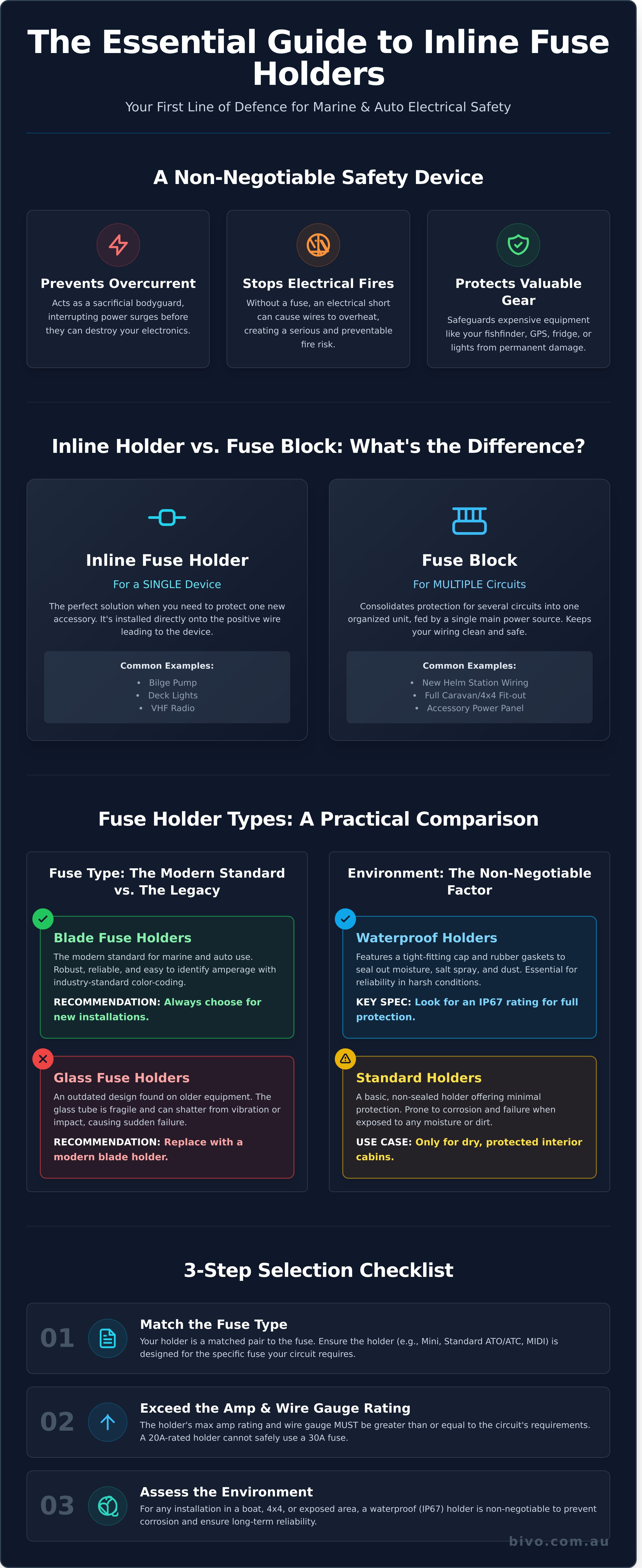
In any marine electrical system, safety is non-negotiable. An inline fuse holder is a simple yet critical safety device designed to protect a single electrical circuit. Think of it as a sacrificial bodyguard for your valuable electronics. Its primary job is to house a fuse, which interrupts the flow of electricity if an overcurrent or short circuit occurs.
Without this protection, a power surge could cause wires to overheat, creating a serious fire risk. It could also permanently damage expensive equipment like your fishfinder, GPS, or bilge pump. When adding any new accessory to your boat, installing an inline fuse holder on the positive wire is a fundamental step for safe and reliable operation.
Inline Fuse Holder vs. Fuse Block: What's the Difference?
Choosing between an inline holder and a fuse block depends on the scale of your project. An inline holder is perfect for protecting one device, like a new bilge pump or a set of deck lights. A fuse block, however, is designed to manage multiple circuits from a single power source. It's essentially several fuse holders consolidated into one convenient, organised unit. You would use a fuse block when wiring a new helm station with several different accessories.
The Anatomy of an Inline Fuse Holder
A standard inline fuse holder is made of three core components that work together to protect your circuit. Understanding them helps you choose a quality product that will last in the harsh marine environment.
- Housing: This is the protective outer case, usually made of plastic or rubber. Its job is to shield the fuse from moisture, salt spray, and physical damage. Waterproof or water-resistant housings are essential for boat installations.
- Terminals: Inside the housing are two metal terminals that grip the fuse. A secure connection here is vital for preventing voltage drop and heat buildup. If you're unsure about the basics of what is a fuse, it's a component designed to break the circuit safely when current exceeds a specific level.
- Wire Leads: These are the two short wires (or "pigtails") extending from the housing. You cut the positive wire of your circuit and connect these leads in line to complete the installation.
Types of Inline Fuse Holders: A Practical Comparison
Choosing the right inline fuse holder starts with understanding the fuse it needs to protect. The holder and the fuse are a matched pair; you cannot use a blade fuse in a glass fuse holder. For any new marine installation, your choice will almost always be a modern blade-style fuse holder, but it's important to recognise older types you might encounter.
Here is a practical breakdown of the most common options available in Australia.
Blade Fuse Holders (Standard, Mini, Micro)
Blade fuses are the modern standard for good reason. They are robust, easy to handle, and widely available. These holders are designed for specific blade fuse sizes: Standard (ATO/ATC), Mini (APM/ATM), and the less common Micro. Their key advantage is the industry-standard colour-coding system, which allows you to identify the amperage rating at a glance. This makes inspection and replacement simple and safe.
Glass Fuse Holders (AGC, SFE)
You may find these older, cylindrical-style holders on vintage equipment. While functional, the glass tube design is a significant weak point on a boat. Constant vibration or a minor impact can shatter the fuse, causing an unexpected circuit failure. For any new wiring project, we strongly recommend replacing older glass fuse holders with a modern, more reliable blade fuse alternative.
Waterproof vs. Standard Holders
A critical distinction for any marine application is whether the holder is waterproof. A standard automotive holder offers little protection against moisture, salt spray, and corrosion. A dedicated waterproof holder features a tight-fitting cap, rubber gaskets, and heavier-gauge insulated wire to create a sealed unit.
Look for an IP (Ingress Protection) rating, such as IP67, which means the holder is fully protected against dust and can be submerged in up to one metre of water. For any installation in a bilge, on deck, or under the bonnet, a waterproof holder is non-negotiable for long-term reliability.
Browse our range of waterproof marine fuse holders.
Quick Comparison Table
| Holder Type | Common Fuse Type | Best Use Case | Key Advantage |
|---|---|---|---|
| Blade (Mini/Standard) | ATM / ATC | New marine & auto installations | Durable, colour-coded, easy to find |
| Glass | AGC / SFE | Replacing like-for-like on old gear | Legacy compatibility |
| Waterproof Blade | ATM / ATC | Bilges, engine bays, exposed areas | Sealed against moisture & corrosion |
While this covers the most common types, specialty options like panel-mount holders for dashboards or high-current MEGA fuse holders for battery circuits also exist for specific, heavy-duty applications.
How to Select the Right Inline Fuse Holder: 4 Key Factors
Choosing the correct inline fuse holder is a critical safety decision. The right component protects your equipment, your wiring, and your vessel from electrical faults. A mismatch can lead to failure or even fire. This guide simplifies the selection process by focusing on the four factors that matter most: matching the holder to the device, the wire, and the marine environment.
1. Match the Amperage Rating
The holder's maximum amperage (amp) rating must be equal to or higher than the fuse it will contain. The fuse rating is determined by the electronic device it's protecting. Never use a 20-amp fuse in a holder rated for only 15 amps. Doing so can cause the holder to overheat and melt before the fuse blows, creating a serious hazard.
Pro Tip: Check your device's manual or data plate to confirm its specific amperage draw. This is the starting point for all calculations.
2. Choose the Correct Wire Gauge (AWG/B&S)
The wire gauge on your fuse holder must match the wire gauge of the circuit. Using a holder with thinner wire creates a bottleneck. This point of high resistance generates heat and is a significant fire risk. Always use quality marine-grade tinned copper wire for reliability.
As a general guide for 12V systems:
- Up to 10A: Use 16 B&S (1.3mm²) or thicker wire.
- 10A - 15A: Use 14 B&S (2.0mm²) or thicker wire.
- 15A - 20A: Use 12 B&S (3.3mm²) or thicker wire.
- 20A - 30A: Use 10 B&S (5.2mm²) or thicker wire.
3. Consider the Environment: The Importance of Durability
A boat is a demanding environment. Your fuse holder must withstand moisture, salt spray, and constant vibration. For marine use, select a holder with tin-plated copper contacts to prevent corrosion. A secure, waterproof cap is non-negotiable. While standard PVC insulation works, silicone offers superior flexibility and resistance to heat and chemicals found in engine bays.
4. Fuse Type and Availability
Practicality is key. Choose an inline fuse holder that accepts a common fuse type like ATC or ATO blade fuses. These are readily available at service stations and chandleries across Australia. Older glass-style fuses can be difficult to source, especially when you are in a remote location. Standardising your fuse types simplifies your onboard spares kit and ensures you can always find a replacement.
Need the right components for the job? We stock a comprehensive range of quality marine electrical supplies backed by 30 years of industry experience.
Common Mistakes to Avoid with Inline Fuse Holders
With over 30 years in the marine electrical industry, we've seen it all. A few common mistakes can turn a simple installation into a serious problem. Getting your inline fuse holder installation right is not just about performance; it's about safety. Avoid these critical errors to protect your boat, your equipment, and yourself. This advice will prepare you for a flawless installation.
Using the Wrong Fuse Amperage
This is the most dangerous mistake we see. The purpose of a fuse is to be the weakest link in a circuit. It's designed to protect the wire, not just the device. Using a fuse with a higher amperage rating than the wire can handle ("over-fusing") means that in a short circuit, the wire will melt and potentially catch fire long before the fuse ever blows. Always match your fuse rating to the wire gauge and the load requirements of the accessory.
Improper Installation and Poor Connections
On a boat, vibrations and moisture are constant enemies of electrical systems. A loose or poorly crimped connection creates high resistance, which generates heat and causes a voltage drop. This can lead to equipment failure or even a fire. Always use high-quality, marine-grade terminals, preferably with heat shrink insulation, to create a secure and waterproof seal. Crucially, the fuse holder must be installed as close to the power source (the battery) as possible to protect the entire length of the wire.
For a detailed walkthrough, see our complete guide on How to Install an Inline Fuse Holder on a Boat.
Choosing a Non-Waterproof Holder for a Wet Environment
Your boat is a wet environment. Your electrical components must be built for it. Using a standard automotive fuse holder might save you a few dollars initially, but it will fail. Salt spray and moisture will get inside, causing corrosion on the fuse contacts. This leads to intermittent power, voltage drops, and eventual failure-often when you need the equipment most.
An example of what happens when a non-waterproof fuse holder is used in a marine environment.
Spending a few extra dollars (A$) on a quality, marine-grade waterproof inline fuse holder is one of the smartest investments you can make for your boat's reliability. It provides peace of mind that your connections are protected from the elements.
Secure Your System with the Right Inline Fuse Holder
Choosing the correct inline fuse holder is a critical safety measure for any electrical circuit. Remember to always match the holder's amperage and wire gauge to your system's demands and select a type suited for the operating environment. Getting these details right is the key to preventing overcurrent damage and ensuring long-term reliability for your equipment.
With over 30 years of industry experience, BIVO is your trusted source for quality components. Our products are tested to withstand demanding Australian marine environments, giving you confidence in your setup. Don't compromise on safety or performance when protecting your valuable assets.
Ready to make the right choice? Shop our expert-selected range of durable inline fuse holders. We provide Fast & Free Delivery Australia Wide, making it easy to get the right parts exactly when you need them.
Frequently Asked Questions
What size inline fuse holder do I need?
The holder’s amperage rating must meet or exceed the amperage of the fuse you intend to use. The right inline fuse holder is determined by the circuit's maximum current and the wire size. For example, a bilge pump drawing 8 amps on a circuit with appropriate gauge wire should use a holder rated for at least 10 amps. This ensures both the holder and the wire can safely handle the electrical load without overheating or failure.
Where in the circuit should an inline fuse holder be placed?
For maximum safety, the fuse holder must be installed on the positive wire as close to the power source as possible. In marine applications, this means placing it within 18cm of the battery's positive terminal or the main power distribution stud. This placement ensures the entire length of the wire running to the accessory is protected from a short circuit, which is critical for preventing electrical fires on board your vessel.
Can you put a 15 amp fuse in a 30 amp inline holder?
Yes, this is perfectly acceptable and safe. An inline fuse holder's rating indicates the maximum current it can handle. You can always use a fuse with a lower amperage rating than the holder itself. Using a 15A fuse in a 30A holder is fine for a circuit requiring 15A of protection. However, you must never install a fuse with a higher amperage rating than the holder or the circuit's wire is designed for.
What's the difference between an inline fuse holder and a circuit breaker?
Both devices protect a circuit from overcurrent, but they do so differently. A fuse contains a metal strip that melts and permanently breaks the circuit when overloaded, requiring replacement. A circuit breaker is a mechanical switch that trips (opens the circuit) during an overload and can be manually reset. Fuses are simple and cost-effective for specific accessories, while breakers are ideal for panels where quick resets may be necessary.
Are all blade fuse holders the same?
No, blade fuse holders are not universal. They are manufactured for specific fuse sizes, most commonly standard (ATO/ATC), mini (ATM), and maxi (MAX). Each fuse type has different physical dimensions and amperage ranges. It is essential to match the holder to the correct fuse type specified for your equipment. Using the wrong size will result in a poor connection, which can lead to overheating and circuit failure.
How do I know if my inline fuse has blown?
The first sign is that the connected electrical device will stop working. To confirm, carefully remove the fuse from its holder for a visual inspection. Most modern blade fuses have a metal link visible through the clear plastic housing. If this link is broken or appears burnt, the fuse has blown and must be replaced. For a definitive test, you can use a multimeter set to continuity; a good fuse will register a connection.