

Most ropes sold as "heavy duty" fail within 12 months when exposed to the 11+ UV index of an Australian summer. You shouldn't have to guess if your gear is safe when you're towing passengers at 30 knots. Finding a genuine heavy duty tow rope for inflatables is about more than just thickness; it's about material science and safety. We know it's frustrating to replace equipment every season because the fibers have degraded or the connection points have weakened.
At Bivo, we've spent 30 years in the industry testing marine gear against the toughest conditions. This 2026 guide teaches you how to select a rope that provides actual durability rather than just a marketing label. You'll learn the difference between standard polypropylene and UV-treated blends that maintain their integrity. We'll also explain why a 4,000-pound breaking strain is the minimum requirement for multi-person tubes. We're here to help you find the right gear for safe, high-performance towing that lasts for multiple seasons. This breakdown covers everything from fiber density to the latest quick-connect hardware for your boat.
Key Takeaways
- Understand the critical difference between static and dynamic loads to prevent dangerous rope snaps and the "slingshot effect."
- Identify why Double Braid Polyester and UV-resistant coatings are the industry standards for durability in harsh marine environments.
- Learn how to select the ideal heavy duty tow rope for inflatables by matching minimum tensile strength to your specific rider capacity.
- Discover how to use water ski bridles and quick-connect systems to protect your transom and ensure a stable, safe tow.
- Leverage Bivo’s 30 years of industry experience to choose professional-grade hardware that balances safety with long-term value.
Why Tensile Strength Matters for Inflatable Tow Ropes
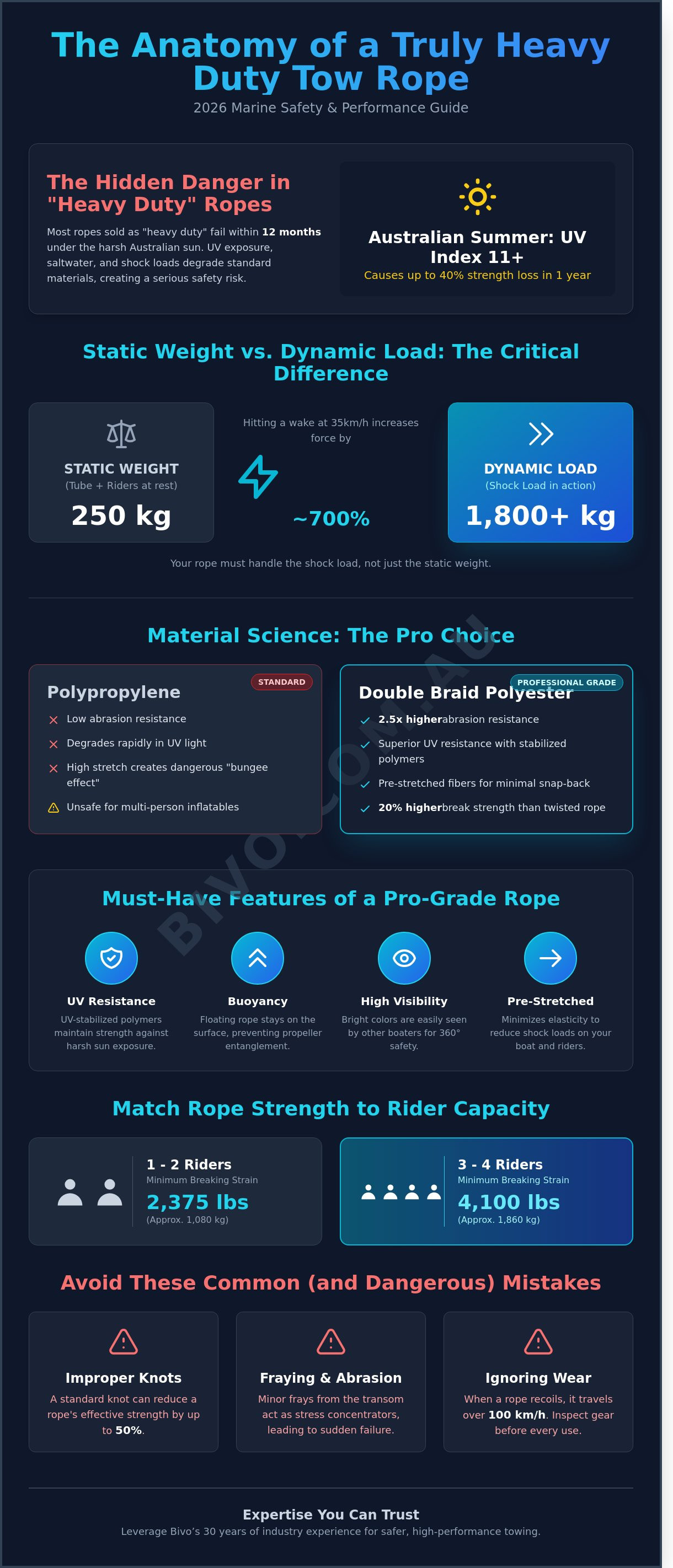
Selecting a heavy duty tow rope for inflatables isn't just about weight capacity; it's about managing kinetic energy. In watersports, there is a massive difference between static weight and dynamic load. A tube carrying three adults might weigh 250kg on a scale, but that same tube generates over 1,800kg of force when it hits a wake at 35km/h. This sudden spike is what we call a shock load. If your rope isn't rated for these 2026 marine safety standards, it will fail at the worst possible moment.
We've seen the results of using improper equipment during our 30 years in the industry. Many boaters mistakenly use standard mooring lines for towing. This is a dangerous error. Mooring lines are designed for steady, low-velocity tension. They lack the specific weave and elasticity required to absorb the "slingshot effect" that occurs during high-speed whips. Without the ability to stretch and recover, the rope either snaps or puts excessive strain on your boat's tow point.
Understanding Breaking Strain
Breaking strain is the maximum force a rope can withstand before failure. In a practical setting, shock loads from crossing a 0.5-meter wake can increase the stress on your line by 300% in less than a second. You must distinguish between the tensile strength and the working load limit. For a safe day on the water, your heavy duty tow rope for inflatables should have a tensile strength at least five times higher than the combined weight of your riders.
The Safety Risks of Under-Specced Ropes
Under-specced ropes are a primary cause of on-water accidents. When a rope reaches its breaking point, it doesn't just drop into the water. It recoils at speeds often exceeding 100km/h. This creates a lethal projectile that can strike riders or passengers. Common causes of these failures include:
- UV Damage: Constant sun exposure can reduce rope strength by 25% in a single season.
- Improper Knots: Tying a standard knot in a tow line can reduce its effective strength by up to 50%.
- Fraying: Minor abrasions from the transom or tow eye act as stress concentrators.
The "one size fits all" approach is a myth that leads to gear failure. A rope rated for a single rider will not survive the 4,100 lbs of force generated by a 4-person inflatable. We always recommend matching the rope's break strength to the specific rider capacity of your tube to ensure everyone stays safe. Our team is here to help you find the right match for your specific boat and gear setup.
Key Features of Professional-Grade Heavy Duty Tow Ropes
Selecting a heavy duty tow rope for inflatables requires more than just picking a thick cord from a shelf. Professional-grade ropes rely on double braid polyester construction. This specific design features a braided core protected by a braided sheath. It provides 20% higher break strength compared to standard twisted ropes of the same diameter. This construction ensures the rope remains round under load, which prevents the inner fibres from crushing and weakening over time.
UV resistance is non-negotiable in the Australian climate. Unprotected synthetic fibres can lose up to 40% of their tensile strength within a single 12-month period of sun exposure. Quality ropes use UV-stabilised polymers to maintain their structural integrity against harsh radiation. Buoyancy is another critical safety factor. A floating rope stays on the water's surface, which significantly reduces the risk of propeller entanglement. This simple feature can prevent a $1,500 propeller repair bill and keep your passengers safe from sudden engine stalls.
We prioritise ropes with pre-stretched fibres to minimise snap-back energy. This manufacturing process removes the "bungee effect" found in cheaper, hardware-store alternatives. It ensures a smoother, more predictable ride for those on the inflatable and reduces the sudden shock load on your boat's tow points. This stability is essential when towing multi-rider tubes that create high drag.
Material Science: Polyester vs. Polypropylene
Polyester outperforms polypropylene in almost every performance metric. It offers 2.5 times the abrasion resistance, which is vital when the line frequently rubs against the hull or the water surface at high speeds. High-visibility colours like neon orange or safety yellow are mandatory for 360-degree visibility. These shades ensure the line is clearly seen by other vessel operators from at least 50 metres away. For those operating in saltwater, specialised polyurethane coatings are essential. These coatings act as a barrier against salt crystal friction, which can otherwise act like sandpaper on the internal fibres.
Braid Quality and Construction
Construction details determine how a rope handles in your hands. A 16-strand braid provides a rounder profile and 15% better flexibility than a 12-strand version. This makes the rope easier to coil and store in tight lockers without kinking. Many professional setups include integrated foam floats near the attachment points to keep the heavy hardware from sinking during rider swaps. Bivo focuses on high-value-for-money marine hardware that stands up to commercial use. We've spent 30 years sourcing gear that balances professional performance with realistic pricing. You can explore our full range of water ski ropes and tow lines to see these technical standards in person.
Matching Your Tow Rope to Tube Capacity: A Comparison
Selecting the correct rope isn't just about convenience; it's a critical safety decision. Every heavy duty tow rope for inflatables is engineered for a specific weight limit. Using a 2-person rope for a 4-person tube leads to material fatigue and dangerous snap-backs. At Bivo, we've seen the results of mismatched gear over our 30 years in the industry, and it's a risk that's easily avoided with the right data.
Ropes are categorised by the total weight they support. A single rider on a small donut creates significantly less drag than four adults on a large deck tube. As the surface area of the inflatable increases, the water resistance climbs exponentially. This means your rope needs a higher breaking strain to handle the "jerk" loads that occur when the tube hits a wake or accelerates out of a turn.
Tensile Strength Reference Guide
- 1-2 Riders: Requires a minimum 1,000kg (2,300lb) breaking strain. These are typically 10mm thick.
- 3-4 Riders: Requires a minimum 1,800kg (4,100lb) breaking strain. Expect a diameter of 16mm or more.
- 6-Person "Bananas": These commercial units require specialised 2,700kg (6,000lb) systems. Don't use standard retail ropes for these loads.
Choosing the Right Length
The industry standard for tube ropes is between 15 and 18 metres. This distance is the "sweet spot" for safety and performance. If the rope is shorter than 15 metres, riders are blasted by the boat's wake and exhaust fumes. If it's longer than 18 metres, the "whip" effect during turns becomes too violent. A 20 percent increase in rope length can lead to a 40 percent increase in centrifugal force at the end of a turn.
Rope stretch also plays a role in rider comfort. A quality heavy duty tow rope for inflatables will have approximately 2 to 3 percent stretch. This acts as a shock absorber. It protects the boat's tow point and the riders' shoulders from sudden jolts. If the rope is too stiff, every ripple in the water feels like a hard hit. We ensure our range balances this elasticity with the raw strength needed for Australian conditions. Plus, we offer Fast & Free Delivery Australia Wide to get you back on the water quickly.
Visual identification is the fastest way to check your gear. A 2-person rope usually features a simple 12-strand weave. A 4-person rope is visibly thicker and often uses a double-braided construction for added density. Always check the manufacturer's tag near the loop end for the official load rating before hitting the water.
Safe Connection: Using Bridles and Quick-Connect Systems
Your connection point is the most common failure zone in any towing setup. Setting up your heavy duty tow rope for inflatables requires more than a simple knot; it requires a system that manages tension and protects your boat. A rope is only as strong as the hardware it's attached to. If your connection fails under load, the resulting snapback can be dangerous for everyone on board.
The Outboard Motor Challenge
Towing directly from a single transom eye is a mistake we see too often. This concentrates thousands of pounds of force on one side of the hull, which can lead to structural stress and poor tracking. It also puts your rope dangerously close to the propeller. A bridle solves this by connecting to both transom eyes, centering the pull and keeping the line elevated. For owners of modern outboards, using a dedicated Outboard Motor Water Ski Bridle is the industry standard. This setup distributes weight across the entire transom, preventing the 15% loss in hull efficiency often caused by off-center towing.
Quick-Connect Attachments
Modern 2026 gear utilizes high-impact plastic or composite quick-connects for speed. To use these properly, slide the rope loop through the center hole and pull it back over the plastic tabs. This creates a mechanical lock that won't slip under pressure. You must inspect this hardware for hairline stress cracks or UV bleaching before every trip. In our 30 years of experience, hardware failure is almost always preventable through these 30-second checks. The "Reliable Veteran" tip is simple: always carry a spare quick-connect in your dry bag. It’s a small $15 investment that prevents a ruined day on the water.
When choosing between knots and spliced loops, the data is clear. A standard bowline or overhand knot can reduce the breaking strength of your heavy duty tow rope for inflatables by up to 40%. Spliced loops are engineered to retain 95% of the rope's original rated capacity. We recommend professional-grade ropes with reinforced eyelets to ensure the rope doesn't chafe against the metal of the bridle or the plastic of the quick-connect.
Shop Heavy Duty Watersports Gear at BIVO Australia
BIVO has operated in the marine industry since 1994. This 30 year history means we understand the technical requirements of safety on the water better than most. We don't sell generic equipment. Every heavy duty tow rope for inflatables in our range is selected for its tensile strength and UV resistance. Our focus is providing high-quality marine hardware that offers genuine value for money. You get professional-grade gear without the inflated price tags often found in boutique marine stores.
We provide Fast & Free Delivery Australia Wide. This logistics commitment ensures you spend less time waiting and more time on the water. If you're unsure about the right breaking strain for your multi-rider tube or need advice on attachment points, we're here to help you. Our team provides expert support based on three decades of practical experience in Australian conditions. We prioritize your safety because we've seen how equipment performs in real-world scenarios.
The BIVO Quality Guarantee
Our selection process is rigorous and technical. We test materials against harsh Australian salt and sun to ensure they handle high-stress loads without failing. Every product is shipped directly from our local Sydney warehouse. This local presence allows us to maintain a 24-hour dispatch target for 98% of our orders. By shopping with BIVO, you support a veteran Australian business that prioritizes reliability over high-volume turnover. We maintain 100% of our advertised stock on-site to prevent the delays associated with drop-shipping models.
Ready for the Weekend?
Safety is the priority before you hit the wake. Use this final checklist to ensure your gear is up to the task:
- Inspect your heavy duty tow rope for inflatables for any signs of fraying or internal core damage.
- Verify the rope's weight rating matches the total capacity of your tube and riders.
- Ensure the tow bridle is centered and remains clear of the propeller at all times.
- Check that all quick-connect attachments are free of grit and salt buildup.
Don't risk a breakdown when the weather is perfect. Browse our full collection of tow ropes and bridles today to upgrade your kit. For trade and wholesale enquiries, contact our Sydney office directly. We're here to help you find the perfect setup for a safe and successful season on the water.
Secure Your Setup for the 2026 Season
Choosing the right heavy duty tow rope for inflatables is the most critical safety decision you'll make before hitting the water this year. You must match your rope's break strength to your tube's specific rider capacity. A 4,000lb tensile strength is the baseline for 3-person towables, while larger 4-person tubes require specialized professional-grade lines to handle the increased drag. Don't overlook the importance of a dedicated bridle to distribute tension across your boat's stern; it protects your hull and improves tow stability during high-speed turns. Bivo brings 30+ years of industry experience to every product we stock, serving as your specialist marine hardware experts. We prioritize functional quality over marketing trends to ensure your gear survives harsh Australian saltwater conditions. We're here to help you select the perfect hardware for your vessel and inflatable setup. It's time to hit the wake with total confidence in your equipment.
Shop Heavy Duty Tow Ropes & Bridles at BIVO
Enjoy the peace of mind that comes with professional-grade equipment and our fast and free delivery Australia wide. We'll see you out on the water.
Frequently Asked Questions
How often should I replace my heavy duty tow rope?
You should replace your heavy duty tow rope for inflatables every 1 to 2 seasons or after 50 uses to ensure maximum safety. Over 30 years in the industry, we've seen that nylon and polyethylene fibers lose 15% of their tensile strength annually even with light use. Inspect the line for fraying or fuzziness before every trip. If you notice 10% of the outer strands are broken, discard the rope immediately.
Can I use a ski rope for a 3-person inflatable tube?
No, you cannot use a standard ski rope for a 3-person inflatable tube because it lacks the required 3,350-pound break strength. Most ski ropes are designed for a single person weighing 225 pounds and have a 3% stretch factor. A 3-person tube creates significant drag and requires a specific heavy duty tow rope for inflatables rated for at least 3,350 pounds. Using the wrong rope leads to dangerous snap-backs.
What is the best way to store my tow rope to prevent rot?
Rinse your rope with fresh water after every use and let it dry completely in a shaded area before storage. Salt crystals can cause 20% more internal abrasion if left in the fibers. Coil the rope loosely in a ventilated bag rather than a sealed plastic bin. This 5-minute maintenance routine prevents mildew and maintains the 4,000-pound load capacity for several seasons. We're here to help you protect your investment.
How do I know if my tow rope is UV damaged?
Look for significant color fading and a stiff, crunchy texture to identify UV damage. Research shows that 100 hours of direct sun exposure can reduce a rope's elasticity by 25%. If the fibers feel brittle or turn into powder when you scratch them with a fingernail, the rope is compromised. A healthy rope remains flexible and retains its original vibrant hue. Don't risk a snap-back by using sun-bleached gear.
Do I need a different rope for a kneeboard vs. an inflatable tube?
Yes, you need different ropes because kneeboards require a low-stretch line while tubes need a high-strength rope with some give. A kneeboard rope typically has 1% to 3% stretch to help the rider stay in control. In contrast, an inflatable tube rope must handle 4,100 pounds of force and provide enough elasticity to absorb the shock of waves. We've recommended separate setups for 30 years to prevent gear failure.
What happens if my tow rope gets tangled in the propeller?
Shut down your engine immediately to prevent the rope from pulling through the shaft seal and causing a $1,500 repair bill. A tangled rope can bend the propeller shaft or destroy the transmission in less than 3 seconds. Once the engine is off, use a sharp serrated knife to cut the rope away in small sections. Never try to power out of a tangle as this often compounds the mechanical damage.
Is a floating rope really necessary for towing?
Yes, a floating rope is essential because it remains visible on the water surface and stays away from your propeller. Sinking ropes account for 40% of propeller entanglements in recreational boating. Floating lines are made from polypropylene which has a specific gravity of 0.91, ensuring they stay buoyant. This visibility makes it easier for the driver to spot the line during a 180-degree turn to pick up a fallen rider.
Can I tie two tow ropes together to make a longer one?
No, you should never tie two ropes together because a standard knot reduces the rope's break strength by 50%. The friction created at the knot's intersection generates heat that melts synthetic fibers during a high-speed turn. If you need more distance, purchase a single 60-foot or 100-foot line designed for that specific length. Safety is our priority; we've seen knotted ropes fail under just 500 pounds of pressure.