

A failed electrical connection out on the water or on a remote track is more than an inconvenience-it can be a serious problem. Salt spray, moisture, and constant vibration are the enemies of standard wire joins, leading to corrosion and unreliable performance. If you're tired of tracing faults or replacing corroded terminals, it's time for a professional solution. For a truly durable, waterproof, and vibration-resistant seal, the clear choice is a set of quality heat shrink crimp joiners.
With over 30 years of experience in Australian marine electrics, we know what works. This guide gives you the practical knowledge you need. We will explain what these connectors are, why they are essential for your boat or vehicle, and provide a step-by-step process for a perfect installation. By the end, you'll have the confidence to create a professional-grade, watertight seal that won't let you down, using the right components for the job.
Key Takeaways
- Understand how heat shrink crimp joiners create a completely waterproof and durable seal, essential for protecting marine and auto electrical systems.
- Discover why these joiners are superior to standard crimps or electrical tape for long-term reliability in harsh Australian environments.
- Master the correct technique, from stripping wire to applying heat, to guarantee a secure, professional-grade connection every time.
- Learn to identify high-quality components to ensure your electrical work is safe and built to last on the water or the road.
What Are Heat Shrink Crimp Joiners and Why Are They Essential?
In any marine or automotive setting, a reliable electrical connection is not just a convenience-it's a critical safety component. A heat shrink crimp joiner is a single, pre-assembled terminal designed for this exact purpose. It combines a high-conductivity metal crimp barrel with a protective sleeve of adhesive-lined heat shrink tubing. The result is a mechanically strong, fully insulated, and environmentally sealed connection that stands up to the harshest conditions Australia can throw at it.
Unlike standard connectors that offer minimal protection, these joiners provide a complete solution. Their core benefits are essential for longevity and performance in demanding applications:
- Corrosion Proofing: The adhesive lining creates a waterproof seal, locking out moisture and salt spray that would otherwise destroy the connection.
- Strain Relief: The rigid, shrunken tubing supports the wire at the connection point, preventing fatigue and breakage from movement.
- Vibration Resistance: A properly crimped and sealed joiner forms a solid, unified bond that won't loosen under constant engine or vehicle vibration.
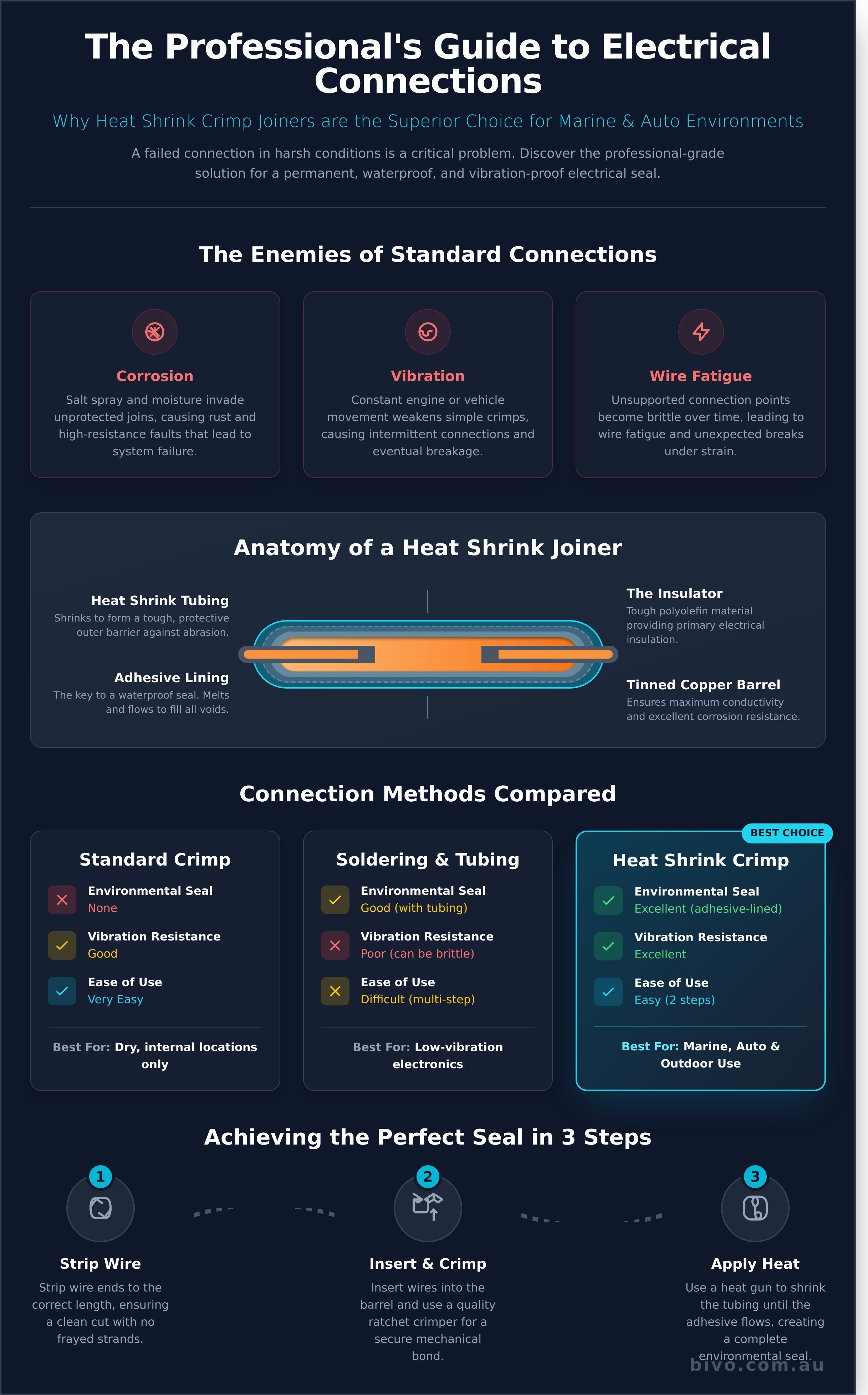
Anatomy of a Heat Shrink Joiner
Understanding what makes heat shrink crimp joiners so effective comes down to their four key components. Each part is engineered for maximum reliability and durability.
- The Barrel: Made from tinned copper for excellent conductivity and superior resistance to corrosion.
- The Insulator: A tough polyolefin material that provides the initial layer of electrical insulation.
- The Heat Shrink Tubing: This outer layer shrinks when heated to conform tightly around the wire. Technically known as Heat-shrink tubing, it creates a robust physical barrier against abrasion and contaminants.
- The Adhesive Lining: This heat-activated sealant is the secret to a fully waterproof and airtight connection. It melts and flows to fill any voids, ensuring total protection.
Why Standard Connectors Fail in Marine Environments
After 30 years in the industry, we've seen countless electrical failures caused by the wrong choice of connector. Standard vinyl or nylon crimps simply aren't built for the marine world. Moisture and salt spray inevitably find their way in, leading to rapid corrosion and high-resistance faults. Furthermore, the constant vibration from an engine or rough seas can easily weaken a simple crimp, causing intermittent or total connection failure. They offer no real defence against the elements, making them a point of weakness in any critical system.
Heat Shrink Crimp Joiners vs. Other Connection Methods
Choosing the right method to join wires is critical for the safety and longevity of your electrical system. This is especially true in marine, automotive, and outdoor settings where moisture, salt, and vibration are constant threats. While several options exist, heat shrink crimp joiners provide a unique combination of mechanical strength and environmental sealing that is hard to beat.
To help you decide, here is a quick comparison of the most common methods.
| Feature | Standard Crimp | Soldering & Tubing | Heat Shrink Crimp |
|---|---|---|---|
| Environmental Seal | None | Good (if tubing is used) | Excellent (adhesive-lined) |
| Vibration Resistance | Good | Poor (can become brittle) | Excellent |
| Ease of Use | Very Easy (1 step) | Difficult (2-3 steps) | Easy (2 steps) |
| Best For | Dry, internal locations | Low-vibration electronics | Marine, auto, outdoor use |
Versus Standard Nylon/Vinyl Crimp Terminals
Standard nylon or vinyl insulated crimps are the most basic option. They create a simple mechanical bond by compressing the terminal barrel around the wire. While they are cheap and fast to apply, they offer zero protection from the elements. A single drop of moisture can wick into the connection, starting a process of corrosion that leads to high resistance and eventual failure. Use them only in completely dry, stable interior locations where exposure to moisture is impossible.
Versus Soldering and Heat Shrink Tubing
Soldering creates an excellent, low-resistance electrical connection. However, the solder itself is rigid and can become brittle. In high-vibration environments common to boats and 4WDs, this inflexibility can cause the joint to crack and fail over time. The process is also more involved, requiring a separate soldering iron, solder, and a piece of heat shrink tubing applied afterwards. It’s a reliable method for circuit boards, but less efficient and potentially less durable for vehicle or marine wiring.
Versus Solder Seal Wire Connectors
Solder seal connectors use a ring of low-temperature solder inside a heat shrink tube instead of a crimp barrel. While they provide a good seal, their mechanical strength relies entirely on the solder alloy. A proper crimp, by contrast, forms a superior mechanical and electrical bond before sealing. This gas-tight connection, a principle detailed in stringent guidelines like NASA's workmanship standard, provides incredible pull-strength and vibration resistance that a simple solder joint cannot match. The crimp provides the strength; the heat shrink provides the protection.
Ultimately, for any application exposed to the elements, a sealed connection is not optional-it is essential. Corrosion will find its way into an unsealed joint. The all-in-one design of heat shrink crimp joiners delivers the best of both worlds: the unmatched mechanical reliability of a crimp and the complete environmental protection of an adhesive-lined seal.
How to Use Heat Shrink Crimp Joiners: A Step-by-Step Guide
Achieving a professional, durable electrical connection is straightforward with the right technique. Following these steps ensures your wiring is secure, waterproof, and built to last. For a reliable result, there are no shortcuts-only the correct process.
Step 1: Select the Right Tools and Joiner
The quality of your connection depends entirely on the quality of your tools. A professional job requires professional equipment. You will need:
- A quality ratchet crimping tool
- A reliable pair of wire strippers
- An electric heat gun
Do not use pliers. Pliers apply uneven pressure, which creates a weak mechanical bond and can damage the joiner's barrel. A ratchet crimper applies a precise, uniform pressure until the tool automatically releases, guaranteeing a perfect crimp every time. Finally, match your joiner to your wire gauge. The industry-standard colours make this easy: Red for 0.5-1.5mm², Blue for 1.5-2.5mm², and Yellow for 4.0-6.0mm² wires.
Step 2: Prepare the Wires
Start by cutting your wires to length. Using your wire strippers, remove approximately 7-8mm of insulation from the end of each wire. Be careful not to nick or cut any of the copper strands underneath. Inspect the exposed strands-they should be clean, straight, and untwisted. Insert the first wire into one side of the heat shrink crimp joiner, pushing it in until it stops at the small dimple in the centre of the metal barrel.
Step 3: Crimp the Connection
Place the joiner into the correct colour-coded nest on your ratchet crimper. Position the tool directly over the wire strands inside the metal barrel. Squeeze the handles firmly and completely. The ratchet mechanism will prevent the tool from opening until the correct pressure has been applied. Once it releases, the first crimp is done. Give the wire a gentle tug to confirm it is secure. Repeat this exact process for the second wire on the other side of the joiner.
Step 4: Apply Heat to Seal the Join
This final step creates a waterproof, corrosion-proof seal. Use a heat gun, not a lighter or a torch, to avoid scorching the tubing. Hold the heat gun about 10-15cm away and begin heating the middle of the joiner, slowly working your way outwards to the ends. Rotate the wire to ensure even heat distribution. Continue until the tubing has fully shrunk and you see the clear adhesive just beginning to flow from both ends. This seal is critical for marine and automotive use, where connections must be protected from the elements, a standard often required by professional vehicle wiring regulations. Allow the joiner to cool completely before handling.
Pro Tips and Common Mistakes to Avoid
Using heat shrink crimp joiners correctly is straightforward, but a few common errors can compromise the integrity of your entire electrical system. A professional, long-lasting connection relies on good technique. With our experience in the marine industry, we've seen what works and what fails. Here’s how to get it right every time.
Common Mistakes That Weaken Your Connection
Avoid these simple pitfalls to ensure your connection is strong, secure, and completely waterproof. A failed connection on the water is more than an inconvenience; it can be a serious safety issue.
- Under-heating: If you don't apply enough heat, the adhesive lining won't melt and flow. This leaves your connection vulnerable to moisture and corrosion, completely defeating the purpose of a sealed joiner.
- Overheating: Too much heat is just as damaging. It can melt the wire's insulation, weaken the joiner's tubing, and create a brittle, unreliable connection point that can fail under vibration.
- Using the wrong size: Each joiner is colour-coded for a specific wire gauge range (e.g., red for 22-18 AWG). Using a joiner that's too large will result in a poor crimp and an ineffective seal. Always match the joiner to your wire.
- Crimping with pliers: Never use standard pliers. They crush the terminal instead of creating the uniform, cold-welded connection needed for low resistance and high strength. This is a common cause of electrical failure. Always use a proper ratchet crimping tool.
Expert Tips for a Professional Finish
Follow these trade secrets to elevate your work from functional to professional. These small details make a big difference in the reliability and lifespan of your electrical work.
- Ensure wire overlap: When using a butt joiner, strip enough insulation so the copper conductors can meet or overlap slightly inside the metal barrel. This maximises surface contact for a solid, low-resistance connection.
- Use a heat gun reflector nozzle: A reflector nozzle wraps the heat around the joiner. This ensures even shrinking and adhesive flow, preventing scorching on one side while the other remains under-heated.
- Look for a clear seal: A perfect seal is easy to spot. The tubing will become clear (not cloudy or burnt), and you should see the adhesive has melted and created a small, visible ring at both ends where it bonds to the wire insulation.
Mastering these techniques ensures your work will withstand harsh marine and outdoor conditions. Have questions about a specific application? We're here to help you with over 30 years of experience.
Choosing Quality Heat Shrink Joiners in Australia
When you're out on the water, the reliability of your boat’s electrical system is non-negotiable. A single failed connection can lead to equipment failure, leaving you stranded. That's why selecting high-quality components isn't just about performance-it's about safety. Not all connectors are created equal, and knowing what to look for is the key to a lasting, professional-grade repair that withstands the harsh marine environment.
What to Look for in a Quality Connector
To ensure your electrical connections are secure and completely sealed against moisture, focus on these three critical features:
- Material: Always choose connectors with tinned copper barrels. Copper offers excellent conductivity, while the tin plating provides superior corrosion resistance against saltwater and humidity, preventing connection failure down the line.
- Shrink Ratio: A 3:1 shrink ratio is the professional standard for a reason. It means the tubing shrinks to one-third of its original diameter, creating a much tighter and more uniform seal over wires and terminals compared to lower-ratio alternatives.
- Adhesive Quantity: A quality connector features a generous lining of heat-activated adhesive. When heated, this adhesive melts and flows to fill any voids, completely sealing out moisture and providing essential strain relief for a truly waterproof, vibration-proof bond.
Why Source Your Marine Electrical Supplies from BIVO
For over 30 years, BIVO has been a trusted supplier for marine trade professionals and boating enthusiasts across Australia. We understand what works in local conditions because we use and test the products we sell. When you choose BIVO, you get more than just a part in a bag; you get the assurance of quality backed by decades of experience.
- Trade-Quality Components: We stock proven, high-performance heat shrink crimp joiners and terminals that meet our strict standards for durability and reliability in Australian marine environments.
- Decades of Experience: With 30+ years in the industry, we provide practical, no-nonsense advice to help you get the job done right the first time.
- Fast & Free Delivery: Get the parts you need quickly with our fast and free delivery Australia-wide, dispatched from our Sydney warehouse.
- Real Value for Money: We offer competitive pricing on professional-grade supplies, ensuring you don't have to compromise on quality to fit your budget.
Your boat's electrical system deserves the best protection. By choosing premium components, you invest in peace of mind and long-term reliability. Explore our complete range of trade-quality marine electrical essentials online at bivo.com.au. We're here to help.
Achieve a Professional, Watertight Seal Every Time
Creating a secure, waterproof electrical connection is non-negotiable in demanding environments. As this guide has shown, the combination of a correct crimping technique and a quality connector is what separates a reliable, long-lasting circuit from a point of failure. It’s about doing the job right once, so you don’t have to do it again.
For a truly professional result, high-grade heat shrink crimp joiners are the superior choice. They deliver a strong mechanical bond and an impenetrable, adhesive-lined seal that protects against moisture, corrosion, and vibration. This is the standard required for wiring exposed to tough Australian conditions.
With over 30 years of marine industry experience, BIVO is a trusted, Australian-owned supplier of electrical components. We stand behind the quality of our products because we've used them ourselves. Shop our range of trade-quality Heat Shrink Crimp Joiners and get Fast & Free Delivery Australia Wide. We're here to help you build connections that last.
Frequently Asked Questions
Can I use a lighter instead of a heat gun for heat shrink joiners?
We strongly advise against using a lighter. A lighter provides uncontrolled, direct flame which can easily burn the tubing, damage the wire insulation, and fail to properly melt the adhesive lining. This results in a weak, non-weatherproof seal. A professional heat gun provides consistent, indirect heat, ensuring the tubing shrinks evenly and the adhesive creates a complete environmental seal. For a reliable job, always use the correct tool.
Are heat shrink crimp connectors completely waterproof?
Yes, when installed correctly, quality heat shrink crimp joiners create a fully waterproof and submersible connection. The process requires a solid crimp and even heating. As the tubing shrinks, its inner adhesive lining melts and flows, bonding securely to the wire insulation. This forms an impermeable barrier against moisture, salt spray, and dust, making them the superior choice for harsh marine and automotive environments across Australia.
What do the red, blue, and yellow colours on crimp joiners mean?
The colours on crimp terminals are a standardised industry code indicating the wire gauge (size) they are designed for. Red connectors are for the smallest wires, typically 22-16 AWG (0.5-1.5mm²). Blue is for mid-sized wires, 16-14 AWG (1.5-2.5mm²). Yellow is for the largest common wires, 12-10 AWG (4.0-6.0mm²). Matching the connector colour to your wire size is critical for a secure mechanical and electrical connection.
How do I know if I have crimped the connector hard enough?
A properly secured crimp is confirmed with a simple "tug test." After crimping, give the wire a firm pull; it should not move or pull out of the connector. A quality ratcheting crimper is your best tool here, as it is designed to apply a precise amount of pressure and will not release until a full, secure crimp is complete. Visually, the barrel should be clearly indented but not pierced or cracked.
Can heat shrink crimp joiners be used on solid core wire?
While designed for stranded wire, you can use them on solid core wire in certain situations. Solid wire is less flexible and more brittle, so it's crucial to use a high-quality crimper to avoid fracturing the conductor. These connections are also more vulnerable to failure from vibration. We recommend their use on solid wire only in static applications where the wiring will not be subject to movement or frequent flexing.
What is the difference between a heat shrink joiner and a solder seal connector?
A heat shrink crimp joiner relies on a mechanical crimp for electrical conductivity and strength, with the heat shrink tubing providing an environmental seal. A solder seal connector, however, uses an integrated ring of low-temperature solder. When heated, the solder melts to create the electrical connection while the outer tubing shrinks to seal it. Crimping offers a faster, more vibration-resistant connection, while soldering provides excellent conductivity but requires more careful heat application.