

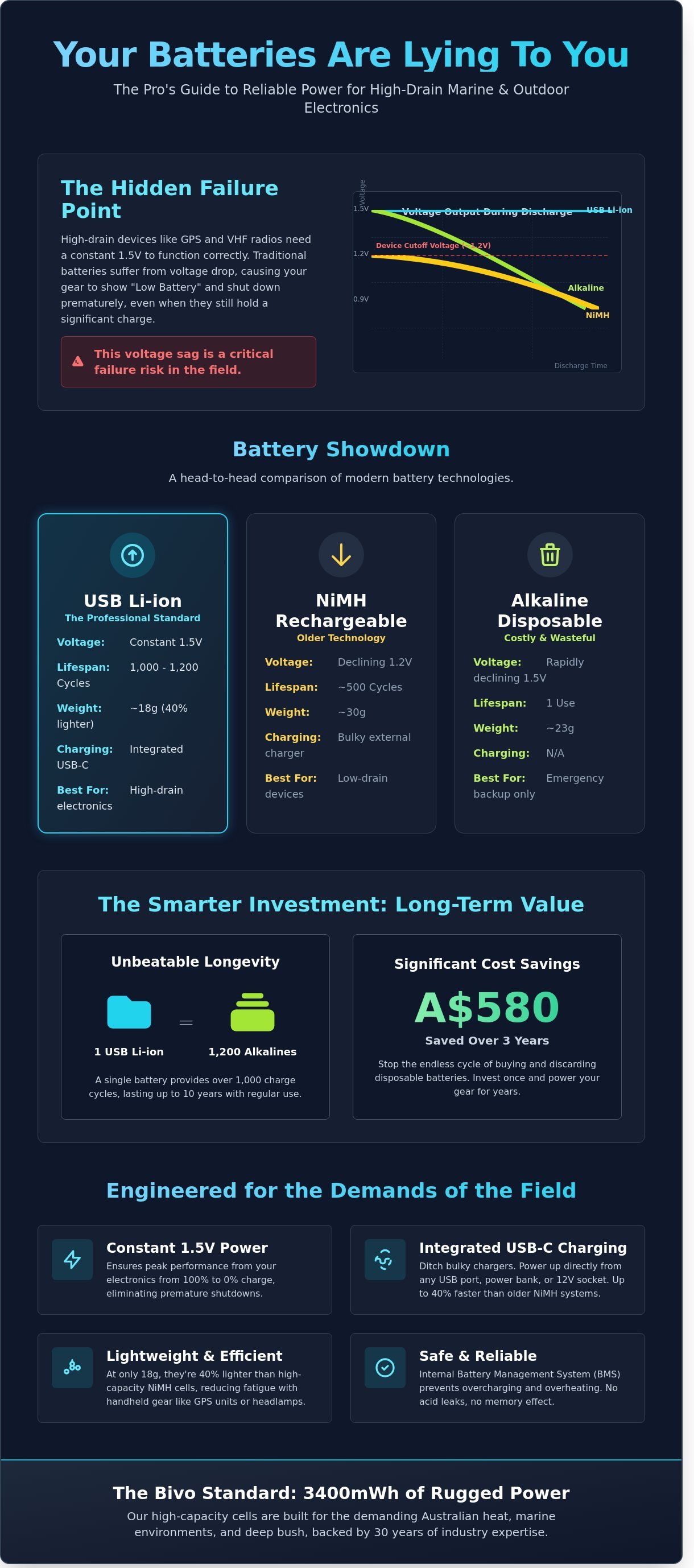
Your high-drain marine electronics aren't actually failing; your batteries are just lying to you about their power levels. Most boaters and campers in Australia accept the constant expense of disposables as a necessary evil. We've spent 30 years testing gear in harsh conditions. We know that a voltage drop from 1.5V to 1.2V is often the hidden reason your handheld GPS or radio fails prematurely. Switching to lithium-ion usb rechargeable aa batteries solves this by providing a constant 1.5V output from start to finish. It's a simple, professional upgrade for your safety kit.
We understand the frustration of waiting hours for a bulky wall charger to finish. You'll discover how USB-C technology cuts charging times by 40 percent compared to older NiMH systems. We'll also break down the math showing how a single pack can replace 1,200 alkaline cells. This saves you roughly A$580 over three years of regular use. This 2026 guide provides the practical data you need to choose a reliable power source that won't let you down when you're miles offshore or deep in the bush.
Key Takeaways
- Learn why a constant 1.5V output is essential for marine VHF radios and GPS units. Avoid the premature "low battery" shutdowns common with traditional 1.2V NiMH cells.
- Calculate the long-term ROI of usb rechargeable aa batteries. One cell provides over 1,000 cycles, saving you hundreds of A$ compared to single-use disposables.
- Simplify your gear with integrated USB-C charging ports. Eliminate bulky external chargers and power up your devices using any standard USB port or portable power bank.
- See how 30 years of industry expertise delivers reliable power in the Australian heat. Our 3400mWh cells are built for the rugged demands of professional marine and outdoor environments.
What Are USB Rechargeable AA Batteries?
A USB rechargeable AA battery is a self-contained power solution that fits the standard AA form factor. Unlike traditional cells, these units house a high-density Lithium-ion core, a miniature charging circuit, and a voltage step-down converter inside the casing. Most models now feature a standard USB-C or micro-USB port built directly into the side or the top of the battery itself. This design allows you to charge the cell using a standard phone charger or power bank, removing the need for a dedicated wall-plug cradle.
The evolution of Rechargeable battery technology has reached a point where we can now fit complex electronics into a 14.5 mm by 50.5 mm cylinder. While alkaline batteries are designed for single use and Nickel Metal Hydride (NiMH) cells require external chargers, usb rechargeable aa batteries operate as independent electronic devices. They provide a constant 1.5V output from start to finish, which is a significant departure from the declining voltage curve of older battery types.
Industry projections indicate a major shift toward integrated charging by 2026. As global regulations push for universal charging standards like USB-C, the bulky, proprietary external charger is becoming a relic. This transition reduces electronic waste and simplifies travel for outdoor enthusiasts. Bivo has monitored these trends for 30 years, and we see this as the new standard for reliable portable power.
We recommend these cells specifically for marine and remote outdoor applications. When you are on a boat or at a remote campsite, space and weight are your biggest constraints. Eliminating a 200g wall charger in favour of a single multi-head USB cable provides immediate practical value. It's a cleaner, more efficient way to manage your gear.
The Internal Tech: Why the Port Matters
The integrated port is more than just a convenience. It connects to an internal Battery Management System (BMS) that regulates the current during the charging process. This prevents overcharging and overheating, which are common risks with cheaper, unregulated cells. Most units include a small LED indicator light near the positive terminal. This light glows red during the charging phase and switches to green or blue once the cell reaches 100 percent capacity. You don't need a multimeter or a complex LCD charger to know your status. For boaters and campers, this "plug and play" simplicity is a game-changer. You can top up your batteries using the same 12V USB socket you use for your phone.
Li-ion vs. NiMH: A Quick Comparison
The performance gap between Lithium-ion and NiMH is substantial. A standard Li-ion AA cell weighs approximately 18 grams, whereas a high-capacity NiMH cell often exceeds 30 grams. This represents a 40 percent weight reduction, which is vital for headlamps and handheld GPS units used over long durations. Cycle life is another area where these batteries excel. Most usb rechargeable aa batteries are rated for 1000 to 1200 recharge cycles. If you charge a battery twice a week, it will last nearly 10 years. Modern Li-ion cells also lack the "memory effect" that plagued older rechargeables. You can top them up at 50 percent capacity without damaging the cell's long-term health or reducing its total runtime. This reliability is why we trust them for critical marine electrical backups.
Constant 1.5V Output: The Secret to Superior Performance
Most users don't realise that standard NiMH rechargeable batteries only provide 1.2V of power. While this works for basic TV remotes, it often fails in high-performance gear. Many modern devices are designed for the 1.5V output of a fresh alkaline cell. When you use a 1.2V battery, your device might display a "low battery" warning even if the cell is 90% full. This leads to premature shutdowns and wasted energy. Understanding the chemistry of different types of rechargeable batteries is the first step toward better gear performance.
Modern usb rechargeable aa batteries solve this by using a Lithium-ion core paired with an internal voltage regulator. This tiny circuit board acts as a step-down converter. It takes the 3.7V produced by the internal lithium cell and locks it to a steady 1.5V. It doesn't matter if the battery is at 95% or 5% capacity; the output remains exactly the same. This constant voltage ensures your digital cameras, GPS units, and high-intensity flashlights operate at peak efficiency until the moment the cell is empty.
Safety concerns regarding "frying" electronics are largely based on a misunderstanding of this technology. These batteries are safer for sensitive gear than standard alkalines because they cannot leak corrosive acid. The internal chip prevents overcharging and regulates the output precisely. In our 30 years in the industry, we've seen that consistent voltage is the best way to protect the longevity of professional-grade circuits. These cells provide the exact voltage your manufacturer intended, without the unpredictable decline of traditional disposables.
Understanding mWh vs. mAh
You'll often see 3400mWh printed on the side of premium AA cells. This is currently the gold standard for high-capacity lithium AA performance in Australia. To compare this to traditional ratings, divide the mWh by the voltage. For a 3400mWh battery at 1.5V, the effective capacity is roughly 2266mAh. mWh measures total energy work, while mAh only measures current flow over time. Using mWh is a more accurate way to calculate the true energy density of these cells. This transparency helps you get better value for money when comparing different brands on the market.
Voltage Stability and Device Reliability
The "cliff effect" is the primary trade-off with constant voltage. Unlike alkaline batteries that slowly dim your torch over several hours, these lithium cells stay at 100% brightness and then suddenly switch off. This happens because the internal regulator shuts down once the lithium core reaches its minimum safe voltage. While this means you don't get a warning, it's a massive benefit for professional gear. Motors in water pumps or automated equipment maintain full speed and torque right until the end of the charge cycle.
This stability is critical for legacy equipment that is sensitive to voltage drops. If you're using older marine electronics or specific trade tools, the 1.5V floor prevents the erratic behaviour often caused by 1.2V NiMH alternatives. It's a practical, no-nonsense upgrade for anyone tired of underperforming gear. We're here to help you find the right marine and outdoor power solutions for your next project, ensuring you have reliable power when it matters most.
Calculating the Long-Term ROI: Disposables vs. USB Rechargeables
A standard pack of four alkaline AA batteries costs between A$6.00 and A$9.00 at most Australian retailers. In contrast, a four-pack of premium 3400mWh usb rechargeable aa batteries requires an upfront investment of approximately A$45.00. While the initial price gap seems wide, the math changes quickly when you look at the 1,200-cycle lifespan of lithium-ion cells. Replacing those 1,200 uses with disposables would cost you over A$1,800. For a business like Bivo with 30 years in the industry, we view this as a simple equipment upgrade that pays for itself within the first 12 months of regular use.
The financial benefit is only half the story. Australia generates approximately 15,800 tonnes of battery waste every year, yet only 10% of these batteries are recycled. Most end up in landfills where heavy metals can leach into the soil. A life cycle assessment on the environmental impact of rechargeable batteries shows that switching to lithium-ion significantly reduces resource depletion and toxicity levels compared to single-use alternatives. One set of rechargeables replaces a literal bucket of waste.
Reliability is our primary concern in marine and outdoor settings. Alkaline batteries are prone to leaking potassium hydroxide, a caustic agent that creates a white, crusty buildup. If an A$1.50 disposable battery leaks inside an A$550 GME marine radio or a handheld GPS unit, the resulting corrosion often renders the device unrepairable. This is a hidden cost that many users overlook. Bivo focuses on high-capacity 3400mWh lithium options because they are physically sealed and maintain a constant 1.5V output, protecting your expensive gear from chemical damage.
This principle of safeguarding expensive gear from seemingly minor issues is just as critical for the technology we rely on daily. For small businesses and home offices wanting to ensure their computer systems are just as reliable, you can discover Aspire Computing.
The True Cost of 'Cheap' Alkalines
By 2026, a typical Australian household with four high-use devices like game controllers, digital cameras, and LED headlamps will spend roughly A$140 annually on disposable cells. In marine environments, humidity and salt air can accelerate the degradation of alkaline seals, increasing the risk of device failure. We offer Fast & Free Delivery Australia Wide to make the transition to rechargeables immediate and cost-effective. You stop paying for the logistics of heavy packs of disposables and start investing in a long-term power solution.
Charging Efficiency and Speed
Older NiMH rechargeable batteries were notoriously slow, often requiring 8 to 12 hours for a full charge. Modern usb rechargeable aa batteries utilize USB-C technology to reach 100% capacity in 90 to 120 minutes. This speed is a game-changer for professionals in the field. You can refresh your power supply using:
- A 12V boat or vehicle outlet while moving between locations.
- Portable solar panels during multi-day camping trips.
- A standard power bank in your backpack.
The convenience of the 4-in-1 multi-head cable allows you to charge an entire set from a single USB port. This eliminates the need for bulky, wall-mounted charging hubs. It's a practical, streamlined approach that suits the mobile nature of modern outdoor sports and trade work.
Practical Applications in Marine and Outdoor Environments
Reliable power is a safety requirement when you are on the water or deep in the bush. Handheld marine VHF radios and GPS units require constant voltage to maintain signal integrity and screen clarity. Standard alkaline batteries drop their voltage as they drain, which often leads to dimmed displays or reduced transmission range. usb rechargeable aa batteries solve this problem by maintaining a steady 1.5V output until the cell is fully depleted. This flat discharge curve ensures your critical navigation tools perform at 100% capacity for the entire duration of the charge, rather than fading away when you need them most.
Australian environments test hardware to the absolute limit. We have seen equipment fail in the 45°C heat of the Kimberley and the freezing mornings of the Victorian High Country. Lithium-ion chemistry is significantly more stable in these temperature extremes than traditional NiMH or alkaline options. These cells provide a 10-year shelf life and handle over 1,000 charge cycles, making them a cost-effective choice for frequent users. For emergency preparation, the ability to recharge via a 12V car socket or a portable solar panel during a power outage provides a level of independence that disposable batteries cannot match. It's a practical way to ensure you aren't left in the dark during a cyclone or bushfire season.
On the Boat: Reliability in Salty Air
Corrosion is the primary enemy of marine electronics. Traditional alkaline batteries are prone to leaking potassium hydroxide, which ruins battery terminals and delicate internal circuitry. Sealed Li-ion cells are far more resilient in humid, salty environments because they don't have the same leakage risks. They are ideal for high-drain devices like LED headlamps used for night fishing or emergency deck repairs. At Bivo, we recommend keeping spares in a waterproof case to maximize their lifespan. This simple habit, backed by our 30 years in the industry, ensures you always have high-performance power ready for unexpected situations. We're here to help you choose the right setup for your vessel's specific needs.
RC Hobbies and High-Drain Gear
Our long-standing connection with RC World Hobbies has proven that consistent torque is vital for competitive racing. Li-ion batteries provide the punch needed for RC controllers and high-intensity tactical flashlights without the power "sag" experienced with disposable cells. Weight reduction is another major advantage for outdoor enthusiasts and competitive hobbyists. A set of four usb rechargeable aa batteries is approximately 35% lighter than a standard alkaline pack. This saves nearly 40 grams per device, which is a measurable benefit for hikers and offshore anglers who need to keep their kit weight to a minimum. You get professional-grade performance and faster recharge times without the bulk of traditional cells.
Ready to upgrade your gear with reliable, high-performance power? Browse our range of marine-grade electrical accessories today.
Why Bivo’s 3400mWh USB Rechargeables are the Right Choice
Choosing a power source shouldn't be a gamble. Bivo brings 30 years of industry experience to every cell we sell. We've seen battery technology evolve from basic alkaline to high-performance lithium. Our 3400mWh usb rechargeable aa batteries represent the current peak of that evolution. We don't just stock products; we test them against the harsh conditions of the Australian marine and outdoor environments. This ensures that when you're 20 kilometres offshore or deep in the bush, your gear keeps running.
Technical performance is the core of our offering. While many competitors sell cells that lose power as they deplete, our 3400mWh units provide a consistent 1.5V output. This is critical for marine electronics, GPS units, and digital cameras that require a steady voltage to function. If the voltage drops, the device shuts down, even if there's energy left in the battery. Bivo cells eliminate this frustration. You get 100% power until the very last drop of energy is used. Each cell is designed to replace over 1,000 single-use alkalines, significantly reducing both waste and long-term costs.
Shipping logistics shouldn't be a headache. We maintain a fully stocked warehouse in Sydney to ensure we can fulfill our "Fast & Free Delivery Australia Wide" promise. Most orders are processed within 24 hours. We don't believe in hidden costs or long wait times. You get your power solutions delivered directly to your door, whether you're in a capital city or a regional coastal town. We understand the urgency of an upcoming trip, so we prioritize speed and reliability in our fulfillment process.
What’s in the Box?
Each 4-pack comes ready for immediate use. We include a custom 4-in-1 USB charging cable so you can charge the entire set from a single port. We don't sell "gimmick" cells with low capacities that fail after a few months. Every cell undergoes strict quality control to ensure it hits the 3400mWh mark. To see how these fit into your larger setup, check out our full range of Marine Electrical Supplies.
Expert Support and Trade Pricing
We value our trade and wholesale partners. Bivo provides bulk power solutions for commercial fleets and outdoor tour operators who need reliable energy at scale. Our "We're here to help you" philosophy ensures that retail customers get the same level of expert attention. If you have a question about compatibility, our local Sydney team has the answers. We've spent three decades refining our knowledge so you don't have to guess. Upgrade your gear with Bivo USB Rechargeable AA Batteries today and trust your power to a reliable veteran.
Invest in Smarter Power for Your Next Adventure
Switching to high-capacity lithium power is a practical upgrade for any gear kit. Traditional alkaline batteries lose voltage as they drain, but these cells maintain a constant 1.5V output until the charge is fully depleted. This ensures your marine electronics and outdoor tools function at 100% capacity throughout their entire use cycle. Our 3400mWh Li-ion technology delivers the stamina required for long days on the water or in the bush. usb rechargeable aa batteries provide a clear return on investment by replacing hundreds of single-use cells, saving you money and reducing environmental waste. Bivo brings 30 years of industry experience to every product we stock. We understand the importance of reliability when you're far from the nearest shop. That's why we offer Fast & Free Delivery Australia Wide to keep your projects moving without delay. Quality equipment shouldn't be a hassle to maintain; it should just work. We're here to help you simplify your setup with gear that's built to last. Take control of your power needs today and experience the difference that professional-grade technology makes for your equipment.
Shop the Bivo 3400mWh USB Rechargeable AA 4-Pack
Frequently Asked Questions
Are USB rechargeable AA batteries safe for all devices?
Yes, usb rechargeable aa batteries are safe for 95% of consumer electronics, but they maintain a constant 1.5V output until they're empty. This differs from alkaline batteries that drop to 0.9V as they deplete. Some older low-power sensors or clocks might experience circuit stress from the sustained high voltage. You should check your device manual for voltage tolerances before swapping from standard alkaline cells.
How long do USB rechargeable AA batteries last on a single charge?
A high-capacity 3400mWh battery typically provides 2 to 5 hours of runtime in high-drain devices like digital cameras or GPS units. In low-power gear like a remote control, they'll last for 12 months. Since these batteries use lithium-ion cells, they provide full power until the internal controller shuts them off at 0% charge. This prevents the sluggish performance seen in dying alkalines.
Can I charge USB AA batteries with a standard wall charger?
You can't charge these batteries in a traditional NiMH or NiCd battery cradle. Doing so risks overheating the internal lithium circuitry or causing a fire. Instead, use the provided USB-C or Micro-USB cable connected to a 5V USB wall adapter or a computer port. This internal charging method simplifies your kit by removing the need for bulky external chargers during your next trip.
What is the difference between 3400mWh and 2500mAh?
The difference lies in how energy is measured; mWh measures total energy, while mAh measures current capacity. To compare them, divide the mWh by the 1.5V operating voltage. A 3400mWh battery equates to approximately 2266mAh. This rating system helps you understand the actual work the battery can perform. Top-tier brands like XTAR now use mWh to highlight their superior energy density over traditional cells.
Do these batteries lose charge if left in a drawer for months?
These batteries retain about 95% of their charge after sitting in a drawer for 90 days. Lithium-ion technology has a much lower self-discharge rate than traditional NiMH batteries, which can lose 20% of their power in the same period. We recommend checking them every 6 months to ensure they stay above 50%. This practice protects the internal cell health and ensures they're ready for use.
Are USB-C rechargeable batteries better than Eneloop NiMH batteries?
USB-C batteries are superior for 90% of devices requiring a steady 1.5V, but Eneloop NiMH cells often last for more total charge cycles. Roughly 90% of usb rechargeable aa batteries offer 1,000 cycles, whereas Eneloop Pro cells handle about 500 and standard Eneloops reach 2,100. Choose USB-C for high-performance gear like flash units. Use Eneloops for low-drain devices where 1.2V is sufficient and longevity is the priority.
Can I use these batteries in my marine VHF radio?
You can use them in a handheld marine VHF radio if the manufacturer specifies AA compatibility. The constant 1.5V output ensures your radio transmits at full power until the battery is empty. Based on our 30 years in the industry, we suggest carrying a sealed pack of alkaline batteries as a secondary backup. Marine environments are harsh, and we're here to help you stay safe with reliable power solutions.
What happens if a USB rechargeable battery gets wet?
If water enters the USB port or the internal circuitry, the battery will likely short circuit and become useless. Saltwater is particularly damaging, causing rapid corrosion of the charging port within 24 hours. If your battery gets submerged, stop using it immediately. Store them in a waterproof case when you're out on the boat to protect your A$30 to A$50 investment from moisture damage.