

A loose electrical connection is more than just an annoyance. On the water, it’s a genuine risk. That feeling of uncertainty-wondering if you used enough pressure or picked the right die-can undermine your entire project. The key to eliminating that doubt and achieving a perfect, lasting bond is mastering the ratchet crimp tool. A proper crimp creates a connection that is strong, secure, and resistant to the harsh marine environment.
With over 30 years of experience in marine electrical systems, we've seen what works and what doesn't. In this guide, we'll give you the practical, no-nonsense advice you need. You will learn how to select the right tool, match dies to terminals, and apply the correct technique for a secure crimp every single time. Get ready to create professional-grade connections you can trust, ensuring your wiring is safe, reliable, and built to last.
Key Takeaways
- Understand why a ratchet mechanism provides a superior, more reliable electrical connection than standard crimping pliers.
- Master the correct step-by-step technique to achieve a perfect, professional-grade crimp on your first try.
- Identify the essential features a quality ratchet crimp tool needs for long-lasting performance in harsh marine environments.
- Learn to spot and prevent the most common crimping errors that lead to failed connections and electrical faults.
What is a Ratchet Crimp Tool and Why Is It Superior?
A ratchet crimp tool is a precision hand tool designed for one job: creating a perfect electrical connection every time. The process, known as what is crimping, involves deforming a terminal to securely grip a wire, forming a solid mechanical and electrical bond. Unlike basic plier-style crimpers that rely on guesswork and hand strength, a ratchet tool uses a specialised mechanism to guarantee a complete, uniform connection. This difference is not just about convenience; it's about safety and long-term reliability in your wiring projects.
The Ratchet Advantage: Consistency and Reliability
The core of the tool's superiority is its ratcheting mechanism. Once you start squeezing the handles, the tool will not release until the jaws have closed to a preset pressure. This ensures a full crimp cycle is completed, eliminating the risk of under-crimping-a primary cause of connection failure. For professionals or anyone tackling a large wiring job, this design delivers key benefits:
- Guaranteed Connections: The mechanism forces a complete crimp, preventing loose wires.
- Repeatable Results: Every crimp is identical, delivering professional-grade consistency.
- Reduced Hand Fatigue: The ratchet provides mechanical advantage, making repetitive tasks easier and more comfortable.
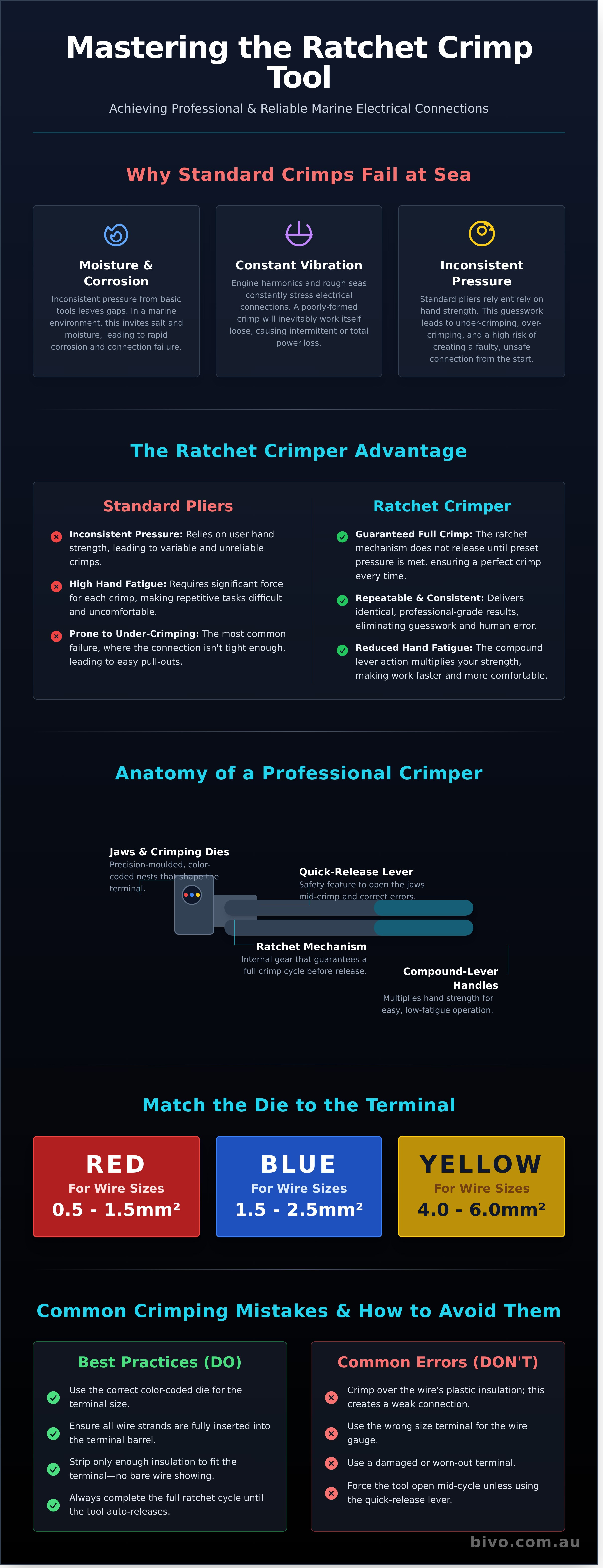
Why Standard Crimpers Fail in Marine Environments
On the water, a bad connection isn't just an inconvenience; it's a safety hazard. Standard crimpers often apply inconsistent pressure, creating small gaps in the connection. In the harsh Australian marine environment, this is a critical failure point. Moisture and salt spray inevitably find their way in, causing corrosion and eventual failure. Add the constant vibration from an engine or rough seas, and a poorly made crimp can easily work itself loose, leading to a loss of power to vital systems like navigation lights or bilge pumps. This is why a quality ratchet crimp tool is considered essential equipment for any serious boat owner.
The Anatomy of a Ratchet Crimper: Understanding Your Tool
To master any tool, you must first understand its parts. A high-quality ratchet crimp tool is a precision instrument, not just a pair of pliers. Knowing how each component works ensures you achieve a secure, reliable electrical connection every single time. A proper understanding builds confidence and leads to professional, long-lasting results.
[Image: A labelled diagram showing the jaws, dies, ratchet mechanism, quick-release lever, and handles of a typical ratchet crimp tool.]
Jaws and Crimping Dies
The jaws are the business end of your crimper, and the dies are the key to a perfect connection. Dies are the precision-moulded nests that shape the terminal around the wire. For standard insulated terminals, these dies are colour-coded to prevent mistakes:
- Red: For wire sizes 0.5 - 1.5mm²
- Blue: For wire sizes 1.5 - 2.5mm²
- Yellow: For wire sizes 4.0 - 6.0mm²
The shape of the die is engineered to create a cold weld between the wire and terminal barrel. Using the wrong die results in a weak connection that can fail under vibration or load. This level of precision is so critical that even NASA's workmanship standard for crimping details the exact criteria for a perfect, gas-tight seal. Many professional models also feature interchangeable dies for different terminal types, adding to their versatility.
The Ratchet Mechanism and Quick-Release Lever
The internal ratchet is what sets this tool apart from basic crimpers. As you squeeze the handles, an internal gear engages, preventing the jaws from re-opening until the crimp cycle is fully complete. You'll hear and feel a distinct 'click' as it progresses. This mechanism guarantees that sufficient, consistent pressure is applied every time, eliminating the common problem of under-crimping. If you misalign a terminal or need to stop mid-crimp, the quick-release lever allows you to open the jaws immediately. It’s a simple but vital feature for correcting mistakes without damaging the terminal or tool.
Handles and Leverage
A professional ratchet crimp tool is designed for repeated use with minimal fatigue. Its long handles utilise a compound lever action, which multiplies your hand strength to make the crimping process smooth and efficient. This means you can create strong, secure connections all day without strain. A comfortable, non-slip grip is also essential for maintaining control and precision, especially when working in demanding marine or outdoor environments where conditions may be less than ideal.
How to Use a Ratchet Crimp Tool: A Step-by-Step Guide
A professional-grade electrical connection depends on a consistent process. Using your ratchet crimp tool correctly ensures every terminal is secure, reliable, and built to last, especially in demanding marine environments. Follow these three simple steps for a perfect crimp every time.
Step 1: Prepare Your Wire and Terminal
Start with the right foundation. Select the correct gauge wire and a terminal designed to match. Use a quality wire stripper to remove just enough insulation-typically 6-8mm-to fit completely inside the terminal barrel without exposing bare wire past the insulation grip. Carefully check for and contain any stray wire strands.
Pro-Tip: After stripping, twist the exposed copper strands tightly between your thumb and forefinger. This creates a neat, compact bundle that slides easily into the terminal and ensures all strands make a solid connection inside the crimp.
Step 2: Select the Die and Position the Terminal
Your tool's jaws contain different sized nests, often colour-coded to match standard insulated terminals. Match the die size to your terminal (e.g., the red die for 0.5-1.5mm² wire). Place the terminal's metal barrel into the correct nest and squeeze the handles lightly. The ratchet will engage just enough to grip the terminal, leaving your other hand free to insert the wire.
For a strong connection, always ensure the seam on the terminal barrel faces the 'anvil' (the solid, rounded side of the jaw), not the 'indenter' (the pointed side). This prevents the seam from splitting under pressure.
Step 3: Insert the Wire and Complete the Crimp
With the terminal held firmly in the die, slide your prepared wire fully into the barrel until it bottoms out. Now, squeeze the handles firmly and completely. The tool does the work, applying precise, uniform pressure. You cannot under-crimp or over-crimp. You'll know the cycle is finished when the ratchet mechanism releases automatically and the handles spring open.
Pro-Tip: Always perform a 'pull test'. Gently but firmly tug on the wire and terminal to confirm the connection is mechanically sound. A proper crimp will not pull out. For a deeper understanding of what makes a durable connection, it's worth reviewing the best practices for marine wire termination from trusted industry experts.
Choosing the Right Ratchet Crimp Tool for Marine Use
In a marine environment, your electrical connections are constantly exposed to moisture, vibration, and salt. A failed connection isn't just an inconvenience; it can be a serious safety risk. Selecting the right ratchet crimp tool is the first step in building a reliable marine electrical system. This guide will help you choose a tool that delivers secure connections and long-term value.
Crimpers for Insulated vs. Non-Insulated Terminals
The shape of the crimping die is critical. Insulated terminals (red, blue, yellow) require a die with a smooth, rounded profile that crimps the metal core while supporting the plastic sleeve. Non-insulated terminals need a die that tightly rolls the terminal barrel into the wire strands. Using the wrong tool will guarantee failure. A non-insulated die will puncture an insulated terminal's sleeve, while an insulated die will create a weak, loose connection on a non-insulated terminal.
The Best Crimper for Heat Shrink Terminals
Heat shrink terminals provide the best protection against water intrusion, making them the standard for marine work. However, they require a specific die profile. Standard crimpers often have sharp edges that can tear or pierce the heat shrink lining, compromising the waterproof seal. A dedicated ratchet crimp tool for heat shrink connectors uses a smooth, rounded jaw that forms a strong mechanical crimp without damaging the sleeve. This ensures a perfect, moisture-proof seal once heat is applied.
For a reliable, waterproof connection every time, it's essential to use the correct tool. View our professional Ratchet Crimp Tool for heat shrink terminals.
Key Features for Long-Term Value
When investing in a tool, look for features that ensure durability and accuracy for years to come. A quality tool is a one-time purchase that pays for itself in reliability.
- Hardened Steel Jaws: Jaws made from high-grade, hardened steel resist wear and prevent deformation. This ensures every crimp is as tight and consistent as the first.
- Interchangeable Die Sets: A tool that accepts multiple die sets offers excellent value and versatility. It allows you to handle a wide range of terminal types with a single, reliable tool frame.
- Calibration Adjustment: Professional-grade tools include a pressure adjustment dial. This allows you to recalibrate the tool as it wears over time, guaranteeing every connection meets specification for the life of the tool.
Common Crimping Mistakes and How to Avoid Them
A perfect crimp creates a connection that is both mechanically strong and electrically sound. After 30 years in the marine electrical trade, we’ve seen a few common errors that can lead to failure down the line. The good news is they are easy to avoid. By understanding the pitfalls, you can ensure every connection you make is professional, safe, and built to last.
Here are the most frequent mistakes and their straightforward solutions.
The principle of identifying and fixing a weak link applies to more than just wiring; it's a core concept in all system maintenance. Whether you're troubleshooting a boat's electrical system or dealing with a slow, unreliable home office machine, recognizing the signs of trouble is the first step. For issues beyond the workshop, such as when your digital systems are failing, resources from a professional computer repair Toowoomba service can be invaluable.
Problem: Under-Crimping (The Loose Connection)
This is the most common error for new users. An under-crimped terminal feels snug at first but will fail under load or vibration. It creates a high-resistance point that generates heat and allows moisture to enter, leading to corrosion and eventual failure.
- Cause: Not completing the full squeeze. The user stops before the ratchet mechanism has fully cycled and released.
- Solution: Always squeeze the handles of your ratchet crimp tool firmly until you feel and hear a "click." The tool will then automatically release its grip. This mechanism guarantees a complete, correct compression every time.
[Image: A photo showing a wire easily pulling out of an under-crimped terminal next to a photo of a solid, correctly crimped connection that withstands a pull test.]
Problem: Over-Crimping (Damaged Wire and Terminal)
More force isn't always better. Applying too much pressure with the wrong die set can be just as damaging as a loose crimp. This mistake compromises the integrity of both the wire and the terminal itself.
- Cause: Using a die slot that is too small for the wire gauge and terminal. Forcing a red (small) terminal into a blue (medium) die slot is a typical example.
- Solution: Check your components. The colour-coding on insulated terminals corresponds to the colour-coding on the crimper's dies. Always match red to red, blue to blue, and yellow to yellow. Double-checking this simple step prevents cut wire strands and fractured terminal barrels.
[Image: A close-up of an over-crimped terminal with a cracked barrel and visible damage to the wire strands, contrasted with a perfectly formed, undamaged crimp.]
Problem: Incorrect Terminal Placement
The final common mistake is improper alignment. If the terminal is not seated perfectly within the die nest before you begin to squeeze, the resulting crimp will be deformed and weak.
- Cause: The terminal is inserted at an angle, too far in, or too far out of the die nest.
- Solution: Position the terminal barrel squarely in the centre of the correct die. Many quality tools include a terminal locator to make this foolproof. Ensure the terminal is sitting flat and straight before applying pressure. A well-aligned terminal results in a uniform, symmetrical crimp that provides maximum grip.
Mastering your ratchet crimp tool is about consistency. By avoiding these simple mistakes, you ensure every connection is reliable. For professional-grade tools and components designed for harsh Australian conditions, we're here to help you.
Achieve Professional Crimps, Every Time
Mastering a ratchet crimp tool is about more than just squeezing handles. It’s about understanding how the controlled-cycle mechanism guarantees a perfect, repeatable connection that standard pliers simply can't match. By selecting the correct die for your terminal, applying consistent pressure until the tool automatically releases, and avoiding common pitfalls, you ensure every electrical connection is safe, secure, and built to last-especially in demanding marine environments where failure is not an option.
For over 30 years, BIVO has been the trusted supplier for trade professionals across Australia. We've built our reputation on providing quality equipment that stands up to the job. Now it’s your turn to experience the difference the right tool makes. Ready to make every connection count? Shop our range of professional-grade Ratchet Crimp Tools and Terminals.
With Fast & Free Delivery Australia Wide, you can have the gear the pros rely on at your door in no time. Take the guesswork out of your wiring and build with confidence.
Frequently Asked Questions
Is a ratchet crimp tool worth the extra money?
Absolutely. While the initial cost of A$50-A$100 is higher than basic pliers, a quality ratchet crimp tool provides a consistent, professional-grade connection every time. This prevents failed connections, which can be costly and dangerous in a marine environment. The controlled-cycle mechanism guarantees a complete crimp, giving you peace of mind that the job is done right. It is a smart investment for reliability and safety on the water.
Can I use a ratchet crimper on any type of electrical terminal?
No, you cannot. Each type of terminal-insulated, non-insulated, or open-barrel-requires a specific die set to form the correct crimp. Using the wrong die will result in a poor electrical connection and can damage the terminal, wire, and even the tool itself. Always match the die profile on your crimper to the specific terminal you are working with. Many quality crimp kits come with interchangeable dies for this reason.
How do I know if I have a good, solid crimp?
A solid crimp will pass a simple 'pull test'. Gently tug the wire and terminal; they should not separate. Visually, the terminal's insulation (if present) should be gripped securely but not pierced, and no wire strands should be visible outside the barrel. The barrel itself should be uniformly compressed, not crushed or misshapen. The ratcheting action of the tool is designed to ensure the correct pressure is applied for a secure connection.
What is the difference between insulated and non-insulated terminals?
The difference is the plastic or nylon sleeve on an insulated terminal. This sleeve provides protection against short circuits when terminals are close together, common in marine switch panels. Non-insulated terminals are used where this risk is low, or when a more robust seal is created afterward using adhesive-lined heat shrink tubing. The choice depends entirely on the application and the level of environmental protection required for the connection.
Do I need to adjust or calibrate my ratchet crimp tool?
Yes, most quality ratchet crimp tools have an adjustment dial to set the crimp pressure. This allows you to fine-tune the tool for different wire gauges and terminal brands to achieve the perfect crimp force. While full recalibration is rare for most users, periodic adjustment ensures consistent performance. It is good practice to test a crimp on a spare wire and terminal after adjusting the tool or when starting a new project.
What are the most common terminal sizes for marine applications?
In Australian marine applications, the most common terminals are the colour-coded insulated types. Red terminals suit wire from 0.5-1.5mm² (22-16 AWG), blue for 1.5-2.5mm² (16-14 AWG), and yellow for 4.0-6.0mm² (12-10 AWG). These sizes cover the majority of wiring for lighting, electronics, bilge pumps, and general accessories found on recreational boats. Always match your terminal size to your wire gauge for a secure connection.